


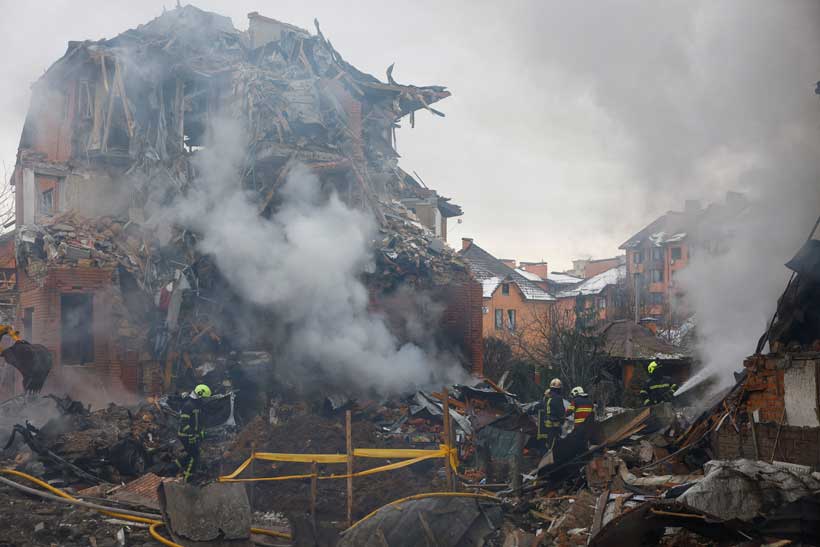
Ukraine’s battlefield looks radically different four years after Russia launched its full-scale invasion in February 2022. Where tanks once clashed in open fields, small, low-cost drones now dominate the skies, reshaping tactics and redefining survival.
For Ukrainian tank commander Valentyn Bohdanov, a senior sergeant in the 127th Separate Heavy Mechanised Kharkiv Brigade, traditional armour assaults have become nearly impossible. First-person-view (FPV) drones small, explosive-laden devices guided in real time by operators have turned open terrain into lethal exposure zones. Tanks that once spearheaded offensives now remain concealed under camouflage netting, used more as static artillery than maneuvering weapons.
The transformation underscores how rapidly innovation has reshaped the conflict, pushing both sides into what analysts describe as a new era of technologically saturated warfare.
The Expanding “Kill Zone”
Thousands of drones many costing only a few hundred dollars now operate daily along the roughly 1,200-kilometre front line. Their affordability and precision have dramatically shifted casualty patterns. According to a recent report by the French Institute of International Relations, drone-inflicted casualties have surged from under 10% of total losses in 2022 to as much as 80% last year.
Stay ahead of the geopolitical week.
MD Briefing delivers expert analysis across five global fronts — the Indo-Pacific, energy, geoeconomics, European security, and the Middle East — every Monday morning. Free.
The battlefield has evolved into what the institute calls an “air battle of mutual denial.” Both sides attempt to prevent the other from moving freely by saturating contested areas with surveillance and strike drones. Movement of any kind rotating troops, evacuating the wounded, resupplying positions has become fraught with risk.
This constant aerial threat has expanded the so-called “kill zone,” extending danger far beyond traditional front-line trenches.
Drone Hunters and Countermeasures
In response, specialized anti-drone units have emerged as a core component of frontline defense. Near the eastern city of Kostiantynivka, mobile drone-hunting teams patrol supply routes shielded by overhead netting designed to disrupt drone navigation and detonation.
Soldiers report relentless waves of attacks, sometimes dozens within an hour against a single target. Larger long-range drones, including Iranian-designed Shahed variants used by Russian forces, add another layer of complexity to the aerial contest.
The result is a battlefield where the sky is rarely clear. Surveillance and strike drones hover continuously, forcing soldiers to adapt to an environment of permanent exposure.
Medical Evacuations and the End of the “Golden Hour”
The drone threat has had profound consequences for battlefield medicine. Colonel Viacheslav Kurinnyi, chief doctor at a military hospital in Kharkiv, says evacuation times have stretched dramatically. Vehicles attempting to retrieve wounded soldiers risk immediate targeting, often delaying transport for days.
This reality undermines the long-held principle of the “golden hour,” the critical 60-minute window in which rapid treatment significantly improves survival odds. In Ukraine’s current conditions, Kurinnyi warns, survival may depend on a “golden day” or even longer.
Unmanned ground vehicles are increasingly used to evacuate casualties and transport supplies, reducing human exposure. Ukraine’s defense ministry reports thousands of such missions in a single month, signaling how robotics are expanding beyond aerial operations into ground logistics.
Are Tanks Obsolete?
The vulnerability of heavy armour has prompted debate about whether tanks are becoming obsolete. Analyst Rob Lee of the Foreign Policy Research Institute argues that while their battlefield role has diminished, it is premature to write them off.
Urban terrain and poor weather conditions can still favor armour. Moreover, technological innovation is moving quickly. Advances in electronic warfare, anti-drone systems or artificial intelligence could again shift the tactical balance, enabling renewed maneuver warfare.
For now, however, infantry assaults supported by drones and long-range artillery dominate operations. Armour-led breakthroughs once a hallmark of conventional warfare have become rare.
A Glimpse of Future War
The Ukraine conflict has become a laboratory for modern warfare. Low-cost drones, rapid technological adaptation and decentralized innovation cycles have compressed the timeline between invention and battlefield deployment.
The lessons extend beyond Eastern Europe. Militaries worldwide are studying how quickly traditional doctrines can be overturned by inexpensive, networked technologies. The shift toward persistent surveillance and precision strikes suggests that future wars may prioritize agility, electronic dominance and rapid adaptation over sheer mass.
Four years into the war, Ukraine’s battlefields offer a stark preview: the decisive arena is no longer just land or sea, but the crowded, contested airspace just meters above the ground.
With information from Reuters.
