


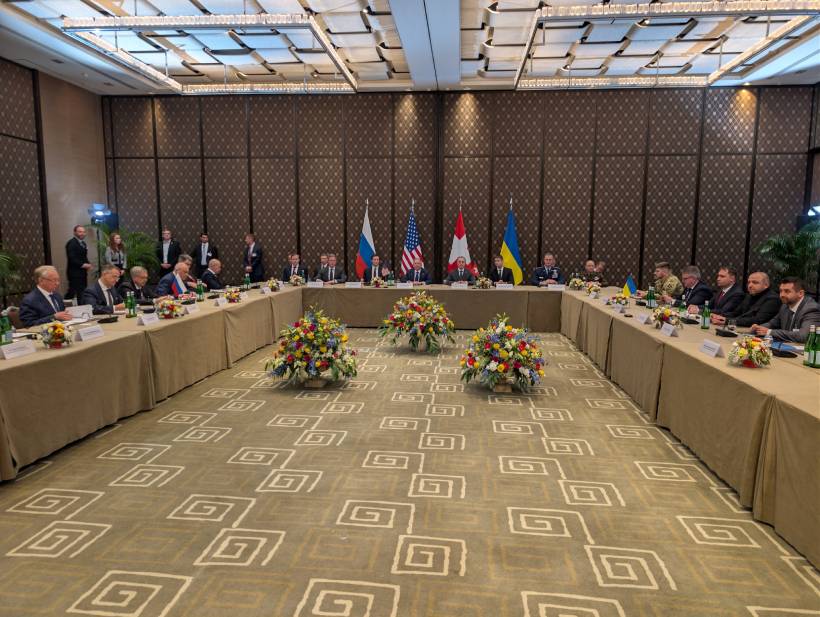
Negotiators from Ukraine and Russia convened in Geneva for the second day of U.S.-mediated peace talks on Wednesday, aiming to find a resolution to the nearly four-year-old war. The talks follow two rounds held in Abu Dhabi, which ended without major breakthroughs, with both sides remaining far apart on critical issues, particularly territorial control in eastern Ukraine.
U.S. Pressure and Zelenskiy’s Response
Ukrainian President Volodymyr Zelenskiy has expressed concern over what he described as undue pressure from Donald Trump to reach a deal quickly. In an interview with Axios, Zelenskiy said it was “not fair” that Trump repeatedly called on Ukraine, rather than Russia, to make concessions. He emphasized that any proposal requiring Ukraine to relinquish territory in the eastern Donbas region not already captured by Russia would be rejected by Ukrainian voters if put to a referendum. Zelenskiy suggested he hopes Trump’s public pressure is merely a tactic rather than a fixed decision.
Negotiation Dynamics
Ukraine’s lead negotiator, Rustem Umerov, head of the National Security and Defence Council, described the first day’s discussions as focused on “practical issues and the mechanics of possible decisions,” without revealing specifics. Russian officials have remained largely silent, though local news sources characterized the talks as “very tense,” with sessions lasting six hours across bilateral and trilateral formats. Zelenskiy maintained that Ukraine’s delegation was approaching the talks “without excessive expectations,” signaling cautious optimism while managing domestic expectations.
Leadership Statements and Public Messaging
In a nightly address on Tuesday, Zelenskiy reiterated readiness to move quickly toward a “worthy agreement” but questioned Russia’s objectives, highlighting ongoing uncertainty over Moscow’s intentions. Trump, meanwhile, publicly urged Ukraine to “come to the table fast,” and his envoy Steve Witkoff stated that the peace efforts were “yielding fruit” under U.S. leadership, portraying the process as a meaningful step toward ending hostilities. Zelenskiy noted that private discussions with top U.S. negotiators, including Witkoff and Jared Kushner, did not carry the same public pressure.
Stay ahead of the geopolitical week.
MD Briefing delivers expert analysis across five global fronts — the Indo-Pacific, energy, geoeconomics, European security, and the Middle East — every Monday morning. Free.
Analysis: Strategic Implications and Constraints
The Geneva talks illustrate the complex interplay between external pressure, domestic legitimacy, and negotiation strategy in the Ukraine-Russia conflict. Zelenskiy faces a delicate balancing act: maintaining Ukrainian sovereignty and public support while engaging in U.S.-brokered diplomacy under intense scrutiny. The insistence on referendum approval for any territorial concessions reflects the domestic political imperative to ensure any agreement aligns with national sentiment, underscoring the limits of external influence.
Russia’s muted official statements and reported tension in the negotiations signal both strategic calculation and a lack of trust in the process, suggesting that breakthroughs will require careful incremental progress rather than immediate, sweeping agreements. The involvement of high-level U.S. envoys underscores Washington’s role as mediator but also highlights the potential complications of public messaging and unilateral pressure, which may risk alienating Kyiv while attempting to nudge Moscow toward compromise.
Ultimately, the Geneva talks remain at a critical juncture: while progress is possible, Zelenskiy’s emphasis on preserving territorial integrity and democratic legitimacy indicates that any deal will require careful navigation of both international and domestic constraints, balancing the urgency of ending the conflict with the enduring need for Ukrainian sovereignty and public support.
With information from Reuters.
