


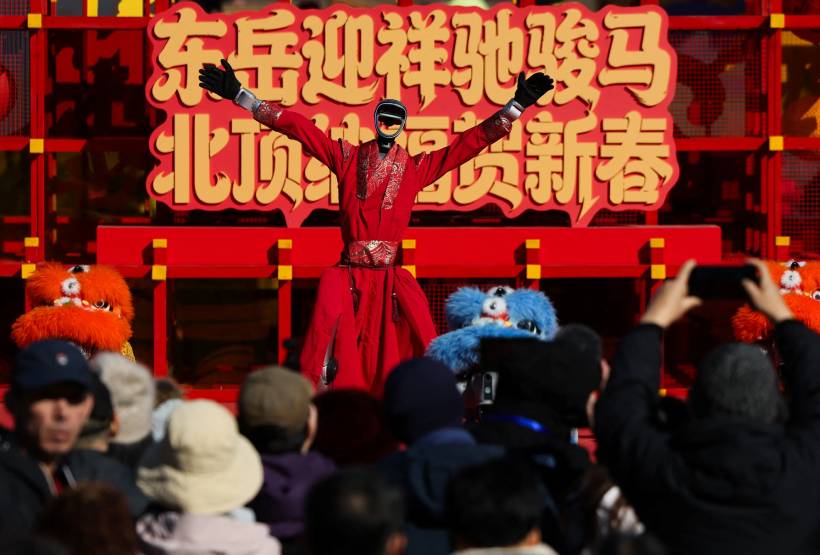
China used its most-watched television broadcast, the CCTV Spring Festival Gala, to showcase humanoid robotics as a symbol of national technological advancement and industrial strategy. The gala, staged annually by China Central Television, functions as a cultural and political platform comparable in mass appeal to the Super Bowl in the United States. This year’s performances highlighted Beijing’s ambition to lead in robotics, artificial intelligence, and next-generation manufacturing.
Four emerging robotics firms Unitree Robotics, Galbot, Noetix, and MagicLab demonstrated humanoid machines capable of martial arts routines, synchronized dance, and interactive performances with human actors.
Robotics as Prime-Time Spectacle and Policy Messaging
The gala featured advanced demonstrations, including a choreographed martial arts sequence in which humanoid robots performed complex movements with weapons and simulated “drunken boxing” techniques. The performance showcased improvements in multi-robot coordination, balance control, and fault recovery key capabilities for real-world deployment in industrial environments.
Stay ahead of the geopolitical week.
MD Briefing delivers expert analysis across five global fronts — the Indo-Pacific, energy, geoeconomics, European security, and the Middle East — every Monday morning. Free.
Artificial intelligence was also foregrounded through the appearance of ByteDance’s chatbot Doubao, reinforcing the integration of AI software with embodied robotics.
Observers note that the gala serves as a direct conduit between industrial policy and public spectacle. Firms featured on the broadcast often receive increased state procurement opportunities, investor interest, and market access, making prime-time exposure strategically valuable.
Industrial Policy Momentum and IPO Wave
Momentum in China’s humanoid robotics sector is accelerating alongside anticipated initial public offerings from companies including AgiBot and Unitree. The prominence of robotics entrepreneurs in meetings with Xi Jinping underscores the sector’s strategic importance. Over the past year, Xi has engaged robotics founders with a frequency comparable to leaders in semiconductors and electric vehicles, signaling prioritization at the highest political level.
Such visibility reflects Beijing’s broader push to upgrade manufacturing through automation and AI integration.
AI+ Manufacturing Strategy and Demographic Pressures
China’s emphasis on humanoid robotics aligns with its “AI+ manufacturing” strategy, which seeks productivity gains to offset demographic headwinds from an ageing workforce. Humanoid robots represent a convergence of national strengths: AI development, advanced hardware production, and deep manufacturing supply chains.
Analysts emphasize that humanoid form factors are both technically versatile and publicly legible, making them effective symbols for policymakers and citizens alike. In early-stage markets, visibility and attention can accelerate adoption and capital flows.
Global Competition and Market Scale
China dominates the emerging humanoid robotics market, accounting for roughly 90% of global shipments last year. Forecasts suggest domestic shipments could more than double this year, widening the gap with international competitors.
In the United States, Tesla is advancing its Optimus humanoid robot initiative under Elon Musk, who has acknowledged Chinese firms as formidable competitors in embodied AI and robotics manufacturing.
Implications
The gala’s robotics showcase illustrates how China integrates industrial policy, cultural messaging, and market development into a unified innovation strategy. By elevating robotics in a nationally symbolic broadcast, Beijing strengthens public acceptance, attracts investment, and accelerates commercialization pathways.
The emphasis on humanoid robotics signals a shift from experimental prototypes toward practical deployment in logistics, manufacturing, and service sectors. It also intensifies technological competition with Western firms, particularly in embodied AI systems that combine physical automation with machine intelligence.
Analysis
China’s deployment of humanoid robots as both technological demonstration and national narrative reveals a strategic model that merges state planning with mass cultural amplification. Unlike purely market-driven innovation ecosystems, China leverages symbolic platforms to shape public perception, direct capital, and reinforce industrial priorities.
The convergence of AI software, robotics hardware, and manufacturing scale positions China to define standards in next-generation automation. While Western competitors retain strengths in advanced semiconductors and foundational AI research, China’s integrated supply chains and policy coordination may accelerate real-world deployment.
The Spring Festival gala thus serves not merely as entertainment but as a signaling mechanism: humanoid robotics are moving from spectacle to industrial reality, and Beijing intends to lead that transition.
With information from Reuters.
