


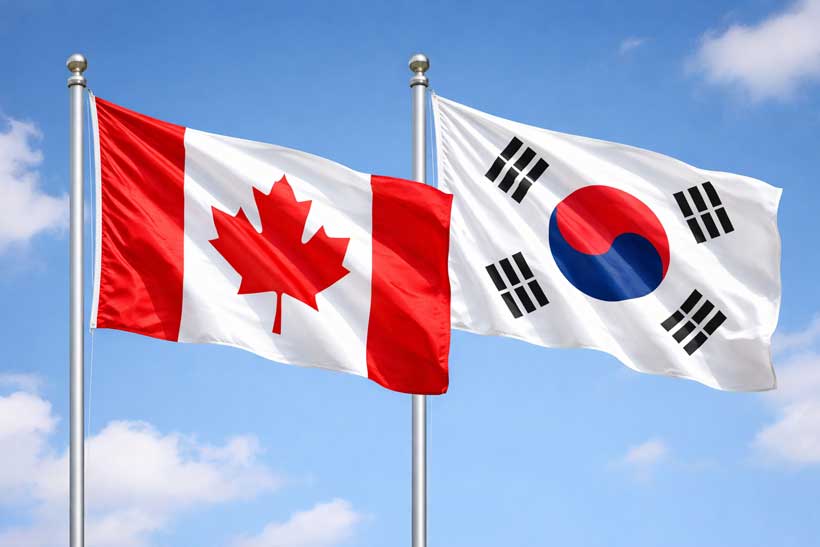
For much of the past decade, security cooperation between Canada and South Korea has been treated as a peripheral matter. Yet, such an assumption is no longer sustainable. The reality—the accelerating convergence of security risks across the Atlantic and Indo-Pacific regions—has increasingly reshaped the role that middle powers must play if regional stability is to be preserved in either theater.
Growing concerns over Russia’s potential military invasion of European countries by 2029, as evidenced by the German foreign minister’s recent remarks, together with China’s increasing coercion against Taiwan in the Indo-Pacific, are not isolated challenges. They are correlated with one another through shared technologies, coordinated diplomatic narratives via the Shanghai Cooperation Organization (SCO), sanctions evasion networks, cyber operations, and above all, the growing probability of simultaneous or sequential regional contingencies. In this context, the resilience of the U.S.-led alliance system does not depend on Washington’s capability alone but also on how middle powers like Canada and South Korea could reduce strategic stress by helping to create credible deterrence and sustainable capacity of their own.
Within this emerging geopolitical landscape, Canada and South Korea occupy a uniquely complementary position. While Canada is deeply embedded within NATO’s institutional, planning, and interoperability architecture, South Korea is one of the U.S.’s key allies in Northeast Asia that possesses a modern and highly capable military and a rapidly expanding defense industry, which ambitiously aims to become the world’s fourth-largest defense exporter. In that sense, cooperation between the two countries should no longer be framed as an optional partnership but as a long-term strategic necessity that links stability in the Atlantic and the Indo-Pacific through middle-power agency.
Canada’s strategic values do not lie in its troop size or forward-deployed firepower. Its comparative advantage is institutional integration: long participation in NATO command structures, combined operations experience, advanced cyber and intelligence coordination capacity, and growing maritime responsibilities across the Atlantic and Arctic. In comparison, South Korea’s strength lies in capability generation. Under a constant deterrence environment, South Korea fields high-readiness forces, operates a mature and scalable defense industry ecosystem, and possesses deep expertise in shipbuilding, missile defense, and munition production. If these advantages are deliberately aligned, it could engender a force multiplier effect that neither country can achieve alone.
Stay ahead of the geopolitical week.
MD Briefing delivers expert analysis across five global fronts — the Indo-Pacific, energy, geoeconomics, European security, and the Middle East — every Monday morning. Free.
From Canada’s perspective, deeper security cooperation with South Korea would be a means that would transform Canada’s engagement in the Indo-Pacific into a credible step that goes beyond episodic reaction. To be sure, Ottawa’s Indo-Pacific strategy already recognizes that security in the region directly impacts Canada’s interests. Nevertheless, existence alone does not equal deterrence. In particular, alignment with South Korea or U.S.–ROK combined operational planning in the field of maritime security, anti-submarine warfare (ASW), cyber defense, and logistics could allow Canadian deployments to generate much greater strategic effect. For South Korea, partnership with Canada offers a gateway into Atlantic security mechanisms while preserving its primary alliance with the United States intact, albeit requiring nuanced diplomacy between Canada and the United States given recent political sensitivities between European NATO member states and the United States, as epitomized by the Greenland affair.
However, in order to go beyond mere rhetoric and move towards meaningful cooperation, Canada and South Korea should institutionalize cooperation that could withstand leadership changes and shifting domestic priorities. The recent launching of the bilateral 2+2 dialogue between foreign and defense ministers is indeed an important step, yet its true value would depend on whether it becomes a permanent, output-driven mechanism, rather than an ad hoc diplomatic event. An annual 2+2 cycle based on clear outputs—which includes joint exercises, industrial projects, and planning initiatives—could provide continuity and responsibility. Likewise, the Canada-South Korea Comprehensive Strategic Partnership (CSP), which was signed in 2022, needs to be materialized with concrete—more so than the Action Plan—implementable measures.
From the strategic perspective, Ottawa and Seoul should formalize a shared approach to what can be termed “dual-theater deterrence.” This does not require a joint war plan or a formal commitment beyond existing alliance arrangements. Instead, it demands structured dialogue and tabletop exercises that examine how Canada and South Korea could reduce alliance vulnerability during simultaneous crises in Europe and Northeast Asia. Such exercises would center their focus on various areas—including logistics bottlenecks, sustainment capacity, maritime chokepoints, cyber escalation dynamics, and rear-area infrastructure protection—where middle powers could offer decisive contributions even without deploying massive combat units.
Despite its huge potential for cooperation, maritime security has not yet been fully explored. Canada’s responsibilities in the Atlantic and Arctic intersect with South Korea’s interest in the protection of sea lines of communication (SLOCs) in the Indo-Pacific. Thanks to ongoing climate change and the further opening of the Northern Sea Route (NSR), Russian naval presence, except for its Black Sea Fleet, would likely increase both in the Atlantic and in the Western Pacific. Instead of treating these as separate regional issues, both governments should pursue an interconnected maritime security framework that focuses on maritime domain awareness (MDA), sanctions enforcement, and gray-area deterrence and that would be more comprehensive than the existing Pacific Security Maritime Exchange (PSMX) and Operation NEON. Even at low classification levels, information sharing can notably reduce ambiguity and constrain adversaries’ coercive behaviors that are below the threshold of armed conflict.
Defense industrial cooperation is where strategic alignment could directly transform into visible deterrence. In an era of munition shortages and production bottlenecks, memoranda of understanding alone are insufficient. Canada and South Korea should identify a small number of co-production priorities—especially in sustained munition supply and counter-unmanned systems—that could meet the needs of both NATO and the Indo-Pacific. A co-production system could not only strengthen national resilience but also create interoperable systems that are suitable for both alliance use and third-party export, reinforcing the broader alliance ecosystem. If the Canadian Patrol Submarine Project (CPSP) selects South Korea as its counterpart this year, defense industrial cooperation between the countries would deepen in the coming decades.
Reducing frictions within the process of procurement and export coordination is equally important. Lengthy authorization procedures and regulatory uncertainty weaken the credibility of defense cooperation. Security reviews, export licensing coordination, and bilateral fast-track mechanisms for joint projects would signal seriousness and encourage investment from the private sector. In an era of prolonged competition, the ability to massively produce and maintain systems is itself a form of deterrence.
Meanwhile, Canada’s position within NATO offers an opportunity to accelerate South Korea’s participation in Atlantic security processes within appropriate political and strategic boundaries. To be sure, this does not imply membership status but refers to South Korea’s structured participation in NATO innovation, cyber resilience, logistics, and standards development initiatives. If Canada plays the role of a sponsor as well as a facilitator, it could help translate South Korean capabilities into NATO-relevant contributions and reinforce recognition within NATO that the security of the Indo-Pacific and Atlantic are inseparable.
Cybersecurity and disinformation resilience are another domain in which middle powers could exercise disproportionate influence. Protection of core infrastructure and joint cyber exercises that focus on defense supply-chain security could directly address vulnerabilities that adversaries routinely exploit. Such cooperation is politically sustainable, operationally meaningful, and directly related to both regions’ security environments.
Last but not least, Canada and South Korea should think in terms of sustainment and logistics, rather than platforms themselves. In any high-intensity or prolonged contingency, deterrence fails not because the alliance lacks advanced weapons, but because it cannot transport adequate numbers of troops or repair and supply defense equipment under pressure. Joint planning on logistics throughput, maritime repair and maintenance, coordination on airlift, and medical support could strengthen alliance resilience without escalating tensions.
To anchor these initiatives, Ottawa and Seoul should announce a concise yet enforceable 10-year security cooperation roadmap. Such a document—limited in scope but rich in specificity—would clarify strategic objectives, define institutional mechanisms, and offer a reference point for annual review. By linking dialogue at the administrative level with parliamentary and legislative engagement, both governments could insulate cooperation from short-term political volatility.
The ultimate purpose of Canada–South Korea cooperation is neither substituting for U.S. leadership nor creating a parallel alliance structure. It is instead to prevent strategic overburden by ensuring that deterrence does not rest on a single pillar. By pooling institutional accessibility, industrial capacity, and operational experience, Canada and South Korea could showcase what effective middle-power strategy would look like in an era of multi-theater competition.
Stability in the Atlantic and Indo-Pacific cannot be preserved by declarations alone. It will heavily depend on whether capable partners are willing to invest in long-term, production-oriented cooperation that transfers alignment into resilience. Canada and South Korea both have the incentives as well as the means to opt for such a pact—if they choose to think beyond regions and act beyond symbolism. If seriously implemented, it could be considered a notable step in realizing what Canadian Prime Minister Carney mentioned at Davos—namely, cooperation among middle powers in accordance with values-based realism.
