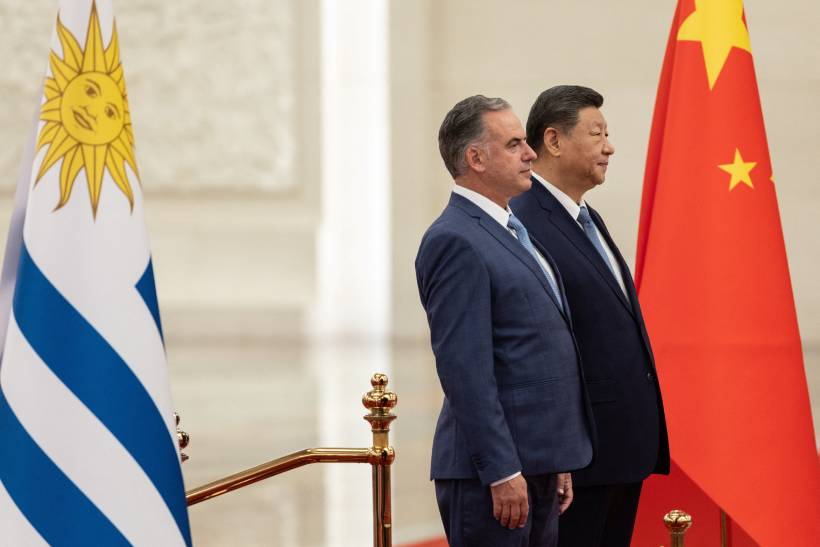
In early February 2026, Chinese President Xi Jinping received Uruguayan President Yamandú Orsi in Beijing, marking a deepening of bilateral ties between China and one of Latin America’s most politically stable, democratic nations. Xi’s core messaging called for advancing an “equal and orderly multipolar world” and a more inclusive globalization, while signing a new strategic partnership and over a dozen cooperation agreements spanning trade, technology, the environment, intellectual property, and more.
This diplomatic meeting is symbolically significant for two reasons: it’s the first visit by a South American head of state to Beijing since the U.S.–Venezuela confrontation in January, and it underscores how even democratic, open societies like Uruguay are willing to engage deeply with Beijing in a time of intense geopolitical competition.
Uruguay, often lauded as one of the most robust democracies in Latin America, is signaling strategic cooperation with China raises key questions: What drives this alignment? Does it reflect Uruguay’s autonomy in foreign policy? What does it mean for U.S. influence in the Western Hemisphere? And how does this fit into deeper shifts in global order?
Uruguay’s Foreign Policy Objectives
Uruguay’s political institutions, rule of law, and democratic norms differentiate it from many neighbors historically susceptible to populist swings or political volatility. This stability gives the country a reputation as a beacon of democracy and liberal governance in a region otherwise grappling with polarization and crisis.
Stay ahead of the geopolitical week.
MD Briefing delivers expert analysis across five global fronts — the Indo-Pacific, energy, geoeconomics, European security, and the Middle East — every Monday morning. Free.
Yet Uruguay’s foreign policy has long balanced ideological affinity with the West against economic engagement with the broadest possible set of partners. Its leadership has consistently framed international relations around sovereignty, development, and diversified partnerships, not ideological blocs, a stance on vivid display in Orsi’s Beijing rhetoric.
Uruguay’s official messaging emphasizes that multilateralism isn’t abstract but necessary for small states; cooperative ties with China, in this view, are means to preserve diplomatic room to maneuver rather than a wholesale shift in alignment.
The Economic Foundations of the Relationship
China has been Uruguay’s largest trading partner for over a decade, absorbing key agricultural exports and providing an external market for Uruguay’s rural economy. In 2025, an estimated one‑quarter of Uruguay’s goods exports went to China, and the country ran a significant trade surplus with Beijing.
This economic link isn’t trivial: for Uruguay’s export‑oriented sectors, China’s huge demand has expanded markets and foreign currency receipts in a way that diversified trade with Western markets has often struggled to replicate. The urgency of these economic ties was underscored by a 150‑member Uruguayan delegation accompanying President Orsi, including business leaders and academics.
Strategic Partnerships Beyond Business
While a mutually beneficial economic relationship is what brought the two presidents to meet, the alliance expands the relationship between China and Uruguay in several key areas.
The two nations agreed upon deals that would expand cooperation into intellectual property, environmental sustainability, and university level educational collaboration programs.
These moves signal that for Uruguay, the partnership is no longer a financial one. Montevideo clearly sees Beijing as a crucial component to its development as a leader in several areas within the Latin American region.
China’s Messaging
Xi’s emphasis on an “equal, orderly multipolar world” reflects Beijing’s long‑standing diplomatic narrative that posits a global order in which U.S. dominance is attenuated and emerging powers share influence. China frames this as respect for sovereignty, noninterference, and inclusive development, appealing especially to Global South partners.
In Uruguay’s case, President Orsi’s commentary echoed this theme: sovereign equality and cooperation should underpin relations in an era of unpredictability and unilateralism.
The Inherent Modern Challenge to the Monroe Doctrine
For decades, Washington’s policy in Latin America was built on the notion that the region falls within its influential orbit, underscored by doctrines and interventions. Beijing’s overt embrace of “multipolarity” and economic engagement directly challenges this presumption.
The fact that Uruguay, which has historically aligned with Western governance norms, is engaging China with such depth sends an implicit signal that U.S. influence is neither uncontested nor all‑encompassing in its own hemisphere. This is amplified by the fact that Orsi’s visit is the first major Latin American trip to Beijing since the U.S. capture of Venezuelan President Maduro, itself a geopolitical rupture for Washington.
Implications for U.S. Regional Policy
The Uruguay‑China partnership illustrates a broader trend: Latin American countries are exercising greater agency in balancing between Washington and Beijing. Brazil’s recent openness to deeper Mercosur‑China trade talks underscores this trend across the Latin region.
Rather than a simple “tilt” toward one great‑power patron, many countries are pursuing interest‑driven diversification. This places pressure on Washington to craft foreign policy that is competitive not only militarily or diplomatically but economically and technologically.
For the United States, Uruguay’s partnership with China highlights the need for more proactive engagement that respects Latin American autonomy while offering credible alternative partnerships. Trade agreements, development finance, and cooperation on transnational issues could form the basis of renewed U.S. engagement without coercive overtones.
Conclusion
Uruguay’s growing relationship with China reflects an era of strategic diversification, not ideological subservience. As a democratic state with a tradition of political stability, Uruguay’s decisions carry weight far beyond bilateral relations; they signal to the region that economic opportunity and geopolitical strategy can coexist outside traditional Western alignments.
However, this alignment also underscores a global shift: power is more networked. Middle powers like Uruguay are no longer passive actors responding to great‑powers they are purposeful agents shaping their own autonomous path. In a world where narratives of multipolarity increasingly resonate, and where relationships are constructed through trade, technology, and cooperation, Uruguay’s engagement with China is a powerful illustration of how middle power democracies can navigate the fault lines of geopolitics in the 21st century.
The deeper question now is not whether Uruguay will maintain its democratic identity while partnering with China, but how other democratic middle powers will interpret and respond to this model of diversified global engagement.