


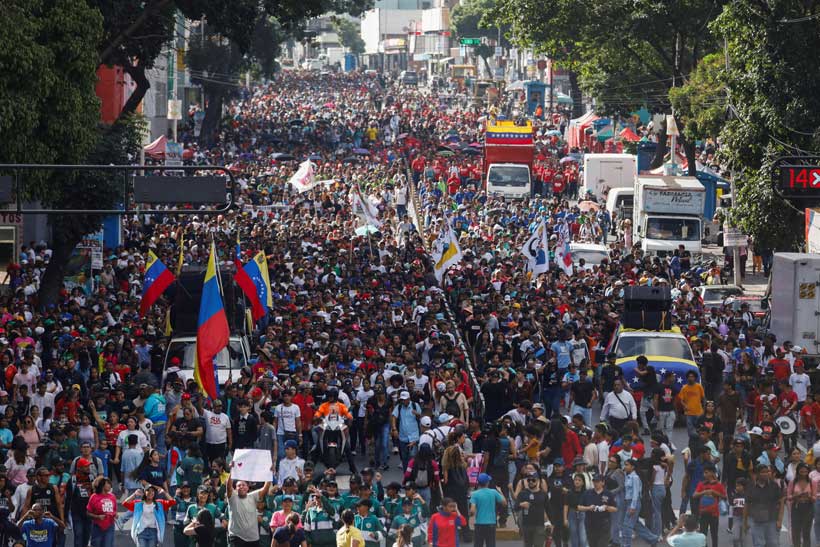
In Venezuela’s main oil city, Maracaibo, members of the ruling socialist party have been checking local support after President Nicolas Maduro was captured by U. S. forces. Roughly half of those surveyed reported that they no longer supported the party, indicating significant division among members. While Reuters could not confirm the exact findings, they align with similar reports from other areas of the country.
Interviews with 13 party members from four states revealed concerns about the future of the United Socialist Party (PSUV). Many felt uncertain and worried about their economic situations. The government’s system of providing financial benefits and food parcels to maintain loyalty seems to be under strain, with some contributions reportedly stopped since Maduro’s removal. Several party loyalists expressed distrust toward interim President Delcy Rodriguez, and many reported a notable drop in participation at local events, with attendance estimates plummeting by up to 70%.
All sources requested anonymity due to fear of retaliation, noting that local leaders have encouraged party members to report those who show any signs of losing faith in the party. Voting and membership figures are not publicly available, and the lack of foreign media presence and fear of reprisals contribute to this difficulty in gathering accurate data.
The Venezuelan government and PSUV have not responded to inquiries about the declining support and weakening of their support system. Rodriguez has made calls for unity in her public addresses since Maduro’s capture, vowing to develop the economy. Despite condemning Maduro’s detainment, she appears to be complying with U. S. demands, including discussions on oil and cooperation against drug trafficking.
This situation poses a challenge for Rodriguez, who is already concerned about her position, especially with influential figures like Diosdado Cabello, who leads the PSUV and has strong ties with security forces, potentially threatening her power. Rodriguez seeks to publicly project unity within the party, but reports suggest a lack of grassroots support and political viability for the PSUV post-Maduro.
A local leader acknowledged that even with a revolutionary figure as a candidate, the party lacks the means to win elections. Experts warn that the weakening of the party’s enforcement apparatus and the demobilization of its grassroots supporters present governance challenges. Yet, there remains hope for future support as Venezuela’s oil sales may provide economic improvement, potentially replenishing the party’s resources. A senior U. S. official noted stability in the country, claiming that economic prospects would benefit both Venezuela and the United States.
Means of control
Venezuela’s ruling party, the PSUV, was formed in 2007 by combining various groups that supported President Hugo Chavez, who gained power in 1999. By 2009, the party had over 7 million members, as Chavez used oil money to fund social projects. However, after Chavez’s death in 2013, the party became a tool for President Maduro to exert power and suppress dissent. The PSUV holds a super majority in the national assembly and controls nearly all governorships.
Local support for the PSUV is now declining. Some party members are wary of being associated with the party if the opposition gains power, fearing consequences. Others are experiencing infighting within the party and are disillusioned with the new leadership’s commitment to Chavez’s ideals. These troubles have been compounded by issues with delivering government handouts, such as food and financial aid, leading to member desertion in states like Zulia, Aragua, and Falcon. Many Venezuelans rely on these payments to survive, as the monthly minimum wage is less than $1 and poverty is widespread.
Reporting indicates that some welfare payments, including the “family bonus,” have not been received by many people. Food aid deliveries have also stalled, and some members of the party express frustration over these issues, indicating that dissatisfaction predates Maduro’s rule. In the Mara municipality, about 70% of local party members ignored calls to participate in pro-Maduro marches, leading to threats of job loss. Additionally, even violence-prone ‘colectivos’ have been less active in supporting the government, with some members choosing other work, including motorbike taxi driving, and avoiding participation in marches.
With information from Reuters
Stay ahead of the geopolitical week.
MD Briefing delivers expert analysis across five global fronts — the Indo-Pacific, energy, geoeconomics, European security, and the Middle East — every Monday morning. Free.
