


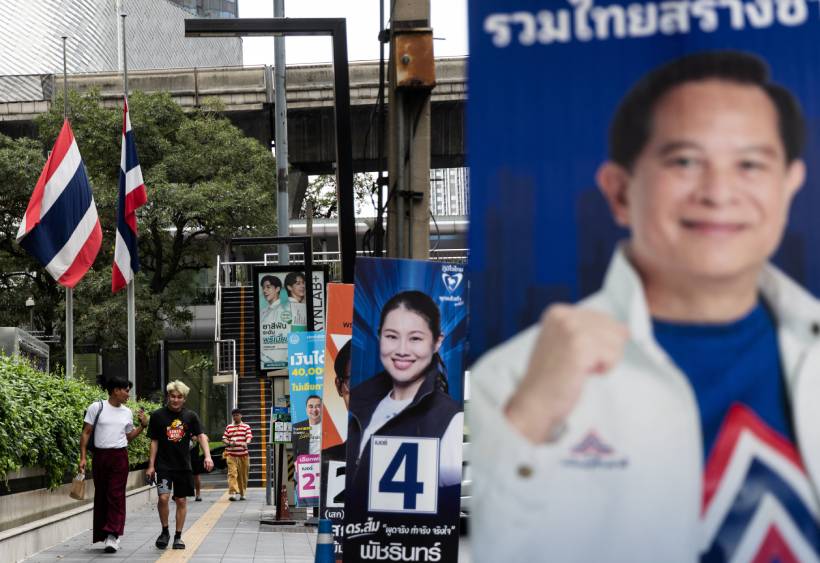
Thailand heads to the polls on February 8 in a three-way contest that pits the progressive People’s Party against the populist Pheu Thai and the conservative Bhumjaithai Party. The election is the latest chapter in a turbulent power struggle between reformist, establishment, and conservative forces in the country.
Who Is Leading the Polls?
Opinion surveys show the People’s Party as Thailand’s most popular force. With a strong social media presence and an ambitious reform agenda, it appeals especially to young and urban voters. Its predecessor, Move Forward, won nearly all of Bangkok’s 33 seats in 2023 and made gains in conservative areas but lacked the parliamentary support to form a government despite a pact with Pheu Thai.
Recent polls indicate the momentum continues. A Suan Dusit University survey of 26,661 people between January 16-28 gave the People’s Party 36% support, with Pheu Thai at 22.1% and Bhumjaithai at 18.9%. Another poll by the National Institute for Development Administration from January 23-27 showed similar results: People’s Party at 34.2%, Bhumjaithai at 22.6% and Pheu Thai at 16.2%.
Stay ahead of the geopolitical week.
MD Briefing delivers expert analysis across five global fronts — the Indo-Pacific, energy, geoeconomics, European security, and the Middle East — every Monday morning. Free.
Forming a Government: Coalitions Are Key
An outright majority for any party is unlikely, meaning a coalition is almost certain. But forming alliances could prove challenging, given deep ideological divides, histories of political betrayals, and tensions among Thailand’s dozens of smaller parties.
While the People’s Party leads at the ballot box, building a coalition may be difficult. Bhumjaithai leader Anutin Charnvirakul is a pragmatic dealmaker who has previously brokered coalitions across ideological lines, often backed by conservative establishment figures. Pheu Thai, the billionaire Shinawatra family’s party, has the resources to negotiate strategically, though its popularity has waned and defections have bolstered Bhumjaithai’s ranks. Analysts suggest a Pheu Thai–Bhumjaithai alliance could be decisive, even if the People’s Party wins the most seats.
Challenges Facing the People’s Party
Despite its popularity, the People’s Party faces significant obstacles. Its liberal, anti-establishment agenda including reforms targeting monopolies, the military, and the judiciary threatens entrenched elites, business interests, and royalist generals. The party’s predecessors have repeatedly faced legal and institutional pushback: Future Forward was dissolved in 2020, and Move Forward was blocked from forming a government in 2023.
The National Anti-Corruption Commission is currently investigating 44 former Move Forward lawmakers for ethics breaches related to efforts to amend the law protecting the monarchy. Among them are 15 People’s Party members, including two of its three prime ministerial candidates, Natthaphong Ruengpanyawut and Sirikanya Tansakun. A Supreme Court referral could impose political bans, adding uncertainty to the party’s prospects.
Anutin’s Chances
Anutin, 59, is a politically astute royalist whose Bhumjaithai Party has enough clout to negotiate ministerial posts and coalition agreements. His rise to the premiership in September 2025, following the court ousting of then-Prime Minister Paetongtarn Shinawatra, demonstrated his ability to outmaneuver rivals and rally parliamentary support.
To succeed again, Anutin will need to expand Bhumjaithai’s 71 seats from the last election and leverage his establishment ties to form a coalition capable of sidelining the People’s Party.
How the Prime Minister Is Chosen
Parties can submit up to three prime ministerial candidates. Any party with at least 25 seats can nominate a candidate, who is then put to a parliamentary vote. A majority of the 500-member lower house is required for election. If no candidate secures a majority, the house reconvenes until a premier is chosen, with no set time limit for the process.
Conclusion
Thailand’s election is likely to be closely fought, with a popular reformist party facing entrenched conservative and populist forces. While the People’s Party may lead in votes, coalition-building, legal challenges, and pragmatic maneuvering by opponents like Anutin will ultimately determine who forms the next government.
With information from Reuters.
