


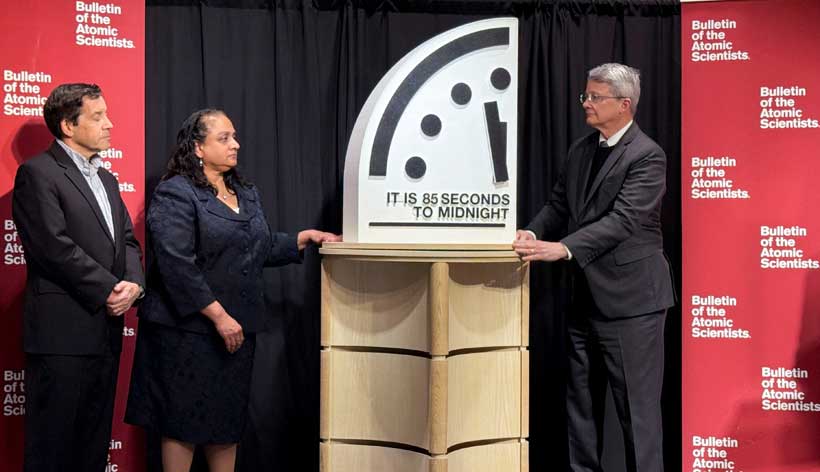
Atomic scientists have set their “Doomsday Clock” at 85 seconds before midnight, reflecting increased risks of global disaster due to aggressive actions by nuclear powers Russia, China, and the United States. They have cited weakening nuclear arms control, ongoing conflicts in Ukraine and the Middle East, and concerns about artificial intelligence as key factors driving the heightened risks. This new setting is the closest to midnight the clock has ever been, having moved four seconds closer than last year.
The Bulletin of the Atomic Scientists, which created the clock in 1947 during post-World War Two tensions, warns that unregulated artificial intelligence in military systems could lead to misuse and biological threats, alongside spreading disinformation. Climate change also remains a significant challenge. The Bulletin’s president, Alexandra Bell, stated that the clock reflects a global failure in leadership and a trend towards aggressive governance, contributing to the escalating dangers.
This marks the third instance in the past four years that the clock has been moved closer to midnight. Bell highlighted that in 2025, no positive trends in nuclear risks were observed. Existing diplomatic efforts are struggling, and the likelihood of nuclear weapon use is unacceptably high amid conflicts, including Russia’s war in Ukraine, U. S. and Israeli actions against Iran, and tensions between India and Pakistan.
The New START treaty, the last nuclear arms agreement between the U. S. and Russia, is set to expire soon, with Russian President Putin suggesting a one-year extension without a formal U. S. response. President Trump has called for the U. S. military to resume nuclear testing after a three-decade pause, which may benefit nations looking to expand their nuclear capabilities, such as China.
Bell asserted that major powers are growing increasingly aggressive and nationalistic, which hampers international cooperation necessary to avert nuclear war, climate change impacts, and emerging threats from biotechnology and AI. Maria Ressa, a journalist and Nobel Peace Prize laureate, described the current state of information dissemination as an “information Armageddon,” where technology spreads misinformation rapidly, exacerbating societal divisions. The Bulletin, founded by notable scientists in 1945, aims to alert the public to these existential threats.
With information from Reuters
