


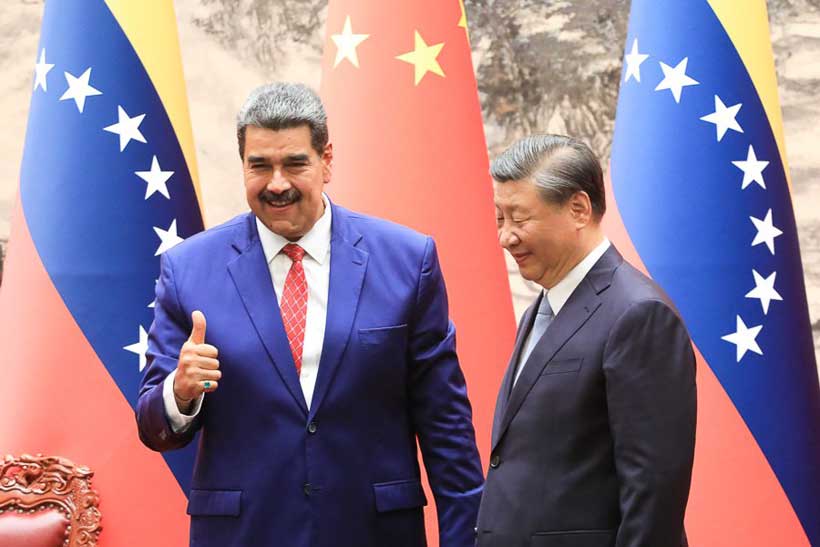
The American provocation against China came in the form of announcing the arrest of Venezuelan President “Nicolás Maduro” and his wife, less than 10 hours after Maduro met with Chinese President Xi Jinping’s envoy in Venezuela. This timing was perhaps deliberate, as the US chose to announce the removal of Maduro’s regime and send a direct message to Beijing about the diminishing of China’s geopolitical influence in Venezuela, Latin America, and the Caribbean—Washington’s backyard—following the regime change in Caracas. This effectively severed Beijing’s connection with the Venezuelan government and its network there. China considered this the most aggressive foreign military intervention by Trump during his presidency.
Consequently, the Chinese government’s concerns for its large community and workforce in Venezuela intensified, leading it to issue an official statement warning its citizens against traveling to Venezuela in the near future. Perhaps what most worries the Chinese side at present, after losing contact with its ally, Venezuelan President “Nicolás Maduro”, is its concern for the safety of its citizens, workers, and organizations in Venezuela. China has urged them to closely monitor the local security situation, strengthen preventive measures and necessary precautions in case of emergencies, avoid unnecessary travel, and stay away from conflict zones or sensitive areas. In case of emergency, Chinese authorities have instructed them to immediately contact the police and the Chinese embassy in Venezuela for assistance.
Conversely, Chinese authorities have accused the Trump administration of seeking to control Venezuela’s oil reserves, the largest in the world, and to harm China’s interests. This is what Chinese think tanks and intelligence agencies have found significant indications and signs of: the expansion of the American Chevron company’s production in Venezuela despite the US sanctions imposed on Venezuelan oil production and exports. Further supporting this Chinese intelligence and analytical perspective is the granting of several exceptional approvals by the “US Treasury Department’s Office of Foreign Assets Control,” which is known as OFAC, in November 2023, allowing “Chevron” to resume crude oil exports from its joint ventures in Venezuela. In October 2025, Chevron also received a permit to resume oil production in Venezuela. This demonstrates the double standards employed by the US in its dealings with Venezuela and Venezuelan oil, aimed at harming the network of interests of China and its allies, such as Russia, Iran, and North Korea, in accordance with US interests in confronting all parties.
According to Chinese analyses, the United States has not engaged in such direct intervention in Latin American affairs since its 1989 invasion of neighboring Panama to overthrow its then-military leader, Manuel Noriega, an act condemned by all relevant circles in Beijing. Beijing’s security, military, and intelligence agencies considered this a direct challenge to China and its allies in the Caribbean and Latin America. Hence, China categorically rejected US President Donald Trump’s statements that Venezuelan President “Nicolás Maduro” had been captured and flown out of the country along with his wife, claiming the operation was carried out to enforce US law and promising further details later.
Stay ahead of the geopolitical week.
MD Briefing delivers expert analysis across five global fronts — the Indo-Pacific, energy, geoeconomics, European security, and the Middle East — every Monday morning. Free.
In contrast, the Chinese Ministry of Defense supported the statements made by Venezuelan Defense Minister Vladimir Padrino in a video released on Saturday, January 3, 2026, in which he declared that his country would resist the presence of foreign forces, particularly American forces; that the US military attack had targeted civilian areas; and that Venezuela and its partners were currently gathering information on all the losses inflicted upon them by Washington’s blatant interference in their internal affairs. This escalation comes at a time of unprecedented tension between the United States and Venezuela, with China being the Venezuelan regime’s biggest supporter, amid warnings of a potential large-scale military escalation in the region.
Based on this information, the Chinese government announced its support for the current Venezuelan government in deploying popular military and police forces to guarantee sovereignty and peace throughout Venezuelan territory, calling on the peoples and governments of Latin America and the world to mobilize and stand in solidarity against US imperialist aggression. China, as a permanent member of the UN Security Council, called for an immediate emergency session to condemn the US intervention in Venezuela’s internal affairs and its attempt to forcibly change the government and seize power, and to affirm the international legitimacy of the blatant US aggression against Venezuela. China also affirmed Venezuela’s right to defend itself and protect its sovereignty and security against any external intervention or aggression led by Washington, whose actions must be condemned immediately and sanctions imposed. Official and diplomatic sources in Beijing declared that the principles of international law and the “UN Charter” must be respected. Beijing reiterated its commitment to the fundamental principles of international law, foremost among them the prohibition of the use of force. Beijing supported holding a Security Council session on Venezuela while simultaneously emphasizing the need to guarantee Venezuela’s right to self-determination without foreign military intervention.
This led to China’s continued warnings and criticism of the blatant US interference in Venezuela’s internal affairs. China and Venezuela accused the United States of causing explosions in the Venezuelan capital, Caracas, and of conducting low-altitude flights of US military aircraft over Venezuelan territory prior to the US announcement regarding the overthrow of the Maduro regime. The Chinese and Venezuelan governments accused the United States of “military aggression against Venezuela to change the regime and overthrow President Maduro through a widespread US attack on civilian and military areas in Caracas and the Venezuelan states of Miranda, Aragua, and La Guaira.”
Accordingly, China strongly rejects US interference in Venezuelan affairs and condemns the statements made by US President Trump regarding the arrest of Venezuelan President “Maduro” and his wife. As Chinese President Xi Jinping himself stated from the outset of the US aggression against Venezuela, “China supports Venezuela in safeguarding its sovereignty, national security, national dignity, and social stability. China firmly opposes the interference of foreign forces in Venezuela’s internal affairs.” The Chinese government is well aware that the US’s stated objective of controlling Venezuelan coastlines under the pretext of combating terrorism and drugs is merely a pretext to seize control of the Venezuelan government and its oil resources, which are exported to China and around the world. These are the same accusations leveled against Venezuelan President “Maduro” in October 2020, when a US court indicted him for involvement in drug-related terrorism and conspiracy to import cocaine into the United States. In August 2025, the US Department of Justice increased the reward for information leading to the arrest of “Maduro” himself to $50 million. China protested this move, fully aware of the US desire to control its backyard in South America and the Caribbean region surrounding Venezuela and its borders and to install new leaders loyal to Washington’s agenda against China and its interests in the region. The US Embassy in Bogotá, Colombia, notes that Venezuela has been subject to the highest level of travel warnings since December 3, 2025.
Venezuela was the first Spanish-speaking country to enter into a “strategic development partnership” with China in 2001, a move that angered Washington at the time. This partnership opened billions of dollars in trade between China and Venezuela and resulted in the continued settlement of Chinese immigrants in Venezuela to serve Chinese interests within the country. Therefore, the declared American response to these close strategic relations between China and Venezuela, aimed at harming its network of interests, came in August 2017 with the Trump administration imposing several sanctions that prevented Venezuela from accessing US financial markets. In May 2018, Washington expanded these sanctions to include a ban on purchasing Venezuelan debt, which strangled the Venezuelan economy. Venezuela had become heavily reliant on its close trade and economic ties with China and its partners Russia, Iran, and North Korea, in the face of Washington’s continued harassment and bargaining with the Venezuelan regime.
