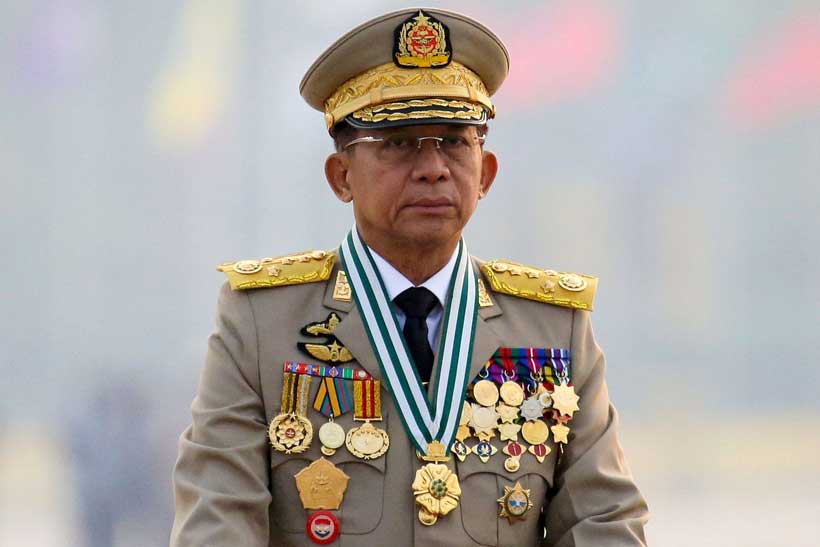
Last week, Myanmar’s junta chief Min Aung Hlaing urged voters to select candidates who would work with the military during the upcoming general election, which takes place nearly five years after the military coup. His comments signal the junta’s efforts to maintain control in a country facing significant armed resistance. Analysts indicate that trying to establish a stable government is unrealistic amid ongoing civil conflict, and a government that appears civilian but is military-controlled is not likely to receive international support. Richard Horsey from Crisis Group noted that this type of military rule will not address the ongoing armed conflict or civil unrest, leaving Myanmar in a state of crisis.
Voting will occur in two phases, but only in 202 of the 330 townships, where the military has varying levels of influence. There has been no announcement about when results will be counted. The military, which has had a long history of dominating Myanmar’s politics since its independence from Britain in 1948, has attempted to maintain its strict control over the country. Min Aung Hlaing took power in February 2021 by ousting Aung San Suu Kyi’s civilian government based on unfounded allegations of electoral fraud. David Mathieson, an independent analyst, pointed out that the military’s attempts at change are unlikely to threaten its hold on power.
The National League for Democracy, which won the last two general elections, is dissolved, and few opposition parties are participating. Six parties are in the running, including the military-backed Union Solidarity and Development Party (USDP), which is expected to perform well. Sai Kyi Zin Soe, a political analyst, explained that while a national leader may come from the USDP, defining whether that leader would be Min Aung Hlaing remains uncertain.
Historical comparisons with previous military-managed elections, such as in 2010, can be misleading due to the unprecedented violence currently affecting Myanmar. Ye Myo Hein, from the Southeast Asia Peace Institute, stated that these orchestrated elections might escalate violence instead of creating a stable political or economic environment.
The elections also represent an attempt by the junta to gain international legitimacy following widespread condemnation after the coup. While China supports the junta, they are also seeking backing from ASEAN and neighboring countries. However, Thailand’s foreign minister indicated that re-engagement with Myanmar by ASEAN is challenging due to the lack of an inclusive political dialogue and called for the release of Suu Kyi. The elections have faced criticism from the United Nations and various human rights organizations, denouncing them as lacking fairness. The junta maintains that the elections are conducted for the people of Myanmar, disregarding international opinions on their legitimacy.
With information from Reuters