


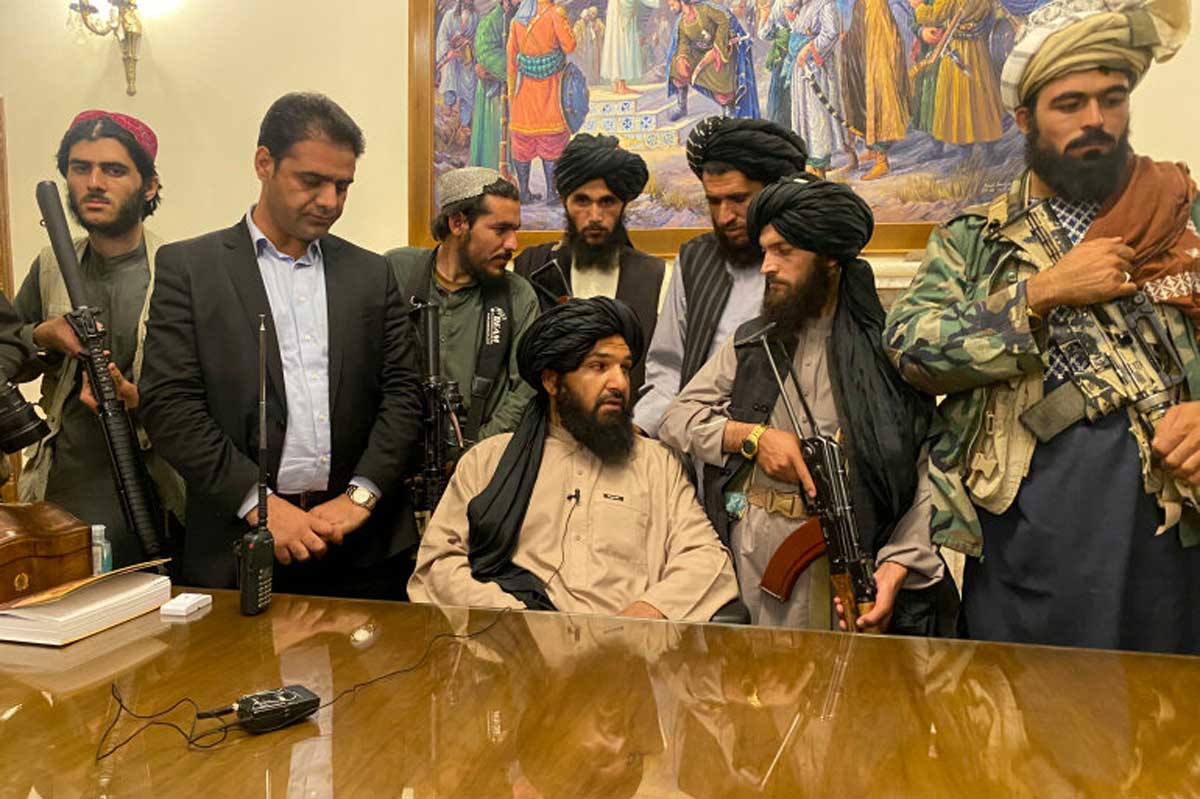
The acceleration of the resurgence of Daesh in Afghanistan is not merely the inability of security on the local levels but in fact it is turning into a transnational one that has far reached implications on the stability of the region and the entire world. Although the militancy in Afghanistan is centuries old, the difference is only in the scale, daring and splendour of the operation of Daesh, the Khorasan group, ISKP/Daesh-K, which is exploiting the lack of governance in the nation. The Afghanistan state is ripped off, and the guard lines are not strongly guarded; now the violent extremist actors are even more free than ever. What is being left is the security environment whereby terrorism is not only limited in Afghanistan alone but rather extended to its borders destabilizing the neighbouring states and inspiring jihadist networks throughout the world.
Pakistan has been among the most vigorous in notifying the world community of these growing threats. In a briefing to the UN Security Council on 26 November 2025, the Pakistani representative pointed out that the weak systems of governance and large regions of ungoverned Afghanistan terrain have provided an opportunity to ISKP to form and develop its presence. What was once a backdoor network operating in the shadows in the eastern regions has now evolved into an out in the open organization capable of operating higher-level attacks, recruitment pipelines, and coordinate the actions of the operations across the borders. The threat in the case of Pakistan is no more abstract and remote but on the ground in bloodshed, direct assassinations, sectarian assaults and destabilization on already precarious border regions to militancy.
The other aspect of the crisis that was overlooked but one of most critical ones was pointed by the Permanent Representative of Pakistan Asim Iftikhar Ahmad, that is the weapons proliferation in Afghanistan after the withdrawal of the international force. These are both modern and lethal and unbridled weapons which are now finding their way into the hands of terror cells operating inside Pakistan. The trafficking of such weapons is not merely a matter of failure on the part of security alone but a gas that adds more intensity to the attacks launched by the terrorists and makes the process of counterterrorism to be more difficult. Should there have been a transformation of the Afghan soil into the sooner or later launching point of the cross-border terrorism, then the weapons pipeline which is coming into being of the country is the blood which is bringing fire.
When it became apparent that this was no laughing matter, Pakistan has requested the regional powers and the international community to implement coordinated actions to curb in-flow of the terrorists and weapons in and out of Afghanistan. Counterterrorism cannot be a one-sided exercise in this aspect. South and Central Asia are geographically positioned such that insecurity in one state is inevitably transpired to another state. The half strategy, or even better, geopolitical timers, will present the precise circumstances of permissiveness that Daesh will gladly exploit. Intelligence, border protection, money laundering, and counter-radicalization collaboration between the regions is not a choice, but a compulsion.
Stay ahead of the geopolitical week.
MD Briefing delivers expert analysis across five global fronts — the Indo-Pacific, energy, geoeconomics, European security, and the Middle East — every Monday morning. Free.
It is not just Pakistan which is raising alarm. As considered by independent assessments conducted by the United Nations and reputable think tanks, the fact that there is no organized Daesh network on the territory of Pakistan as such leaves much to be desired. Instead, most of the attacks that are associated with ISKP involve the intrusion of militants in Afghanistan or are coordinated by the handlers, who are in Afghanistan. This brings out two important facts first, the epicentre of ISKP operation is in Afghanistan and second, the domestic counterterrorism machinery in Pakistan, is still vibrant and active and can intercept infiltration operations despite this having serious resource constraints. The challenge, it is not, therefore, internal proliferation, but external penetration.
The report of the UN enhances the assessment given by Pakistan because it proves that Afghanistan is the hub of recruiting, planning, and providing logistical assistance of ISKP. The domestic disintegration within the nation has served as a haven to the Daesh-K that has enabled it to rebound even in times when it was under the constant pressure of counterterrorism in past years. These revelations have echoed way beyond Pakistan. Russia issued its warning of the increasing strength of the group in Afghanistan on 20 November 2025 and on 19 November, Denmark made the Afghan cell of Daesh a threat to international security of high seriousness. The fact that these evaluations are made by those states whose views on geopolitics appears to be divergent, is evocative of the cross-cutting of concern. The threat is not only in South Asia, but it extends to Central Asia, Middle East, Europe and maybe beyond.
Most of the recent studies about the attacks and radicalization events in Pakistan in relation to the Afghan-based networks of Daesh is another instance of the sinister role of cross-border. The case of an indirectly connected person of Afghan extremist broadcasts, Rahman Ullah, and his half-brother, Muawiyah Khorasani, who had known contacts within Daesh circles in eastern Afghanistan, demonstrates that even local Afghan-based radical ecosystem continues to influence the selected by people routes of violence, even outside of Afghanistan. These days, radicalization does not require physical exercises, encrypted messages and channels, ideological propaganda and virtual infiltrators are as effective and even borderless means of brainwash. Afghanistan has become a digital and physical centre of terror in the region due to the existence of lax environment.
It is not a governance issue in Afghanistan, but an issue of collective security, the consequences of which are experienced globally due to the uncontrolled growth of Daesh in Afghanistan. The passivity or inactivity of the international community will not be safe since the group will be able to centralize its authority in the territorial level, increase its transnational recruitment process, and even project the violence to the wider level. Afghanistan will become like Iraq and Syria were a target of terrorists, a control tower in international jihad, and a catapult of attacks in other continents.
