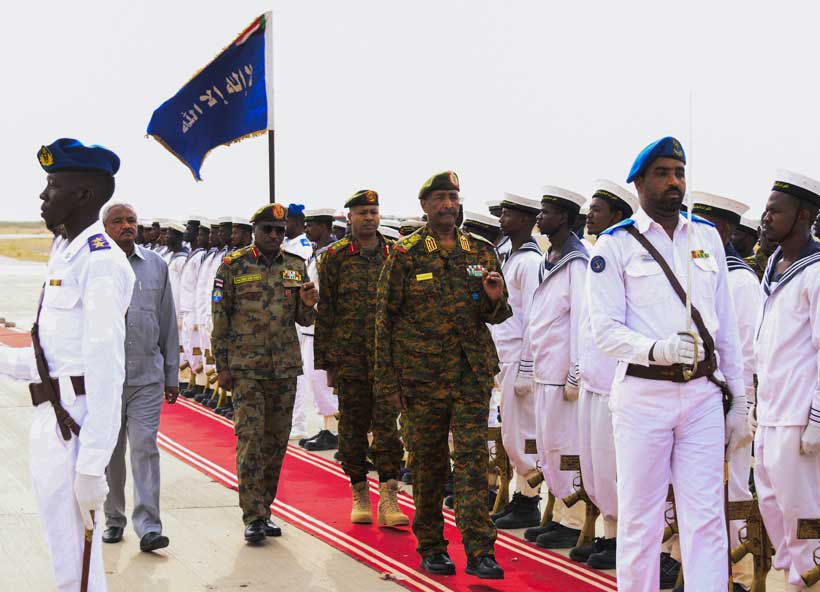
It was an interesting editorial choice by the Wall Street Journal to give General Abdel Fattah al-Burhan, the leader of the Sudanese Armed Forces (SAF), the platform of an op-ed piece on their pages. His article tells less than half of the story and can only be seen as a ploy by the general and his backers to divert attention from the fact that he has yet again flatly refused to engage in the peace efforts of the international community.
Burhan’s piece, in which he postures as the legitimate leader of Sudan when indeed he has no popular mandate and led the overthrow of its civilian government in 2021, has many glaring omissions. When he writes about backers, he fails to mention his own backers, which include the Islamist militias on which he is completely dependent and are considered one of several factors behind his resistance to any peace process. Africa Intelligence calls Burhan’s dependency a “politically toxic” situation, explaining that he relied upon the 20,000 fighters of the Islamist militia the Al-Baraa Ibn Malik Brigade to deliver territories such as Khartoum. The US Treasury has sanctioned the brigade, as well as Finance Minister Gibril Ibrahim, who is also the leader of the JEM militia. Both the brigade and Gibril Ibrahim are accused by the US of being radical Islamists and of obstructing “efforts to reach a ceasefire to end the war and [of] cultivating ties with and receiving technical support from the Iranian government.” Burhan himself, and his army, are subject to US sanctions for, inter alia, their use of chemical weapons.
His own backers, whom he studiously avoids mentioning, include those supplying his weapons. Burhan’s confidence in totally refusing to negotiate comes in no small part from the support that the SAF has received from Iran throughout 2024 and 2025. This reliance is evidenced through weapon shipments, drone operations, intelligence support, and diplomatic coordination, especially following the restoration of formal ties between Khartoum and Tehran in late 2023. Turkey is also a backer of Burhan and the SAF. The SAF’s use of Iranian and Turkish drones was crucial in enabling the SAF’s recapture of Khartoum from RSF forces earlier in 2025.
Perhaps the most astonishingly cynical part of Burhan’s article was his suggestion that he wants a “just and equitable peace in Sudan.” It is impossible to overstate just how many times Burhan has shut down peace efforts with an absolute refusal to engage. Whether looking back to his failure to show up in Switzerland in August 2024 for talks or to his words in August 2025 immediately after meeting with US envoy Massad Boulos, Burhan has certainly been consistent in his total refusal to negotiate. Around his August 2024 no-show, Burhan said that his forces would “fight for one hundred years” against the Rapid Support Forces (RSF), part of the Tasis Alliance. After the summer 2025 Boulos meeting, he immediately ruled out compromise or reconciliation, stating yet again that the conflict would only end in outright military victory for the SAF. He pledged to “fight for dignity, defeat the rebellion,” and shun any peace deal.
Stay ahead of the geopolitical week.
MD Briefing delivers expert analysis across five global fronts — the Indo-Pacific, energy, geoeconomics, European security, and the Middle East — every Monday morning. Free.
Predictably, Burhan’s stance has not changed as of November 2025. Just this week, he rejected a new truce proposal from US envoy Massad Boulos as the “worst yet.” The RSF at the time said it agreed to the truce and committed itself to a unilateral ceasefire. Burhan’s response: “If this is where the mediation is going, then we consider it biased, especially Massad Boulos, who threatens us and speaks like he wants to impose things on us. We fear he could be an obstacle to the peace all of us Sudanese want,” Burhan said. The idea that Boulos, rather than Burhan, is the obstacle to peace is one of the more unfathomable notions about this conflict.
Even more cynical was Burhan’s line in the Wall Street Journal, “Real peace in Sudan will never be achieved by military victory alone.” This was a new low, even for him. He has consistently said that only a military victory for the SAF would be acceptable to him as an outcome of this conflict. Negotiation and compromise have been firmly off the table. He has been very clear that only the total elimination of the RSF would allow an end to the conflict as far as he and his Islamist militias are concerned.
Another driver behind Burhan’s foray into the editorial pages might be the fact that the SAF is, according to France 24, “currently on the back foot, after losing its last major stronghold in the Darfur region last month to the RSF. It currently holds the country’s north, east, and center, including the capital, Khartoum, while the RSF and its Tasis Alliance control the west and parts of southern Kordofan.”
The Wall Street Journal giving column inches to the Sudan conflict is, of course, to be welcomed. The tragedy has gone on for two and a half years, with the death toll, displacement, and famine more than meriting the current international momentum for a peace deal. But Burhan’s response to the peace efforts of the US and the Quad is to both refuse to negotiate and then have an adviser write a fanciful op-ed to divert attention from that refusal, which says it all. Perhaps next time, the Journal’s column inches would be better served by an interview in which the general has to answer some questions.