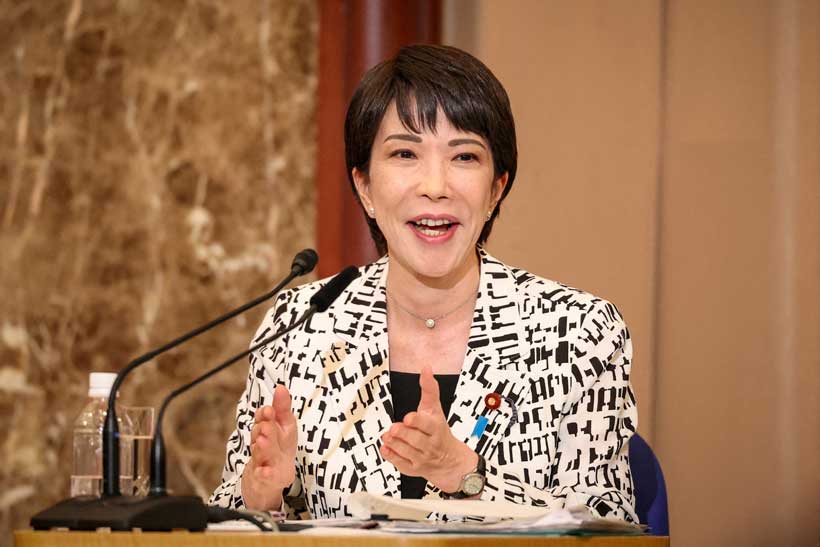
When Sanae Takaichi was elected the first woman president of Japan’s ruling Liberal Democratic Party early this month, she was also expected to be soon chosen as the country’s first female prime minister. Only in neighboring China were doubts expressed over the hardliner conservative leader’s chances to lead Japan. As it were, developments in Japanese politics over the past few days have clearly indicated that China holds the key for Takaichi to create history.
China was the only country to declare Japan “at a crossroads” following the recent election of Sanae Takaichi as president of Japan’s Liberal Democratic Party. Almost all media commentaries in China cast doubts on the new LDP leader’s prospects of becoming Japan’s new prime minister—as the ruling LDP’s past convention has been to choose the elected party president to also lead the government. Some Chinese experts even said if Takaichi does not change her combative stance on China, her government won’t last long even if she is elected prime minister.
Chinese Scholar’s Major Concerns About Takaichi’s Political Outlook
Three main issues attributed to Takaichi’s political outlook and worldview have in particular caused scholars in China to feel concerned. One, her views on Japan’s wartime conduct and post-war responsibility, especially as Takaichi has downplayed Japan’s aggression in the early 20th century—echoing narratives that have long been rejected by people in China, Korea, and the international community. Besides, her repeated visits to the Yasukuni Shrine, including on August 15 this year—the anniversary of Japan’s surrender in World War II—are provocative acts that reopen old wounds in the region. These visits are not private gestures of remembrance; they are political statements that glorify a version of history devoid of remorse or accountability.
Stay ahead of the geopolitical week.
MD Briefing delivers expert analysis across five global fronts — the Indo-Pacific, energy, geoeconomics, European security, and the Middle East — every Monday morning. Free.
Two, Takaichi’s combative tone toward China. While she pledged during her campaign to engage in dialogue with Beijing on the Taiwan question, her actual actions may have crossed the red line for the Chinese government—two examples are being widely discussed in China: a) Takaichi visited Taiwan in April, where she advocated “cooperation with Taiwan to jointly address defense challenges,” and b) in her written response to a Hudson Institute questionnaire, Takaichi reiterated a week after being elected the LDO president her long-standing support for Taiwan, emphasizing that peace and stability in the strait are of utmost importance in Japan.
Three, the third disturbing element for the people and governments in Japan’s neighborhood is her stance on constitutional revision, which signals a decisive break from Japan’s post-war pacifist identity. Takaichi has made no secret of her desire to revise Article 9 of the Japanese Constitution, which renounces war as a means of settling international disputes. She also proposes to rename the Self-Defense Forces as a “National Defense Army.” This would not only alter Japan’s domestic legal framework but also have profound implications for the security architecture of East Asia, further intensifying an already fragile regional balance of power, in the opinion of Chinese security affairs experts.
On the other hand, Chinese experts have also highlighted several of Takaichi’s “regressive visions” on Japan’s domestic issues. Namely her hawkish worldview in economic policy, her opposition to same-sex marriage, and her anti-immigrant views. Takaichi’s push to reduce dependence on China in the semiconductor and rare earth sectors is viewed in China as politically motivated. Despite being a woman in a leadership role, she opposes female imperial succession, same-sex marriage, and even the right of married couples to have separate surnames. On immigration, she views Japan as a monoethnic nation and opposes granting political rights to foreign residents.
China holds the key to who will be Japan’s new prime minister.
Interestingly, merely a week after most political analysts in Japan and globally expected Takaichi to win a majority backing in the Diet—the Japanese parliament—to lead a new LDP government, prospects of both the formation of a new government and Takaichi becoming the new prime minister are in jeopardy. It is the politicians within the LDP and leaders belonging to other political parties—and not the media or analysts in China, who are now “accusing” China of preventing Sanae Takaichi from forming the next LDP government. A lead feature in a major Chinese digital news platform has claimed, “Some far-right Japanese politicians have seized upon the issue of the Komeito Party—LDP’s coalition partner—withdrawing its support to hype anti-China rhetoric.”
The Komeito Party, a coalition partner of the ruling LDP since 1999 and long considered a supporting player in Japanese politics, recently found itself at the center of a political controversy when its leader, Tetsuo Saito, suddenly unilaterally announced it was withdrawing support from the LDP. Because the Komeito Party, since its formation decades ago, has been advocating friendship with China, Haruo Kitamura, a conservative House of Representatives member, claimed Saito’s withdrawal of support from the ruling coalition was “directed by China.” Haruo and other conservative Diet members further stated the Komeito Party’s withdrawal was aimed at “blocking Sanae Takaichi from taking office.”
Furthermore, after Tetsuo Saito categorically denied acting on behalf of China, Kitamura and others cited as evidence that Saito met with the Chinese ambassador to Japan, Wu Jianghao, on October 6 in Tokyo. To which, Saito replied, saying as leader of the Komeito Party, he maintains close relationships with ambassadors from over 30 nations, including China, and regularly exchanges views. “The meeting schedule with the Chinese ambassador was set long in advance,” Saito said, dismissing accusations leveled against him by Kitamura as rumors. A report in Japan’s widely read newspaper Asahi Shimbun, viewed by many as supportive of the Komeito Party’s decision to withdraw support, said the LDP and the Komeito Party have been at odds over issues such as “political corruption” and “black money in politics.”
The Komeito Party, its history, and its stance on China
Since its founding in 1964 by Daisaku Ikeda, a leader of the Soka Gakkai religious movement, the political party Komeito—popularly known as Komei—has consistently prioritized improving Sino-Japanese relations as one of its primary political priorities. It first entered a coalition government with non-LDP political opposition in 1993 and 1994, respectively. The LDP-Komeito Party alliance formed its first government in 1999, which lasted until 2009. In 2012, the two-party coalition returned to power. The coalition government collapsed with the withdrawal of Komeito’s support for the LDP early this month after Sanae Takaichi was elected the LDP leader. The two parties maintained their alliance when they were in opposition between 2009 and 2012.
Described as a self-proclaimed party of “humanitarian socialism,” during its alliance with the hard-line, conservative LDP, Komeito acted as a moderating force over security and military policies. In foreign policy, the party advocates for a more pacifist diplomacy and closer relations with China. The Asahi Shimbun claims the party has long served as a bridge between the Chinese and Japanese governments, and even as Japanese politics has shifted rightward since the Shinzo Abe administration, Komeito delegations have continued to visit China almost annually. The collapse of the 26-year-long LDP-Komeito partnership has put Sanae Takaichi’s chances of being elected prime minister in significant uncertainty.
Before the Komeito Party ended their partnership on October 10, the two-party ruling coalition enjoyed a strength of 220 (LDP 196, Komeito 24) seats in the 465-member House of Representatives—13short of a majority. If Sanae Takaichi wants to win a majority of support in the prime ministerial nomination election, the Liberal Democratic Party must reach a cooperation with other opposition parties. Emerging from the early setback caused by the end of the partnership with Komeito, the LDP and the government are seriously considering convening an extraordinary parliament session as early as October 20 to elect Japan’s next prime minister.
LDP’s dilemma—a fresh party leader election or to continue with the Ishiba government
China Daily, aninfluential state-run Chinese dailyknown for airing views of China’s policymakers, termed the collapse of the Komeito-LDP alliance “a serious blow to the LDP and its new leader in the upcoming election for prime minister. Citing a Japanese political scientist, the daily said the decision was long expected, as Saito had warned that the excessive conservatism by the LDP made cooperation difficult.
Describing the withdrawal of Komeito’s support for the LDP as “a bolt from the blue,” Funada Hajime, a senior LDP member of the House of Representatives and former head of the Economic Planning Agency, proposed two options: One, Ishiba Shigeru, the outgoing prime minister, to withdraw his resignation and temporarily assume government responsibility. The other option was for newly elected president Sanae Takaichi to resign and run for re-election.
Dismissing the accusations leveled against China by far-right elected members of the Diet, including some belonging to the LDP, Professor Da Zhigang, a well-known Japanese affairs expert, said the “anti-China” hype stems from entrenched inter-party conflicts in Japan, and linking it to diplomatic issues is a calculated political manipulation.