Prime Minister Shigeru Ishiba’s resignation in September 2025 brought to an end one of the shortest and most embattled premierships in modern Japanese politics. His Liberal Democratic Party (LDP) had just suffered its worst electoral defeat in decades, losing its majority in both houses of parliament, which forced him to announce that he would step down. The LDP’s collapse was historic. It had dominated Japanese politics almost uninterrupted since 1955, and though challenges to its dominance had appeared before, Ishiba’s defeat marked the sharpest reversal of fortune in a generation. It was not simply the loss of parliamentary numbers but a visible erosion of the party’s aura of inevitability.
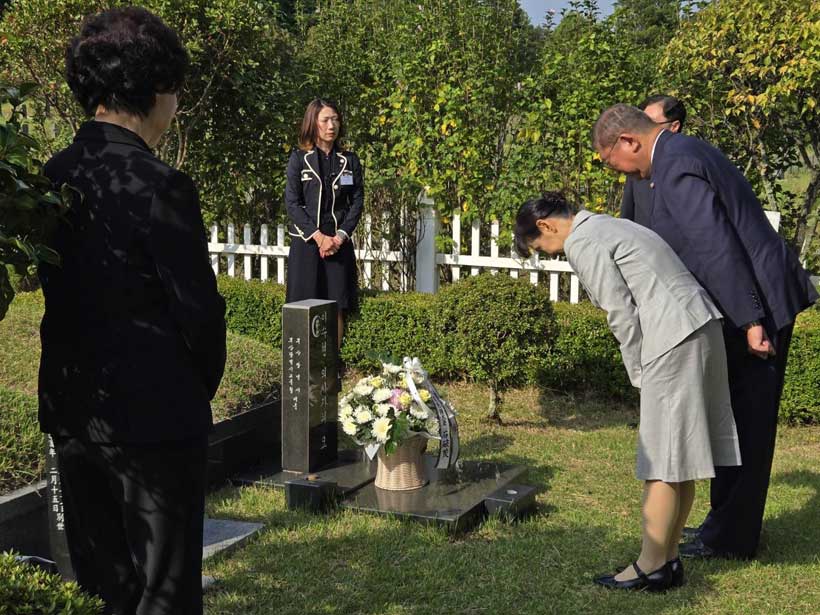
By conventional measures, Ishiba’s legacy should be defined by failure. Yet his final weeks in office were punctuated by acts and headlines that ensured he remained visible long after his political authority had evaporated. He became the first Japanese prime minister to visit the grave of a Korean exchange student who died saving a Japanese man, he delivered an ambitious address at the United Nations General Assembly, and, in a very different register, he won a popular culture award for the politician who “looks best in glasses.”
At first glance, the juxtaposition of these stories might appear odd, if not faintly absurd. But taken together they reveal the changing logic of politics in the twenty-first century. Leaders today are remembered less for laws passed or budgets delivered than for gestures, speeches, and images that circulate long after their terms end. Ishiba’s resignation is therefore not only the story of a defeated leader but also a case study in how political legacies are constructed in an age when symbolism, strategy, and spectacle overlap.
The visit to the grave of Lee Su-hyeon, the Korean student who died in 2001 while trying to save a Japanese man who had fallen onto the Tokyo tracks, carried extraordinary symbolic weight. Lee’s parents had transformed condolence money into a scholarship fund for Japan–Korea exchanges, turning tragedy into a bridge for reconciliation. By bowing at his grave, Ishiba became the first sitting prime minister to recognize that sacrifice, offering a rare gesture of empathy in a bilateral relationship often poisoned by disputes over history and memory. In a region where symbolic acts are deeply political, the gesture mattered. Yet it was also haunted by its timing. Performed after his resignation announcement, it risks being remembered less as the beginning of reconciliation than as an exit performance, a flourish without the policy infrastructure that would give it durability. South Korean commentators rightly asked whether this was an authentic opening or a symbolic act designed to soften Ishiba’s legacy. Symbolism in East Asia carries political weight, but only when accompanied by institutions that can sustain it.
Stay ahead of the geopolitical week.
MD Briefing delivers expert analysis across five global fronts — the Indo-Pacific, energy, geoeconomics, European security, and the Middle East — every Monday morning. Free.
Reactions inside Japan were more complex. While some citizens praised the sincerity of the gesture, others viewed it with skepticism, arguing that it was “too little, too late” from a leader who had failed to deliver domestic stability. Japanese public opinion has long been divided between those who value symbolic diplomacy and those who prioritize practical economic or security policy. Ishiba’s gesture became a mirror for these debates, admired by some for its humanity, dismissed by others as political theater.
The same tension was visible in Ishiba’s address to the United Nations. In New York, he spoke as if Japan were on the cusp of reshaping the global order: he called for the expansion of the Security Council and the freezing of veto rights for new permanent members, condemned Russian aggression in Ukraine, expressed cautious concern about Israel’s operations in Gaza, reaffirmed Japan’s identity as both the victim of nuclear war and an advocate for disarmament, and pledged cooperation with Africa and the wider Indo-Pacific. It was a dignified and sweeping vision, positioning Japan as a responsible middle power bridging North and South. But Ishiba was already an outgoing prime minister. Security Council reform remains an elusive goal blocked for decades, Japan’s nuclear disarmament posture is constrained by dependence on the United States’ nuclear umbrella, and its careful balancing on Gaza risks leaving all sides unsatisfied.
The speech was ambitious, yet it came from a leader whose domestic authority had collapsed. What mattered was not feasibility but performance: an outgoing leader using an international stage to inscribe Japan into the narrative of responsible global actors. Out of power at home, Ishiba projected stature abroad, showing how resignation can become a moment not of disappearance but of legacy-building. Here, too, comparisons with previous leaders are telling. Shinzo Abe, though controversial, left a legacy of strategic clarity around the Indo-Pacific; Fumio Kishida positioned himself as a cautious stabilizer. Ishiba, by contrast, will likely be remembered more for the dignity of his farewell gestures than for his policy imprint.
It was in this context that the “best in glasses” award became strangely revealing. Reported widely in Japanese and international media, the accolade, given annually to public figures with distinctive eyewear, ensured that Ishiba’s final days were remembered as much for style as for diplomacy. Superficial though it may seem, the award demonstrates how a political persona survives the loss of office. Ishiba’s reputation will not rest solely on electoral defeat; it will also carry the lighter image of a statesman remembered for distinctive style. The story also illustrates how politics has been absorbed into spectacle. Media coverage placed the glasses award alongside the grave visit and the UN speech, collapsing distinctions between aesthetics, symbolism, and strategy. In doing so, it signalled that persona is no longer peripheral to politics but central to how leaders are evaluated. And it revealed a paradox of political decline: Ishiba’s parliamentary authority was collapsing, yet his cultural visibility was peaking. At the moment of greatest weakness, his image was amplified.
Ishiba’s resignation highlights a paradox of modern politics: leaders may lose authority at home yet still shape narratives abroad and in popular culture. His final weeks made that clear. The bow at a Korean grave positioned Japan as capable of empathy even within difficult histories. The speech in New York signalled ambition for reform and responsibility on the world stage. The glasses award, however lighthearted, reinforced the resilience of image in an era where politics is inseparable from persona. Taken together, these stories softened the sting of defeat and helped Ishiba frame his exit with dignity.
The question, however, is what comes next. Symbols alone cannot alter Japan–Korea relations without institutional follow-up; speeches at the United Nations will not change global governance unless backed by sustained diplomacy; and public image, though memorable, cannot replace policy. Much will depend on Ishiba’s successors. If they build on these symbolic acts by strengthening educational exchanges with Korea, pursuing practical steps toward Security Council reform, or deepening human security partnerships in Africa and the Indo-Pacific, then Ishiba’s gestures may acquire substance in retrospect. If not, his legacy risks being remembered as a collection of unconnected performances.
This uncertainty also reveals the dilemmas of Japan’s diplomacy. The country aspires to be a responsible advocate for peace, disarmament, and reform, yet it remains reliant on its alliance with the United States and constrained by its pacifist constitution. Ishiba’s exit reflected these contradictions. The grave visit was humane, but without policy backing, it risks fading. The UN speech was ambitious, but its proposals face resistance from entrenched powers. The glasses award showed how persona matters but also how quickly style can overshadow substance.
For observers of Japan, these episodes are not trivial curiosities. They remind us that leadership is no longer judged only by what is achieved during office but also by the narratives leaders leave behind. Ishiba’s farewell acts carry lessons beyond his tenure. They suggest that in Japan, as elsewhere, the battle for political memory is fought not only through policies and institutions but also through the spectacles that frame them. Whether his symbols evolve into substance will determine if his spectacles are remembered as the opening image of a renewed Japan or as the final prop of a prime minister who left office before he could act.