


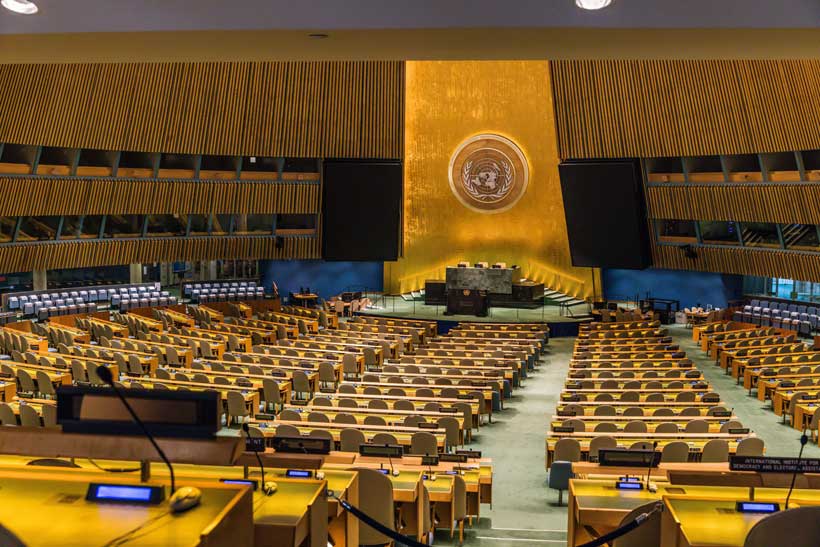
For the first time since 1945, the liberal international order is being replaced by a fractured world between the West and the Global South. The ongoing wars in Eastern Europe and the Middle East have exacerbated the remaking of the international order because they are sometimes interpreted as fault lines separating civilizations. This is the thesis of the “Clash of Civilizations,” which views the world dynamics in terms of civilizations and shapes the political representation of many illiberal parties.
The “Clash of Civilizations” thesis emerged in a geopolitical context characterized by the Gulf War (length of coalition: 1990-1993), which escalated a local conflict into a conflict with worldwide repercussions, shifting the battleground to cultural dimensions. In the summer of 1993, the “Clash of Civilizations” was published as a 27-page article [1], structured as a compilation of distinct assertions set within a meticulously analyzed historical context. For example, the article discusses i) how the Islamists viewed the war as a clash of civilizations despite the heterogeneous nature of the international coalition and ii) claims that they were the main beneficiaries of the democratic opening. While they did aim to capitalize on the conflict by transforming the aggressor country into the aggressed country, it is not accurate to claim that democratization is a failure. For instance, the closest example to this war context was the 12-26-1991 free parliamentary elections in Algeria [2]:In the first round, the Islamists received only 24% of the vote and even less for the nationalists with 12%. In fact, the uninominal electoral system played a crucial role in their success, which stands in contrast to the proportional electoral system, which is more effective in reducing political risks.
Aside from observations, the validity of a theory lies in its ability to explain and predict. The article struggles to define civilization as a supranational cultural entity, depicting Russia as opposed to the West despite the potential for inclusion in the same civilization; this undermines the article’s explanatory capabilities. Furthermore, the article suggests that the likelihood of conflict between Russia and Ukraine is minimal due to their shared cultural space, casting doubt on its predictive power. In reality, the article suggests a resurgence of culture-based tribalism in international politics following the post-Gulf War era, which is why it was featured in a foreign policy journal. To that end, the successive interventions for regime changes carried out in the name of liberal values have severely undermined the liberal order. This is because the argument of democracy spread has been overshadowed by the negative spillovers expressed in terms of public security. Ultimately, the rejection of the liberal order is accompanied by a tendency toward autocratization in the Global South and a democratic regression in the West.
However, if liberal alliances have weakened, liberal ideas still have a future because their intellectual foundations remain strong. Besides, just a few years before the “Clash of Civilizations” thesis, the “End of History” had been proclaimed in an article [3] that appeared in the summer of 1989 to celebrate the triumph of liberalism. A number of countries, their leaders sometimes demoralized, witnessed the rise of popular protests in support of human rights or simply a social demand for extensive reforms, resulting in a remarkable shift towards liberalism. Examples include the political transition in the USSR and the economic transition in China. Most of the world’s elites viewed liberal democracy as the best institutional arrangement and the market economy and free trade as the best form of economic organization. This wave of optimism, contrasting with the prevailing sense of decline during the 70s, came after a decade of neoliberal governance that ended in January 1989, which relied on the economy to demonstrate its competence through strong economic expansion, but also through the promotion of freedom in foreign policy, the balance of power and the prevention of a global war in defense policy, and an optimistic narrative style to promote liberalism.
Stay ahead of the geopolitical week.
MD Briefing delivers expert analysis across five global fronts — the Indo-Pacific, energy, geoeconomics, European security, and the Middle East — every Monday morning. Free.
References:
[1] Huntington, Samuel P. 1993. The Clash of Civilizations? Foreign Affairs, Vol. 72, No. 3 (Summer), pp. 22-49.
[2] Journal Officiel. 1992. Proclamation du 30 décembre 1991 portant résultats officiels des élections législatives du 26 décembre 1991 (1er tour), Vol 31, No. 1, p2.
[3] Fukuyama, Francis. 1989. The End of History? The National Interest, No. 16 (Summer), pp 3-18.
