


Authors: Rahul Karan Reddy and Tridivesh Singh Maini
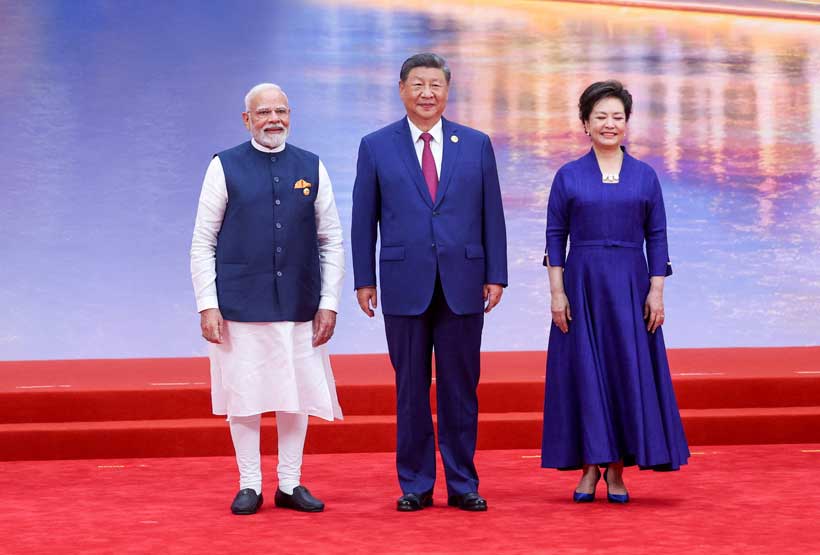
The widely hailed diplomatic re-engagement between India and China has resulted in agreements on key aspects of the bilateral relationship: disengagement at the border and discussions on the possibility of reviving economic linkages and Foreign Direct Investment (FDI). These developments are noteworthy and suggestive of a thaw in strained relations since the Galwan clashes in 2020. The recently concluded Shanghai Cooperation Organisation (SCO) Summit in Tianjin also added further impetus to the new direction of travel.
Since the meeting between PM Narendra Modi and Chinese President Xi Jinping at Kazan on the sidelines of BRICS in October 2024, both sides have worked to restore diplomatic relations by leveraging cooperation in the domain of people-to-people ties, hydrological data sharing, and cross-border connectivity. Pursuing improvements on such issues that have limited scope for disagreement has lent momentum to ties and signals further improvements in relations. Beyond what has been agreed upon so far, there are several para-diplomacy and sub-state opportunities for both sides to explore on the road ahead, while remaining cautious of the challenges emanating from the strategic realities of India-China relations.
People-to-People Ties
Stay ahead of the geopolitical week.
MD Briefing delivers expert analysis across five global fronts — the Indo-Pacific, energy, geoeconomics, European security, and the Middle East — every Monday morning. Free.
Relations have normalized on the back of people-to-people ties, revived when India resumed issuing tourist visas for Chinese nationals for the first time in five years. For its part, Beijing lifted visa restrictions on Indian nationals in March, after both sides announced that they would resume direct air travel between India and China. Together, these moves enable greater people-to-people interactions in the domain of tourism and academic and cultural exchanges. The significance of these efforts is noted by Indian and Chinese academics alike, who argue that exchanges don’t just facilitate cross-cultural engagement but also enable economic and business relations. Top executives from Chinese companies like Vivo, Oppo, Xiaomi, BYD, and others will now benefit from relaxed visa rules for business roles in India.
Removal of restrictions on people-to-people exchange also involves technical exchanges. The Indian government launched a dedicated portal to expedite visas for highly skilled Chinese technicians required in 14 sectors targeted by the Production Linked Incentive (PLI) scheme. Moreover, such human resource-centric economic engagements are likely to be accelerated by the proposal to allow 20 to 25% Chinese investment in sectors like renewable energy and automobile components. Much like people-to-people interactions supporting the potential deepening of the India-China economic linkages, there are other para-diplomacy efforts worth revisiting.
Sister City and State Agreements
An important dimension of the relationship, with the potential to reinforce the broader bilateral with stability and confidence, is sub-national ties between India’s states and Chinese provinces. The past two decades have witnessed several visits by Indian Chief Ministers to China, with PM Modi having visited China as Chief Minister of Gujarat in 2006. One of the important steps taken to promote linkages between states and provinces was the State-Provincial Leaders Forum during PM Modi’s China visit in May 2015. Before bilateral tensions between both countries, the chief ministers of several states visited China, and governor-level delegations from China visited India.Interactions at the sub-national level in the form of sister-state engagements could offer new openings for India-China diplomatic reengagement.
For instance, PM Modi’s home state, Gujarat, and China’s Guangdong established a sister state agreement in 2014, which led to the China-India-Gujarat Economic and Trade Cooperation Conference in 2019. The Chinese delegation attending the event was led by Li Xi, the then-governor of Guangdong and now a Politburo Standing Committee Member. Reviving sister-state agreements has the advantage of resurrecting high-level political linkages that can add momentum and backchannels to India-China relations at various levels. Similarly, dormant for several years now, sister city agreements between Indian and Chinese cities could also unlock a promising avenue of cooperation.
The decision to establish sister cities was made in 2013, during the visit of the late Dr. Manmohan Singh, then-PM, to China, resulting in agreements between Delhi-Beijing, Bengaluru-Chengdu, and Kolkata-Kunming. During Xi Jinping’s China visit in 2014, a sister city relationship was established between Ahmedabad and Guangzhou, and in 2015, sister city linkages were established between Chennai and Chongqing, Hyderabad and Qingdao, and Aurangabad and Dunhuang, and sister province linkages were established between Karnataka and Sichuan. Other sister city agreements have been established between Agra and Chengdu (2016) and Nagpur (Maharashtra) and Jinan (capital of Handong province) in 2017.
A total of 14 sister city and province agreements exist between India and China, and if resurrected gradually and cautiously, can enable cooperation on commercial and governance issues. Moreover, they open the door for states in India to engage more comprehensively with Chinese provinces and municipal governments to explore investment and trade opportunities.
Civilizational and Historical Linkages
Another vector of re-engagement for India and China is civilizational and historical linkages, especially pertaining to Buddhism and cultural expression between both countries. Attempts have been made in this directionin the form of resuming the Kailash-Mansarovar Yatra and easing visa restrictions for cultural intermediaries, which opens up opportunities for Indian and Chinese professionals, like artists and academics, to contribute to a civilizational dialogue between two of Asia’s great powers. For instance, the Chaiti music festival in China has attracted large Chinese audiences, creating a platform for artistic exchange in recent years.
Similarly, Dr. Kotnis, who has long been one of the most enduring symbols of India-China linkages, has inspired Chinese doctors to travel to rural areas, providing free medical services to farmers and rural populations. His legacy is also a major touchpoint in diplomatic contacts; every high-level Chinese leader who visits India has referred to Dr. Kotnis and his contribution. Leveraging such historical exchanges could lend momentum to India-China relations if pursued with caution and consideration of broader strategic realities.
Challenges
The recent diplomatic reengagement between India and China is hardly a reset. There are several pressing strategic, security, and economic challenges that complicate the diplomatic thaw and broader bilateral relations. Tensions at the border could flare with any misstep from either side, and disengagement would be replaced with escalation. Similarly, on the trade front, India’s import dependence on Chinese goods is an economic vulnerability that Beijing could exploit in the event of any new confrontation. The same applies to hydrological data sharing, which became a casualty of the Doklam standoff. At the same time, reintroducing Chinese FDI and economic linkages carries national security risks with it that will have to be carefully scrutinized.
Beyond existing challenges, there are emerging ones that threaten to complicate relations further. The Dalai Lama’s succession issue is already shaping into a thorny one, and China’s Medong County dam is a troubling development with significant downstream implications for Indian states in the Northeast. Even para-diplomacy efforts are embedded with concerns about China’s influence operations and data security.
It is therefore crucial to view progress on non-confrontational issues like people-to-people ties and para-diplomacy efforts as a small, but meaningful, step in the direction of restoring trust and balance. However, further improvements must be pursued, keeping in mind the core interests and concerns of both sides. With the door for para-diplomacy held ajar by the progress made so far between India and China, caution and realism must guide the next phase of efforts to add momentum to warming ties.
