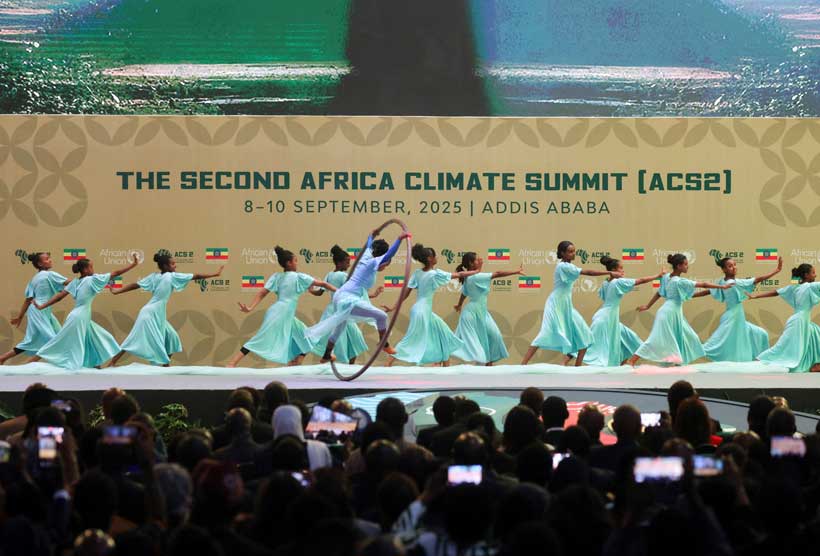
African leaders are advocating for the continent to serve as a global example for addressing the climate crisis through green investments, particularly in the wake of the United States’ withdrawal from the Paris climate agreement.
During their second climate summit in Ethiopia, aimed at establishing a common stance before the upcoming COP30 talks in Brazil, leaders emphasized their objective to design a new global climate economy rather than merely negotiate their survival. They highlighted Africa’s potential for investment in areas such as carbon capture, renewable energy, critical minerals for green technologies, and sustainable food production as crucial for maintaining development amidst the climate crisis. Ethiopian Prime Minister Abiy Ahmed called for an African climate innovation initiative, funded by the continent and involving universities, research institutions, startups, and communities, to deliver 1,000 climate solutions by 2030, envisioning Africa as the first continent to industrialize without ecological damage.
Despite past calls for increased climate financing at the Nairobi summit, the continent continues to receive only 1% of annual global climate financing, exacerbating fiscal constraints and debt burdens. African nations, highly vulnerable to man-made global warming despite minimal contribution, are demanding climate finance that is “fair, significant and predictable” and advocating for “climate justice” to redress vulnerabilities and structural inequalities. Concerns were also voiced regarding the weakening of multilateral cooperation on climate change, with Kenyan President William Ruto noting that commitments are broken and international solidarity is dismissed precisely when enhanced cooperation is most critical.
With information from Reuters
Stay ahead of the geopolitical week.
MD Briefing delivers expert analysis across five global fronts — the Indo-Pacific, energy, geoeconomics, European security, and the Middle East — every Monday morning. Free.