


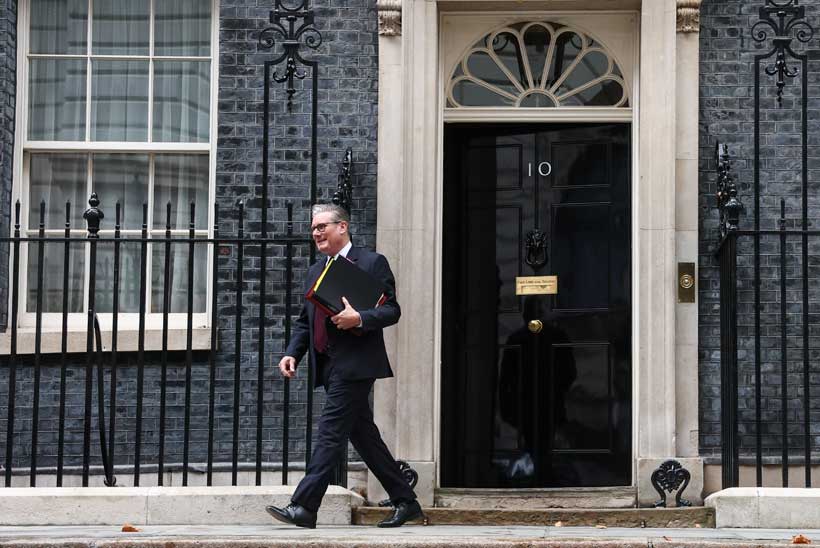
Soaring debt and borrowing costs are approaching levels that once forced London to seek a humiliating IMF rescue. The UK economy has taken a perilous turn, with the pound plummeting and borrowing costs soaring.
The Labour government of Keir Starmer is experiencing similar peril—an August survey found that just 13 percent of the public said they approved of the government’s record since returning to power last summer—roughly 68% disapproved.
The British electorate has had 3 prime ministers in the past 5 years; each minister serves for as long as the House of Commons—and the people—has confidence in them. Will there be a fourth?
Britain faces a real threat—the prospect of repeating its crippling 1976 economic crash as escalating debt and borrowing costs raise doubts over the prime minister’s budget policies.
Stay ahead of the geopolitical week.
MD Briefing delivers expert analysis across five global fronts — the Indo-Pacific, energy, geoeconomics, European security, and the Middle East — every Monday morning. Free.
The crisis of nearly fifty years ago witnessed a Labour government forced to seek an emergency loan from the International Monetary Fund (IMF) after deficits and inflation spiraled out of control. It became one of Britain’s worst postwar crises, with the bailout bringing deep spending cuts and Labour losing credibility and then power shortly thereafter.
Today, Britain’s Chancellor of the Exchequer, Rachel Reeves, faces similar warnings, with forecasts showing a £50 billion ($68 billion) gap in the public finances and debt interest set to exceed £111 billion. Debt currently exceeds 96% of GDP. At roughly £2.7 trillion, it is one of the heaviest burdens in the developed world. Economic consulting group Global Firepower tracks ‘external debt’ of each country in its annual defense review. This metric—as a measure of the economic stability of a country—is defined as both public and private debt owed to outside parties—namely the international community. Britain ranks as the second largest carrier of external debt ($9.6 trillion)—behind the US at $22.3 trillion, but $2.5 trillion more than France (with a comparable population) and $3 trillion more than Germany with 20 million more in population.
Jagjit Chadha, former head of the National Institute for Economic and Social Research, told the Telegraph the outlook was “as perilous as the period leading up to the IMF loan of 1976,” warning Britain could struggle to meet pensions and welfare payments.
Andrew Sentance, once a Bank of England policymaker, said Reeves was “on course to deliver a [former UK Chancellor Denis] Healey 1976-style crisis in late 2025 or 26,” accusing the Starmer government of fueling inflation with higher taxes, borrowing, and spending.
The warnings come as Reeves is expected to announce further tax increases to cover the deficit—a move critics argue would deepen the downturn—including declining support for the government’s policies.
At the same time, London has pledged to raise military spending to 2.5% of GDP by 2027, aligning with NATO commitments. Britain remains one of Ukraine’s most ardent supporters, delivering billions in military and financial aid—further squeezing already stretched public finances.
And complicating matters even more, some 69% of the British public say they are dissatisfied with the way the current government is dealing with immigration. The estimated cost of illegal immigration to the UK is significant, with the Home Office facing around £6.4 billion ($8.6 billion) in pressures related to asylum and illegal migration for the fiscal year 2024-25. Additionally, it could cost approximately £169,000 ($227,408) to relocate an individual migrant to a safe country, which is more than the estimated £106,000 ($142,634) spent on housing support if they remained in the UK.
The number of migrants currently living in roughly 200 taxpayer-funded hotels as of June this year is 32,059. This is an 8% increase compared with the previous year.
The UK’s foreign-born population increased rapidly between 2004 and 2021. According to data from the latest Census, it stood at 10.7 million—roughly 16% of the British population.
Britain unveils legislation to halt investment capital going to the US.
Labour wants to redirect pension investment into the British economy amid geopolitical uncertainty and the flow of investment capital across the Atlantic.
The UK has unveiled a controversial plan to have pension funds invest more heavily in domestic assets in the face of fiscal strain and escalating geopolitical pressure.
Since 2012, British pension fund allocations to London-listed shares have fallen to 4.4% compared with over 50% of their assets 25 years ago, according to a study by think tank New Financial.
“As UK pensions have switched out of UK equities, they have helped feed a doom loop of lower demand, lower valuations, and a less dynamic market,” said the report.
The initiative comes as Sir Keir’s government faces deepening political and economic challenges, including an uncertain relationship with Donald Trump.
British pension funds have historically invested heavily in the US, particularly in large-cap technology stocks such as Apple, Amazon, and Microsoft. But recent shifts, including new US tariffs under Trump and diverging approaches to Ukraine, have prompted the British government to reassess their exposure to American markets.
Crumbling under scrutiny
Government borrowing soared this year to a 27-year high, with 10-year government yields up 14 basis points in one day to 4.82%, the highest since August 2008.
Nigel Green, chief executive of the De Vere group, a firm of international financial advisers, said Britain’s finances appear to be “crumbling under scrutiny.”
In 1976, Britain borrowed £3.1 billion from the International Monetary Fund (IMF) after the price of sterling fell, leaving the then Labour government of Jim Callaghan facing an economic crisis.
Inflation surged to 25% in 1975, and the UK had a growing balance-of-payments deficit—demanding huge interest payments on loans, which also created a public-spending deficit and rising unemployment.
The IMF bailout came with a quid-pro-quo set of conditions, including more cuts to public spending.
The harsh austerity measures left deep financial and psychological scars on the economy and people of Britain. Will ‘stagflation’ once again plague the British economy and the electorate—under another Labour government?
