


NEWS BRIEF
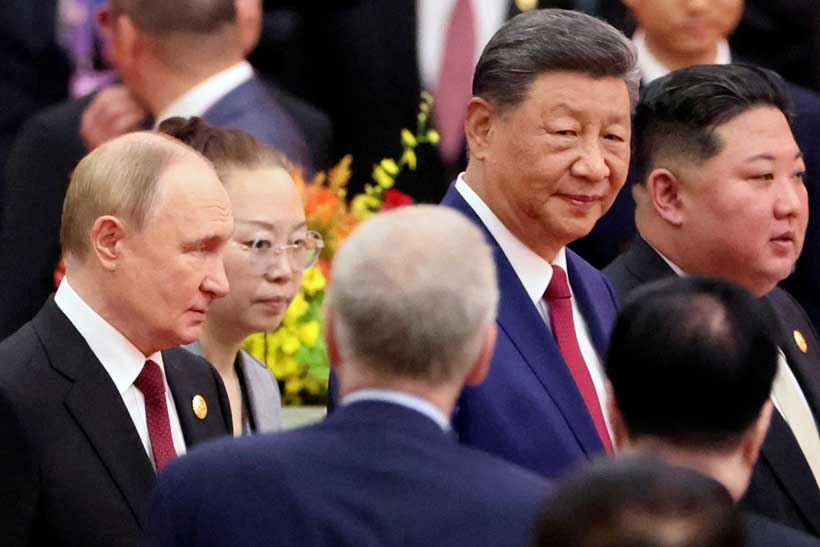
Chinese President Xi Jinping staged Beijing’s largest-ever military parade to mark 80 years since Japan’s defeat in World War Two, declaring the world faces a choice between peace or war. Flanked by Russia’s Vladimir Putin and North Korea’s Kim Jong Un, both ostracized by the West — Xi projected China’s growing military might and diplomatic clout. The Tiananmen Square spectacle, shunned by most Western leaders, showcased cutting-edge missiles, drones, and tanks, as well as Xi’s push for a new global order that challenges U.S. dominance.
The gathering also gave Putin a platform to deepen energy deals with China, while Kim gained rare international legitimacy, becoming the first North Korean leader to attend a Chinese parade in over six decades.
WHAT HAPPENED
- Massive military showcase: Xi inspected troops and unveiled China’s most advanced weaponry including long-range missiles, stealth drones, and armored vehicles as helicopters and fighter jets flew overhead.
- Symbolic messaging: The 70-minute event ended with the release of 80,000 doves and balloons, framing military might as a “peacekeeping” force under Xi’s leadership.
- High-profile guests: Putin used the occasion to cement deeper energy ties with Beijing. Kim made his first major multilateral debut, accompanied by his daughter, signaling dynastic continuity at home while gaining rare international exposure.
- Trump’s intervention: As the parade began, Trump posted on Truth Social, sarcastically sending his “warmest regards” to Putin and Kim “as you conspire against the United States of America.” He later played down the display, saying it was not a challenge to Washington and touting his “very good relationship” with Xi.
- Selective attendance: Over 20 foreign leaders joined, including Indonesian President Prabowo Subianto, while Western leaders largely stayed away — highlighting the East-West split.
- Propaganda and control: Beijing shut major roads, deployed thousands of volunteers to monitor unrest, and staged rehearsals for weeks to ensure the parade projected unity and order.
WHY IT MATTERS
Stay ahead of the geopolitical week.
MD Briefing delivers expert analysis across five global fronts — the Indo-Pacific, energy, geoeconomics, European security, and the Middle East — every Monday morning. Free.
- Marks a geopolitical alignment of China, Russia, and North Korea at a moment of rising U.S.-China tensions.
- Xi used the parade to recast China as the driver of a new security order, shifting attention from U.S. unilateralism to China’s military modernization.
- Putin and Kim’s presence highlighted the formation of an alternative bloc that openly challenges Western norms and sanctions regimes.
- The West’s absence exposed sharpening divides in global governance, with Beijing rallying Global South support as Washington struggles to maintain consensus.
IMPLICATIONS
- Military coordination in the Indo-Pacific: Beijing, Moscow, and Pyongyang could move toward joint drills or intelligence-sharing, complicating U.S. and allied defenses.
- Nuclear deterrence shift: Kim’s presence signals Chinese and Russian acceptance of North Korea’s nuclear status, weakening non-proliferation and emboldening Pyongyang.
- Energy and economic lifelines for Moscow: Putin’s energy deals with Beijing secure Russia’s sanctions-hit economy, sustaining its Ukraine war and blunting Western pressure.
- Erosion of Western diplomatic isolation: By honoring Putin and Kim, Xi rehabilitates their standing, showing sanctions and ostracism have limits beyond NATO.
- Cold War fault lines hardening: Western absence versus Global South presence underscores a divide, with Beijing casting itself as leader of a counter-Western bloc.
This briefing is based on information from Reuters.
