


Wars are often remembered not for who won on the battlefield but for who ultimately emerge victorious in its aftermath. Success in war is measured not by short-term military gains but by long-term achievements—military, economic, political, and diplomatic. Sometimes a defeat paves the way for peace, while a victory sets the stage for failure. Occasionally, what is gained in exchange for a military loss is more critical than what was lost, and sometimes what is gained is not worth the price paid.
Now, following the announcement of a ceasefire between Israel and Hamas, we must ask: who won this 467-day war? The immediate answer may seem simple. Israel is the military victor, a result that was predictable given the stark disparity in weaponry and the full support of the United States. However, this is not the complete answer. The true victor of a war is the side that achieves strategic success. From this perspective, the question becomes far more complex. Determining whether Israel or Hamas emerged strategically successful has less to do with military outcomes and more with broader implications.
Consider historical examples. In World War I, the Allies won militarily but their humiliating treatment of Germany in the Treaty of Versailles (1919) paved the way for the rise of Nazism and World War II. The Soviet Union achieved military control over much of Afghanistan but incurred immense human and economic costs, alongside internal resistance and Western support for the Mujahideen, contributing to its eventual collapse. Decades later, the United States swiftly achieved military victory in Afghanistan but laid the groundwork for the Taliban’s more formidable return after 20 years. Similarly, the U.S. and its allies ousted Saddam Hussein’s regime in 2003 but faced consequences like political instability, the rise of ISIS, and Iran’s growing influence in Iraq. These examples illustrate that battlefield victories do not guarantee strategic success.
In the recent Gaza conflict, Israel achieved significant military gains but failed to secure absolute victory or eliminate Hamas entirely. In exchange for this military success, Israel faced mounting international pressure. Its attacks on civilian areas and restrictions on humanitarian aid drew widespread criticism from human rights organizations and global public opinion. The International Criminal Court even accused Israel of human rights violations and genocide in Gaza, issuing arrest warrants for Netanyahu and Gallant. These pressures contributed to Israel’s acceptance of the ceasefire, but by then, the damage was already done. Israel had destroyed much of Gaza’s infrastructure, including Hamas’ facilities, and killed thousands of civilians, including women and children. Yet, in doing so, Israel eroded its legitimacy in the eyes of global public opinion, even among its allies.
Stay ahead of the geopolitical week.
MD Briefing delivers expert analysis across five global fronts — the Indo-Pacific, energy, geoeconomics, European security, and the Middle East — every Monday morning. Free.
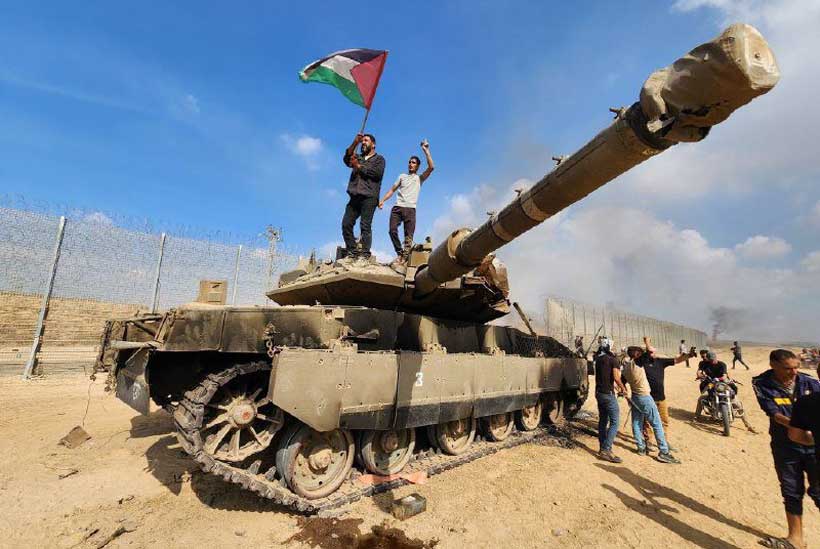
On the other hand, Hamas, despite losing many of its leaders and commanders, succeeded in bringing the Palestinian cause back to the forefront of global consciousness. By emphasizing resistance to Israeli occupation, Hamas garnered widespread support from Muslim and Arab communities, becoming a symbol of the fight for Palestinian freedom. The recent ceasefire also conferred implicit legitimacy on Hamas, as it was brokered through regional mediators without disarming or significantly weakening the group. This solidified Hamas’ status as a key player in Palestinian resistance and regional politics, undermining Israel’s goal of eliminating or isolating the group.
So, who emerged as the strategic winner in this conflict? Between Israel and Hamas, it was Hamas that achieved strategic success—not through battlefield victories, but by skillfully managing its political capital. Building legitimacy is a long-term process that can take decades, yet losing it can happen in an instant. For Israel and Hamas, this journey spanned exactly 467 days. During this period, Israel focused solely on military victory, while Hamas strategically accumulated political capital for the post-war period. Ultimately, the war that Israel thought would end with military dominance turned into a political and legitimacy victory for Hamas.
This confrontation brought unprecedented human costs and marked a turning point in regional power dynamics. Israel, through its military actions, created a landscape of destruction and human tragedy, shaking global opinion about its legitimacy and driving Muslim nations and even some Western communities to support Palestinians. Meanwhile, Hamas, instead of focusing solely on territorial gains, used storytelling and public solidarity to portray itself as a legitimate resistance movement. This strategy elevated Hamas to iconic status, not just among Palestinians but across the Muslim world.
Today, Gaza continues to bear the scars of war, but Hamas has emerged from the crisis with unprecedented political capital for its future. This conflict demonstrated that in politics, military victory is only part of the equation; legitimacy is the trump card that determines the outcome.
