

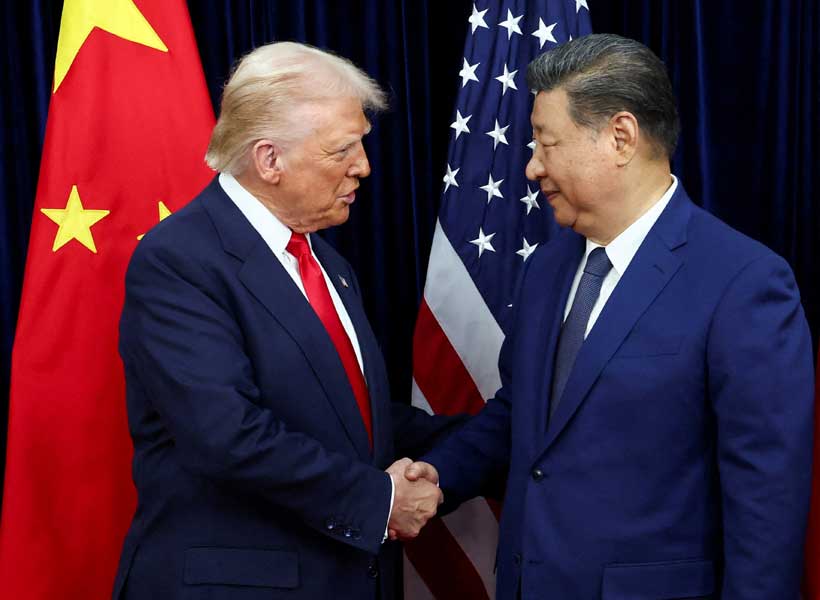
The upcoming meeting between Donald Trump and Xi Jinping in Beijing is not a bilateral summit between two competing powers. It is a test of whether the United States can still manage major international crises on its own terms. The agenda is expected to include Iran, Taiwan, trade, artificial intelligence, nuclear issues and rare earths, but the deeper issue is America’s waning ability to translate coercive power into political control. Washington is a military giant, but the war in Iran and the troubles in Taiwan show that American power creates as many problems as it seeks to solve.
And the war on Iran has made this contradiction crystal clear. Trump’s dismissal of Iran’s response to a US peace proposal as “totally unacceptable” came in the context of a 10-week conflict, a fragile ceasefire since early April, sporadic clashes around the Strait of Hormuz and continuing disruption to global energy flows. Oil prices jumped on the rejection, reflecting fears the conflict could drag on, the Reuters news agency reported, with shipping through Hormuz still largely paralysed. This is not just a regional crisis; it is a global stress test of American strategy.
The Strait of Hormuz is the critical choke point, turning military escalation into an economic shock. The International Energy Agency estimates that about 20 million barrels per day, or a quarter of the world’s seaborne oil trade, passes through the strait, most of it headed for Asia. It also says Qatar and the United Arab Emirates rely heavily on Hormuz for exports of liquefied natural gas. When this waterway becomes a battlefield or a bargaining chip the costs aren’t limited to Tehran or Washington; they flow through energy markets, shipping routes and Asian industrial economies.
The more serious problem is that the United States has relied for years on pressure as a substitute for diplomacy. Sanctions, naval coercion, military signalling and isolation were proposed as ways to force Iranian concessions. But the current war shows the limits of that strategy. Iran’s counter proposal reportedly called for lifting the naval blockade, sanctions relief, guarantees against further attacks, the release of frozen assets, and safe passage through Hormuz. Whether Washington accepts those demands is uncertain, but their content reflects a crisis born of years of economic war and security confrontation.
We see the same pattern repeated with recent US sanctions. On May 8, 2026, the US Treasury Department’s Office of Foreign Assets Control sanctioned individuals and companies it said were helping Iran obtain weapons, drone components and ballistic missile-related material. It said its “maximum pressure” campaign was aimed at breaking Iran’s revenue, procurement networks and defence industrial base. These measures might be costly but they do not necessarily mean a settlement. More often they push their enemies into other networks, into illegal channels and under non-Western patrons.
This is where China becomes inevitable. China is the most important external economic actor in Tehran’s oil trade, buying more than 80 per cent of Iran’s shipped oil, Reuters reported citing Kpler data for 2025. Trump is therefore expected to ask Xi to use Chinese leverage on Iran. The irony is not lost on Washington: it helped push Iran into a sanctions economy, only to find itself needing China’s leverage to manage the outcome. It is not a sign of American irrelevance, but it is a sign of the limits of unilateral crisis management.
This is where China gets inevitable. According to Reuters, citing Kpler data for 2025, China buys more than 80 per cent of Iran’s shipped oil, making Beijing the most important external economic actor in Tehran’s oil trade. Trump is therefore expected to urge Xi to use Chinese leverage on Iran. The irony is palpable: Washington helped push Iran into a sanctions economy, then found itself needing China’s leverage to manage the outcome. This is not a sign of American irrelevance, but it is a sign of the limits of unilateral crisis management.
The US still formally articulates its Taiwan policy via the Taiwan Relations Act, three Joint Communiqués and Six Assurances. The American Institute in Taiwan says US policy has been a “one China” policy for years, guided by those instruments. Reuters reports that Washington is legally required to assist Taiwan with the means to defend itself. But political uncertainty cannot be eliminated by legal frameworks when a president’s diplomacy is highly transactional. Taiwan’s concern is not just Chinese coercion, but also the prospect that American reassurance may be conditional, negotiable or unstable.
Iran and Taiwan are very different cases, but together they reveal a common weakness in American statecraft. Washington’s coercive posture in the Middle East has helped create a war whose fallout now demands Chinese engagement. Washington’s strategic ambiguity and transactional diplomacy mean Taiwan has no idea how long American support will last in East Asia. In both theatres smaller and medium-sized actors are sucked into the bargaining logic of larger powers. Their security is no longer a question of law or of alliance, but of the shifting calculations of Washington and Beijing.
The alternative is not American retreat or Chinese domination. A more disciplined, less militarised foreign policy. In Iran, the priority should be to stabilise the ceasefire, to restore safe navigation through Hormuz, to stop retaliatory attacks and to move towards a genuinely multilateral framework involving regional states, Europe, China, Russia, the United Nations and technical institutions. A sustainable settlement must address nuclear risks, sanctions relief, maritime security and regional anxieties in tandem. Humiliating one of the region’s major powers cannot build security in the Gulf.
Washington should not abandon Taiwan nor should it recklessly provoke it. To have peace across the Taiwan Strait, we need credible deterrence and consistent messaging to Beijing and clear reassurance to Taipei that its security will not be traded for concessions on Iran, rare earths, technology or trade. The United States must not promote symbolic escalation or abandon Taiwan to a private bargain for its future. Stability depends on restraint, credibility, and the refusal to treat smaller partners as disposable instruments in great power politics.
Thus the Trump-Xi summit is a test of American statecraft as much as it is of Chinese ambition. The lessons of Iran and Taiwan are that coercion can disrupt, but it cannot govern. It can punish but cannot build trust. It can put a crisis on the agenda, but it cannot guarantee a lasting settlement. Foreign policy that creates crises and then relies on rivals to resolve them is not sustainable. More diplomacy, less war, more multilateralism, less unilateral pressure, more reassurance, less transactional bargaining.