



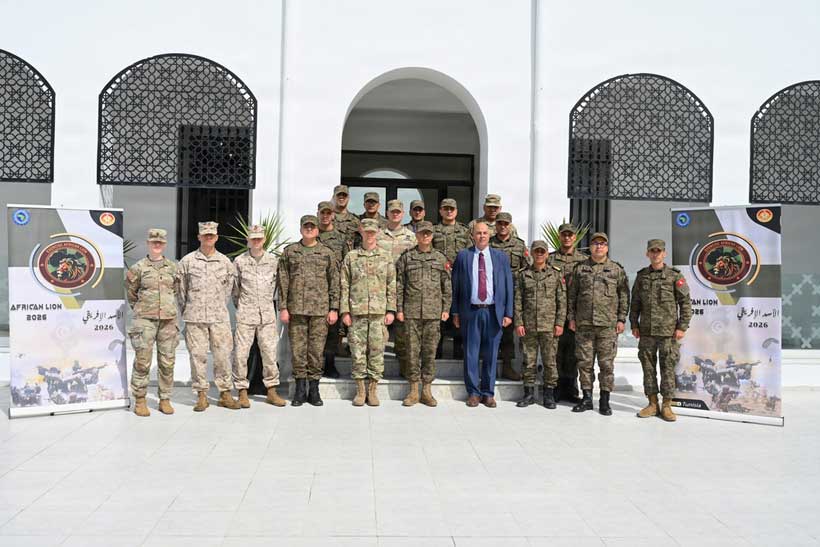
In the 2026 edition of African Lion, Morocco is consolidating its role as a key operational environment for the testing and validation of capabilities adapted to emerging forms of conflict. Far beyond a conventional military exercise, African Lion is evolving into a structuring framework where technological innovation, information superiority, and doctrinal transformation converge. This dynamic is underpinned in particular by a Moroccan electromagnetic spectrum that remains relatively uncongested and minimally contested, providing a controlled environment for the integration of advanced systems—tactical communications, ISR sensors, data links, and C2 architectures—as well as for experimentation in electronic warfare.
In this context, the exercise is no longer confined to equipment testing; it functions as a validation space for a full technological ecosystem, bringing together armed forces, the defense industry, and data architectures. Thus, Morocco is progressively embedding itself in the emergence of data-centric warfare, grounded in the control of flows, intelligence fusion, and accelerated decision-making, at the heart of evolving African and Euro-Atlantic security dynamics.
This shift unfolds against a backdrop of intensifying global tensions, as Morocco prepares to co-host African Lion alongside the United States—one of the most consequential security cooperation platforms on the continent. The momentum extends well beyond the exercise itself. Through recurring integrated frameworks such as Flintlock, Handshake, and Atlas Handshake, Rabat and Washington are anchoring their partnership (2026-2036) in a sustained logic of strategic alignment. The objective has shifted from mere cooperation to the co-development of operational responses tailored to shared areas of interest, combining interoperability, projection, and the security of strategic flows.
In this regard, African Lion has emerged as one of the principal mechanisms for the co-production of security across Africa. Initially conceived as a joint training exercise, it has gradually evolved into a structuring ecosystem incorporating new operational and doctrinal dimensions. The introduction of specialized training cycles, particularly around emerging technologies, reflects this transformation. The stakes now extend beyond joint training to the progressive shaping of a shared security strategy at the continental level, centered on securing strategic routes and corridors—maritime, energy, and logistical—whose resilience is increasingly a determining factor in the balance of power.
This transformation is accelerating, with the 2026 edition marking a decisive inflection point. Morocco is emerging as a full-scale experimental platform for next-generation combat technologies. More than forty U.S. technology firms are embedded within the exercise, testing advanced capabilities alongside deployed forces in a deliberate effort to compress the timeline between innovation and operational deployment. In this respect, the initiative is overseen by the U.S. Army Southern European Task Force, Africa, through its Advanced Capabilities Directorate, which serves as a critical interface between the military, industry, and the broader innovation ecosystem. Participating companies include leading actors from the U.S. defense and innovation landscape, ranging from startups specializing in artificial intelligence and autonomous systems—such as Anduril Industries, Shield AI, and Skydio—to major defense industrial primes including Lockheed Martin, Raytheon Technologies, and Northrop Grumman.
Under these conditions, African Lion evolves into a large-scale, iterative operational validation environment—test, adapt, validate—structured around concrete capabilities: mission command systems, deep strike capabilities, defense-in-depth components, and integrated counterattack solutions. The objective is no longer demonstrative; it is to deliver to the warfighter capabilities that are immediately usable in the field, particularly in securing critical spaces and strategic corridors.
African Lion’s Transformation: From Exercise to Strategic Architecture
This technological shift and evolution in operational practice finds a particularly critical application on the African continent, where the security landscape demands rapid adaptation of both capabilities and modes of engagement. The operational environment is characterized by a convergence of complex, persistent, and adaptive threats. Violent extremist organizations exploit weakly governed spaces to expand their networks, while transnational trafficking—arms, narcotics, and illicit flows—reinforces their logistical depth and resilience. These dynamics are compounded by forms of hybrid conflict that combine disinformation, economic pressure, and the instrumentalization of local vulnerabilities.
The porosity of borders, the vastness of Sahelian spaces, and the fragmentation of state capacities complicate early detection and threat neutralization, particularly along key logistical axes and strategic corridors. In this context, the challenge is no longer confined to the tactical level; it operates within a systemic logic in which control of information and multi-domain coordination are decisive.
In practical terms, this requires the development of integrated, interoperable, and intelligence-driven capabilities capable of compressing decision cycles and ensuring rapid responses to evolving threats.
From a forward-looking perspective, the growing availability of drone capabilities (FPV) in the hands of non-state actors in the Sahel can be understood along three trajectories, particularly in light of recent developments in Mali, where coordinated offensives by GSIM and ISIS against multiple strategic sites have demonstrated increased operational synchronization, defense saturation, and the exploitation of critical infrastructure vulnerabilities. A first scenario reflects opportunistic diffusion, where drones remain tools for surveillance, propaganda, and intimidation, without fundamentally altering the balance of power. A second scenario would involve a tactical concentration of capabilities, with groups integrating drones into their operational patterns to support attacks, enhance mobility, and increase surprise, thereby complicating state force maneuver. A third, more structural scenario would mark a systemic shift: drones would become a force multiplier embedded within strategies of attrition, disruption of logistical corridors, and pressure on economic flows, placing conflict within a broader logic of “war of flows,” where low-cost capabilities generate disproportionate strategic effects.
Under these conditions, operational priority now rests on consolidating durable partnerships, strengthening command-and-control architectures, and integrating advanced technologies—particularly in ISR, data fusion, and secure communications—in order to preserve decision advantage in environments defined by uncertainty and the dispersion of threats.
Morocco as a Reference Operational Environment
It is increasingly evident that, in this setting, Morocco stands out as a compelling strategic choice. By virtue of its geographic position at the crossroads of the Atlantic, the Mediterranean, and the Sahel, it serves as a natural anchor point for securing the continent’s critical flows and strategic corridors. Its extensive training ranges and relatively unconstrained airspace provide optimal conditions for large-scale maneuvers.
This is further reinforced by an electromagnetic spectrum that acts as a true force multiplier in modern warfare, particularly well-suited to advanced military capability integration. It encompasses the full range of frequency bands used for tactical and strategic communications (VHF, UHF, and SATCOM); radar systems (air surveillance, target detection, and tracking); as well as ISR sensors and inter-platform data links. In the Moroccan case, the spectrum is characterized by low saturation and limited operational contestation in the absence of hostile jamming. This controlled and low-congestion environment enables the simultaneous deployment of multiple systems without significant interference while offering an optimal setting for multi-system experimentation and the controlled simulation of electronic warfare scenarios.
Such an environment provides ideal conditions for conducting electronic warfare operations, including jamming, signal detection (SIGINT), dynamic spectrum management, and the deployment of electronic countermeasures. It also enables the simulation of interconnected command-and-control (C2) architectures, where data flows from multiple sensors are fused in real time to generate a common operational picture.
It is precisely within this capacity to integrate and synchronize information flows that the current shift in military power is taking shape. In this year’s exercise, the demonstration of power lies less in visible maneuver than in the C4ISR architecture that synchronizes, accelerates, and redefines military decision-making within a “war of flows” environment. This logic extends, within a renewed technological framework, the principles of the AirLand Battle doctrine—based on depth, simultaneity, and continuity of command. Unlike earlier approaches centered on mass or sequencing, the decisive factor now lies in the ability to connect sensors, decision-makers, and effectors in near real time, thereby generating a sustained decision advantage in multi-domain environments.
In such a context, where information superiority depends on the ability to exploit, protect, and dominate the electromagnetic spectrum, this configuration constitutes a decisive operational advantage. It enables realistic testing of the integration of autonomous systems, drones, artificial intelligence, and resilient communication networks under conditions closely aligned with contemporary combat constraints. This is further reinforced by the country’s stability, the ongoing modernization of the Royal Armed Forces, and an advanced level of interoperability with U.S. forces, now extending into doctrinal integration.
Operationally, several high-profile U.S. units are engaged in this dynamic, including the 19th Special Forces Group, the 173rd Airborne Brigade, and the 207th Military Intelligence Brigade (Theater), alongside key entities such as the Army Test and Evaluation Command and the Army Global Tactical Edge Acquisition Directorate. Their role is central: to test, under real-world conditions, technologies developed by industry and validate their suitability for coalition use.
At the core of this transformation lies a major evolution in command structures. The exercise aims to transform Combined Joint Task Force headquarters from manual information processing to real-time, automated exploitation. Through artificial intelligence, ISR systems, and launched effects, the decision-making chain is compressed, significantly reducing the kill chain. Now, this acceleration makes it possible to detect, track, and engage targets at greater distances with enhanced precision. It increases stand-off range, improves lethality, and strengthens the credibility of land-based deterrence. Systems such as Maven Smart System contribute to building a common operational picture by fusing data from tactical and operational sensors.
In this framework, the outcomes of these operational validations extend far beyond the technical domain. They contribute to the progressive upgrading of Morocco’s Royal Armed Forces by accelerating the adoption of critical technologies, the mastery of interconnected architectures, and the integration of advanced operational standards. Operationally, they enhance the ability of Moroccan forces to operate in multi-domain environments by improving intelligence fusion, decision speed, and targeting precision. Doctrinally, they support continuous adaptation of operational concepts, integrating data-centric warfare and distributed command approaches.
From an industrial and technological standpoint, they open pathways for knowledge transfer, human capital development, and Morocco’s integration into defense innovation value chains. At the geostrategic level, they reinforce the Kingdom’s positioning as a regional security hub and a credible partner in the co-production of security, strengthening its role in shaping military balances and strategic corridors across Africa.
This dynamic aligns fully with transformations observed in contemporary theaters. In the Russia–Ukraine war, drones have redefined tactical balances. In the Middle East, they have demonstrated their ability to bypass conventional defenses. In the Nagorno-Karabakh conflict between Azerbaijan and Armenia, they have fundamentally altered the balance of power.
Without being explicitly directed against a specific actor, the exercise operates within a strategic environment deeply shaped by Middle Eastern conflict dynamics. Observed developments—particularly in drone employment, information warfare, and decision compression—reflect less an adaptation to a single adversary than an anticipation of contemporary forms of conflict, as seen in the evolving confrontation between the United States, Israel, and Iran.
In this context, the training of African forces in drone operations takes on a broader strategic dimension. It aims not only to address immediate operational gaps but also to support the long-term development of African capabilities. The objective is not merely to train on a tool but to embed a new way of warfare—centered on data, speed, and precision—particularly in securing critical spaces and strategic axes.
The objectives are clear: to enhance operational effectiveness against hybrid threats, develop sustainable local capabilities, and build advanced interoperability between African and Western partners.
Limits, Asymmetries, and the Reconfiguration of Power Balances
In a context of intensifying strategic competition across the African continent, this transformation assigns African Lion an indirect structuring role in shaping power balances, particularly around the control and security of strategic corridors. This dynamic, however, is not without its limits. It rests on a structural asymmetry within the partnership, whereby the United States retains technological and doctrinal superiority, while Morocco provides an operational environment for validation and projection. While this configuration serves as a powerful accelerator of capability development, it also entails vulnerabilities. Acting as a testing ground exposes Morocco to potential forms of technological and logistical dependency while raising sensitive issues related to intelligence security.
Moreover, the projection of this model at the African scale encounters heterogeneous political and capacity realities. In this context, the upgrading of the Royal Armed Forces comes with non-negligible costs—both financial and doctrinal—particularly in terms of gradual alignment with Western standards. This raises a structural paradox: the articulation between an increasingly data-centric form of warfare and African partners with uneven digital capacities, which may, in the short term, constrain effective interoperability and the uniform diffusion of these operational models.
These constraints, however, do not undermine the broader logic; rather, they redefine its conditions of balance and implementation. It is within this perspective that the Moroccan–American dimension acquires its full depth. The partnership between Rabat and Washington now extends beyond traditional cooperation into a logic of strategic co-construction. Yet it remains grounded in a structural asymmetry, where the United States provides technological and doctrinal innovation, while Morocco offers a unique experimental deployment space, geostrategic depth, and projection capacity at the heart of continental dynamics. This complementarity translates into a clear articulation between American innovation and Moroccan operational depth.
Gradually, African Lion is asserting itself as far more than a training framework. It is evolving into an integrated strategic infrastructure, combining training, testing, innovation, and validation under operational conditions. This dynamic is driven by a short, iterative cycle—test, adapt, refine, validate—designed to rapidly convert innovation into deployable capabilities, immediately usable in coalition settings. Within this strategic construct, African Lion extends beyond force preparation for futureconflicts and actively prefigures their modes of engagement, integrating multi-domain operations, information dominance, and faster decision cycles from the outset.
In this emerging architecture, Morocco is no longer a peripheral actor. Through the convergence of its geography and alliances, it is positioning itself as a point of equilibrium where key vectors of security, technology, and informational power intersect and stabilize across the African and Euro-Atlantic space.
A further shift is also underway: NATO’s southern flank has moved beyond its former status as a peripheral zone and is emerging as a theater of strategic confrontation, increasingly exposed to hybrid, diffuse, and transregional threats. The credibility of deterrence no longer rests solely on presence or mass but on the ability to detect, anticipate, and act in depth across all operational domains.
This posture relies on integrated architectures combining space-, air-, and maritime-based sensors—such as secure communication satellites like Syracuse IV, early warning systems such as the Defense Support Program, and advanced surveillance platforms like the Northrop Grumman E-2 Hawkeye. It is complemented by a maritime dimension, with the deployment of next-generation frigates equipped with electromagnetic intelligence capabilities, capable of capturing, analyzing, and exploiting signals in contested environments.
Together, these elements form a coherent chain of detection, decision, and action, where control of information constitutes the foundation of operational superiority. In this framework, African Lion emerges as a space of convergence, where these capabilities are tested, integrated, and validated under real-world conditions.
The shift is now unmistakable. The African Lion is no longer an exercise in the traditional sense but a structuring ecosystem for the production of power. Within this evolving architecture, Morocco is not merely a co-organizer; it is becoming a credible security producer, establishing itself as a strategic anchor at the heart of a security continuum linking the Atlantic, the Sahel, and the Euro-Mediterranean space—where the stability of the southern flank is an essential condition of global equilibrium. What is unfolding through African Lion is not an exercise but the early architecture of a new security order across the Afro-Atlantic space.
