



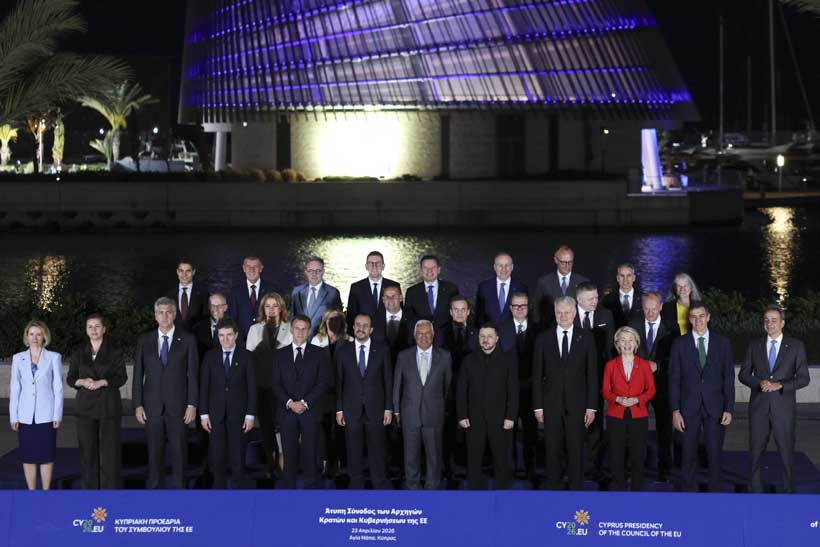
On April 24, 2026, the presidents of three of the European Union’s most powerful institutions gathered on the sidelines of an informal summit in Nicosia and signed something that, in the typically measured language of Brussels, counts as a genuinely bold statement of intent. The European Parliament, the Council of the EU under its Cypriot Presidency, and the European Commission put their names to the “One Europe, One Market” roadmap, a joint declaration committing all three institutions to completing and deepening the EU single market by the end of 2027.
The timing was not accidental, and the location was not merely ceremonial. Cyprus, holding the rotating Council Presidency, hosted an informal meeting of EU heads of state that had competitiveness and economic resilience squarely at its center, making the signing a natural capstone to a summit focused on Europe’s ability to compete in an increasingly hostile global environment.
Beyond the Photo Op: What’s In the Document
The roadmap is not a wish list or a vague statement of European solidarity. It contains 42 specific actions organized around five strategic pillars: regulatory simplification, deeper market integration including the removal of the ten most harmful barriers to the single market, trade policy reinforcement, energy cost reduction alongside decarbonisation, and accelerating digital transformation and artificial intelligence adoption.
Each of those pillars comes with concrete legislative targets, co-legislator agreement deadlines, and a quarterly review mechanism designed to hold all three institutions publicly accountable for delivery. The 2027 deadline is significant because it falls before the next major EU budget cycle, which means the reforms being legislated now will shape the economic architecture Europe takes into the next decade of industrial and digital policy.
European Parliament President Roberta Metsola described the roadmap as “ambitious” and said it “strengthens our capacity to withstand shocks” while providing “predictability to our citizens and businesses,” framing it as Europe delivering on what it had promised rather than producing more political language without follow-through. Commission President Ursula von der Leyen said the actions would “boost Europe’s economic growth, guarantee our digital transformation, and strengthen industrial resilience,” calling it an absolute priority of the current Commission. Cypriot President Nikos Christodoulides, speaking in his capacity as Council Presidency, called the roadmap “a strategic necessity” rather than a regulatory exercise, which is the kind of framing that signals the institutions are treating this as a security issue as much as an economic one.
The Competitive Gap That Made This Inevitable
The EU single market is one of the largest integrated economic zones in the world, but it has never fully lived up to its potential, and the gap between what the single market promises on paper and what businesses and citizens actually experience has been a persistent source of frustration for decades. The single market remains affected by national fragmentation, uneven implementation, and barriers in services, digital activity, capital markets, energy, and cross-border business operations, which increase compliance costs for companies operating across member states and reduce scale at exactly the moment when European firms need to compete against American and Chinese counterparts operating from far more integrated domestic bases.
That competitive pressure has sharpened dramatically in the past two years. Trump’s tariffs have created direct trade friction with Europe’s largest export partner. China’s dominance of clean energy supply chains means European industrial policy cannot achieve its climate goals without reducing dependency on Chinese components. The Iran war’s energy shock, which drove gas prices to near-record highs and forced the European Central Bank to revise its growth forecasts downward, demonstrated once again that a fragmented European energy market amplifies external shocks rather than absorbing them. The roadmap lands in this context not as an aspirational document but as a response to a set of pressures that the EU’s current economic architecture is visibly struggling to manage.
Five Bets Europe Is Making on Itself
Regulatory simplification is the first pillar and the most politically sensitive, because it requires member states to accept that national regulations which diverge from EU-level standards are not sovereign preferences but competitive liabilities. The roadmap commits to reducing administrative burdens on businesses operating across borders, which in practice means harmonizing everything from product certification to data governance rules in ways that will generate resistance from governments that have built domestic regulatory ecosystems around existing frameworks.
Deeper market integration, and specifically the commitment to remove the ten most harmful remaining barriers to the single market, is where the concrete legislative targets will be most visible. The barriers in question span financial services, where capital markets remain far more nationally fragmented than in the US, professional services, where cross-border recognition of qualifications remains inconsistent, and digital markets, where platform rules and data localization requirements vary significantly across member states.
The Energy pillar is the most urgent given the current price environment. European industrial competitiveness is directly constrained by energy costs that remain significantly higher than in the US or China, and the decarbonisation agenda requires investment at a scale that only an integrated European energy market can finance efficiently. The roadmap’s commitment to reducing energy prices while advancing decarbonisation is the most technically complex of the five pillars, requiring simultaneous progress on grid interconnection, hydrogen infrastructure, and renewable deployment that no single member state can deliver independently.
The Digital and AI pillar reflects the recognition, increasingly shared across EU institutions, that Europe’s long-term economic position depends on whether it can build AI and digital infrastructure that competes with American and Chinese systems rather than simply regulating the ones built elsewhere.
Our Take: The Implementation Gap Is the Real Story
The “One Europe, One Market” roadmap is notable for what it is and also for what it represents structurally. The joint signature of all three EU institutions on a single operational document with binding timelines and a quarterly accountability mechanism is not the normal mode of EU governance. That the Parliament, Council, and Commission have agreed not just on a direction but on a shared enforcement framework suggests a genuine shift in institutional urgency.
Anna Cavazzini, the German Green MEP who chairs the European Parliament’s Committee on the Internal Market and Consumer Protection, offered a measured but cautiously optimistic assessment. She called the roadmap “an important signal for more unity and a stronger single market in times of geopolitical turmoil.” But she stressed that urgency is paramount: “We need to speed up and deliver concrete results, first and foremost on the Commission’s proposal for a Single Market Emergency Instrument.” Cavazzini warned that cutting red tape must not come at the expense of the Green Deal, arguing that “without the support of our citizens and businesses, we will not be good at tackling the challenges we are facing.” Her conclusion was pointed: “The joint declaration might be a signal of unity, but we also need the follow-up.”
That follow-up is precisely where the roadmap’s success or failure will be determined. The 2027 deadline is tight by EU standards, and the history of single market initiatives is littered with ambitious plans whose political language exceeded their practical implementation. The Draghi report on EU competitiveness made a comprehensive case for integration in 2024, yet several of its key recommendations remain unimplemented. The quarterly review mechanism is a direct response to that gap.
Cavazzini’s warning about the Green Deal is worth taking seriously. The roadmap’s energy pillar and its decarbonisation commitments are central to Europe’s ability to maintain industrial competitiveness while meeting climate targets. If regulatory simplification becomes a cover for rolling back environmental standards, the coalition that supports deeper integration will fracture.
Whether the quarterly review mechanism will have practical teeth depends on whether the political will that produced the Cyprus signing holds through the legislative grind ahead. The roadmap does not resolve the underlying tensions between member states, and those tensions will resurface as specific proposals move through the co-decision process. What it does provide is a shared institutional framework and a public accountability structure that makes foot-dragging more visible. For a bloc that has spent years producing competitiveness language without competitiveness outcomes, delivering on Cavazzini’s call for “follow-up” may be the most important thing the roadmap can achieve.
