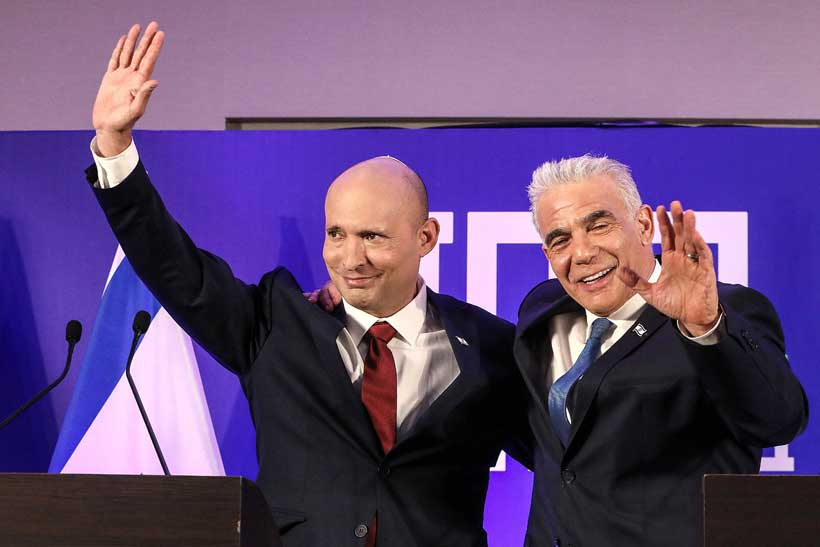
Two of Israeli Prime Minister Benjamin Netanyahu’s main rivals, Naftali Bennett and Yair Lapid, announced they will unite in the upcoming election to challenge his coalition government, mainly focusing on domestic issues like military conscription for the ultra-Orthodox. On broader issues such as Iran, Gaza, and Lebanon, their joint party, “BeYachad,” aims to maintain a security stance similar to Netanyahu’s, suggesting little change in Israel’s foreign policy.
Bennett and Lapid have supported Netanyahu’s military actions against Iran, reflecting strong public backing for the conflict. Lapid described the war in Iran as a “just war against evil. ” However, they criticize Netanyahu for not achieving key objectives, such as toppling the Iranian government. Despite these critiques, they have not called for renewed fighting after a ceasefire on April 8. A source close to their party characterized them as “hawkish” but also pragmatic, recognizing the need for diplomacy following military actions.
Regarding Lebanon, both leaders have endorsed military operations while expressing doubts about an April 17 ceasefire that has not stopped hostilities with Hezbollah. Before Israel’s military operations in Lebanon began, Lapid emphasized necessary steps to ensure Israeli safety. Following the ceasefire announcement, he suggested that the only solution would be to permanently eliminate threats from northern Israel. Bennett was critical of the ceasefire and remarked on Hezbollah’s strengthening capabilities.
In Gaza, following a series of Israeli strikes despite a ceasefire in October, both politicians have criticized Netanyahu for not dismantling Hamas completely after its attack on October 7, 2023. Lapid mentioned that Netanyahu’s government achieved the “worst possible outcome” as Hamas still maintains many armed fighters. Bennett highlighted that Netanyahu’s policies allowed aid into Gaza, which he argued has enabled Hamas’s recovery.
On the topic of Palestinian statehood, polling shows most Israelis oppose a Palestinian state in the West Bank, Gaza, and East Jerusalem, suggesting that a Bennett-Lapid government would not enact significant changes in this area. Netanyahu is against establishing a Palestinian state and has accelerated settlement building. Lapid has not entirely opposed the idea of Palestinian sovereignty, speaking in favor of a two-state solution, while Bennett criticized it, fearing it could lead to violence against Israelis. All three leaders have condemned settler violence against Palestinians, which has reportedly increased under Netanyahu’s leadership.
With information from Reuters