Authors: Sanjay Turi and Praveen Sothwal*
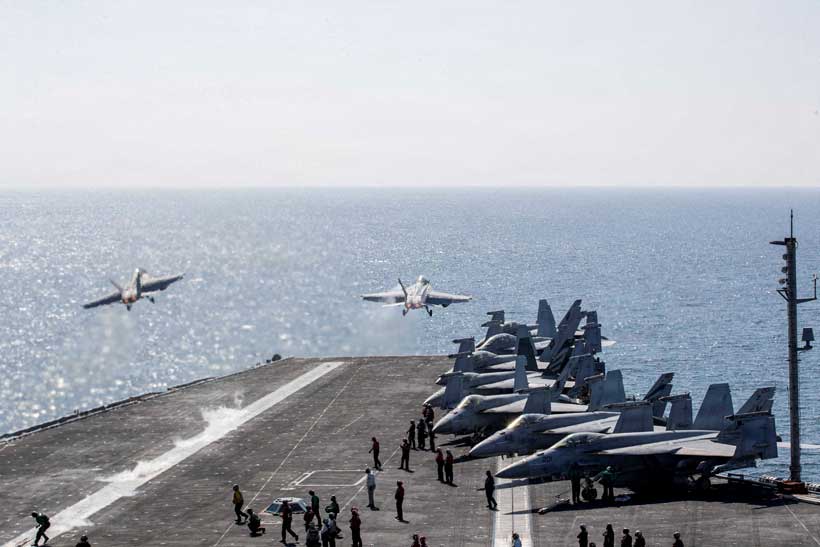
Amid rising geopolitical uncertainty over a US-Iran war, the Trump-led US is reportedly seen to be deploying tens of thousands of soldiers in West Asia along with massive aircraft carrier strike groups near the Iranian water. Since the US War in Iraq in 2003, this is the first time the US has moved the Aircraft carriers and the American troops in West Asia to this extent. The ceasefire deadlock between the US and Iran has put both countries at a crossroads, where direct confrontation between the two is inevitable sooner or later. Since the conditions put forward by both countries in their respective ceasefire proposals are unacceptable to each other, the accusations being made by both countries are nothing but a part of narrative building to deal with the outcomes of this conflict, as this war has already turned into a modern psychological warfare. While Iran is fighting this war to save its very existence, considering it a holy war against American imperialism, the US is possibly fighting this war to maintain a perception of American global hegemony. There is no doubt about it that American military might remains unparalleled and unchallenged in today’s time; nevertheless, Iran’s determination to tackle the US’ global hegemony has given a nightmare to the Trump administration for sure.
Iranian government officials mocking Trump for announcing counter blockade in the Strait of Hormuz as “ Break the enemy blockade by blockading the blockade’’ is not merely a meme per se, this strategy of the US Navy is working well in the Strait as Iran-bound ships are rarely being given passage through this counter blockade, which Trump claims that Iran may be losing more than five million dollar per day because of this blockade. President Trump further claims that the Iran-bound empty oil container ships are now moving towards the US post the counter-blockade in the Strait of Hormuz. However, although it is a part of a psychological attack and narrative building to put pressure on Iran for a peace deal, megalomaniac Trump may be going to use this counter-blockade as a final war against Iran soon in the coming weeks or months, as the Trump administration has aggressively started moving US defence forces and Aircraft carriers all across the West Asian region surrounding Iran completely.
In response to the Iranian Foreign Minister, Abbas Araghchi, leaving Islamabad after meeting with Pakistani leaders before the second round of talks, the Trump Administration’s sudden decision to stop US officials from visiting Pakistan for the upcoming peace meeting has a similar pattern, which was earlier seen during the US-Israel joint pre-emptive attack on Iran on 28th February. President Trump ordering the US Army to aggressively shift its troops, along with massive Aircraft Carriers, to West Asia, may be trying to attack Iran with the intention to end this war as soon as possible, as the ultimate sufferer, in an actual sense, of this war is the US itself.
Stay ahead of the geopolitical week.
MD Briefing delivers expert analysis across five global fronts — the Indo-Pacific, energy, geoeconomics, European security, and the Middle East — every Monday morning. Free.
It is reportedly said that this war is costing more than one billion dollars per day to the US, which is actually way more than what the Iranian economy is suffering. As Iran, already having severe sanctions, is very much firm on their decisions to continue with this war, it may have become difficult for the US to defeat Iran by just bullying and blackmailing the Iranian government on economic grounds. However, as the date for the second round of talks is approaching, it would not be wrong to assume that Trump’s decision to station the American troops all across West Asia surrounding Iran is just to showcase its military might and put pressure on Iran to accept the ceasefire proposal put forward by the US. Given the geoeconomic circumstances and massive stationing of the American troops in West Asia, it would also not be wrong to assume that the upcoming round of peace talks, if it fails, may end up with a full-fledged war, leading to a ground operation in Iran by the US forces.
As China and Russia have become the biggest beneficiaries of this war, both countries are playing well on different fronts together in this war. While China, being the biggest threat to the US, is fighting a proxy war with the US at multiple fronts, such as the Strait of Hormuz and Iran in West Asa, issues related to resource access over many South African and Latin American countries, Myanmar and possibly the Strait of Malacca in Southeast Asia, etc., Iran, in this context, has possibly become a testing ground for AI-driven advanced Chinese weapon systems. On the other hand, Russia is benefiting more from the skyrocketing crude prices arising from the post-Hormuz blockade.
As this war with Iran stands at the crossroads of declining US hegemony, the inconclusive consequences of this war will additionally undermine the very core of the global image of US hegemony. Although the US can easily afford to lose billions of dollars in this war, it can’t afford to live with the declining image of US hegemony, and this is what is preventing the US from exiting this war without reaching any conclusions.
President Trump is reportedly seen as blaming the US War Secretary, Pete Hegseth, for miscalculating the outcomes of this war. Now, it has become irreversible for the US to exit from this war, given that Iran has challenged the Petrodollar system of the US, which is a very fundamental part of the US economy at this time. As Iran has already announced that it will grant access through the Strait of Hormuz only to those ships that conduct trade in Petroyuan, taking, for the US, an inconclusive exit from this war may create a domino effect for dedollarisation. As various instances of dedollarisation are already underway, the seriousness of this announcement by Iran lies in the fact that, in response, the US has also ordered its Navy to counterblockade the Strait of Hormuz. That is why the Strait of Hormuz has become a central point of negotiation in the ongoing peace talks, where both parties are rigid about maintaining control over this strait.
Ahead of the second round of talks, President Trump cancelled the US envoy’s visit to Islamabad for peace talks and additionally ordered the deployment of three aircraft carriers in the waters near Iran, for the first time since 2003. This decision by the US president has a similar pattern to what he had during the final round of Oman-mediated US-Iran talks, which led to the joint preemptive attack on Iran on February 28th. Keeping this pattern in mind, it would not be wrong to assume that the US is either going to attack Iran again or is trying to put pressure on Iran to accept the ceasefire proposals put forward by the US.
As the US is also fed up with regularly issuing warnings to surrender, it may have now decided to attack Iran with full strength to exit this war at the earliest possibility, as this prolonged war is directly and indirectly hurting the US economy the most. Mr Donald Trump, being a true businessman first and the US President second, may have realised that the longer he is engaged in this war with Iran, the more the US economy will suffer. Therefore, the possible actions by the Trump administration in the upcoming days or weeks are likely to focus solely on just managing global perceptions of US hegemony, no matter what outcomes were initially planned before the war started.
Bio: Praveen Sothwal is a Doctoral candidate at the Centre for West Asian Studies (CWAS), School of International Studies (SIS), Jawaharlal Nehru University, New Delhi.