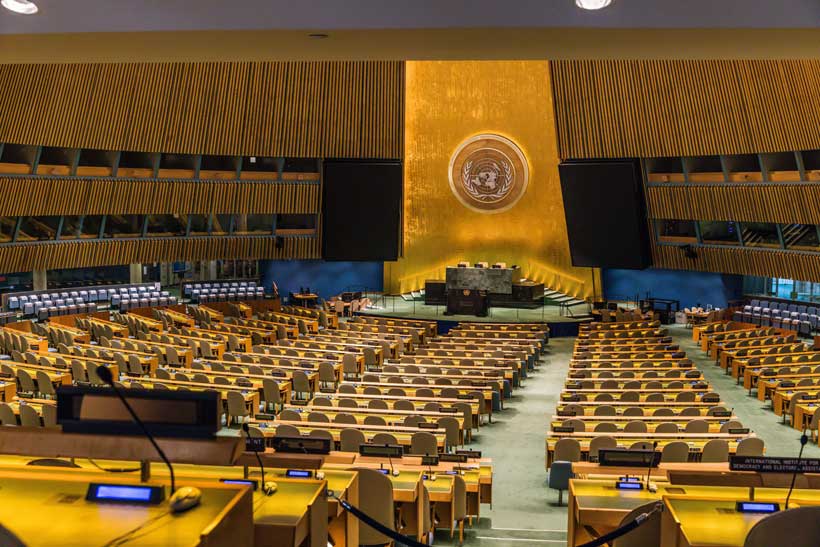
The April rejection of the United Nations draft proposal to reopen the Strait of Hormuz, despite being backed by 112 member states, paints a picture of the declining relevance of the international organisation. The UN started out as an ambitious body seeking to fulfill the liberal objective of preventing another world war through mutual cooperation. Theorists such as Mearsheimer questioned the viability of such an organisation, especially when the liberal project reconciled with finding applicability in economic circumstances rather than militarian. Mearsheimer’s considerations have found meaning within the threads of the colored missteps of UN peacekeeping operations in their heyday, perhaps a direct reason behind the UN’s inaction in today’s context. The UNPROFOR (United Nations Protection Force) operation from 1992-1995 acts as a solid example for the geopolitical complexities and immense costs surrounding UN peacekeeping operations, rationalising why the UN intervenes less tangibly in today’s era. It speaks to a larger pattern of states pursuing self-interested goals, rather than rationalising a beneficial cooperative sentiment – thus proving the declining relevance of the 21st century’s UN.
The UN was founded after the failure of the League of Nations in preventing the second world war. Against the backdrop of the Cold War period, its members created a cooperative framework to rectify conflictualities arising from postcolonial sociopolitical and cultural divisions. These motives culminated in the creation of the United Nations Peacekeeping program, consisting of a multi-country peacekeeping force acting based on the considerations of the United Nations Security Council (UNSC). UN peace operations primarily operated on the principle of peacekeeping over peace enforcement – a terminological method of ensuring minimum use of force. They also required state consent (the state in question requiring intervention) and impartiality. These aspects in concert proved to be successful in cases such as UNTAG (United Nations Transition Assistance Group in Namibia), but created a recipe for disaster in others such as UNPROFOR (United Nations Protection Force in Former Yugoslavia). The failures of UN peacekeeping missions were mostly predicated on the lacking supranational sentiment required for such initiatives, apart from derogatory domestic circumstances within the states requiring intervention. Coming together as external parties seeking to intervene and ‘keep and force’ peace within contexts that they could not fully comprehend held an inherently flawed logic. The politics involved in the planning, funding, and resourcing of peacekeeping operations also lessened the ambitious positive impacts that the UN championed.
In the case of UNPROFOR, the most expensive UN peacekeeping operation at an expenditure of 4.6 billion USD, the politics of American involvement in the planning of the mission and vested Truman doctrine-esque agendas in communist Yugoslavia led to an issue of skewed planning. Geopolitically vested parties were principally to stay out of peacekeeping operations. Due to NATO countries’ systemic involvement in maintaining regional stability and introducing free trade to the Balkan nations, its military involvement in Yugoslavia in partnership with UNPROFOR remained colored and produced outcomes quite contrarian to the humanitarian narrative that they parroted at the UN General Assembly (UNGA). During the planning of the mission itself, the ideological motivation behind the Safe Areas Mandate and Pink Zones in Croatia and Bosnia came in opposition to the ‘consent’ aspect of UN peacekeeping missions, since the consenting party in question was perpetuating atrocities against its people. The fundamental miscalculation on the lack of authorisation for the use of force in the Croatia and Bosnia safe areas led to a massive logistical failure, resulting in the genocide of Bosniak Muslim men in Srebrenica. These factors, due to the involvement of decision-making parties with opposing interests, proved to create expensive mistakes – not just financial, but also costing innocent human lives.
The planning of UN peacekeeping missions shined light on the tangled web of considerations from a variety of parties. Where this would lead to bureaucratic delays and inefficiencies within domestic policy discourse, the acute timeframe for decision making during the Yugoslav crisis translated to a vague plan requiring several extensions as the situation worsened. This earned it the title of “Mission Creep” – a term that has been used for quite a few UN peacekeeping missions. The vague mission mandate made it difficult for commanders to give concise orders to their soldiers. This, in addition to what is known as “phone-home syndrome,” where soldiers would be torn between listening to the orders of the UN commanders versus their own commanders from back home, led to a systematic implementation issue. Once again, in accordance with the inherent fragmentation in the planning due to the involvement of differently politically motivated parties, UNPROFOR’s implementation became extremely costly with very few peace-related outcomes.
Stay ahead of the geopolitical week.
MD Briefing delivers expert analysis across five global fronts — the Indo-Pacific, energy, geoeconomics, European security, and the Middle East — every Monday morning. Free.
While the UNPROFOR case is the most expensive and had immense human casualties (military personnel and civilian police observers alike), it is just one among many operations faced by the same constraints of consensus and the politics of vested parties. This is not to say that UN peacekeeping operations are without successes; some operations have been immensely helpful in democratic consolidation and stabilising polities. However, the complexities involved in tying together these operations ideologically and logistically, as well as their immense financial costs, have led to a steady decline in joint peacekeeping operations under the UN. The era of the UN’s active involvement in conflict-resolution has given way to a more individualistic view of global state involvement in the outcomes of violence.