


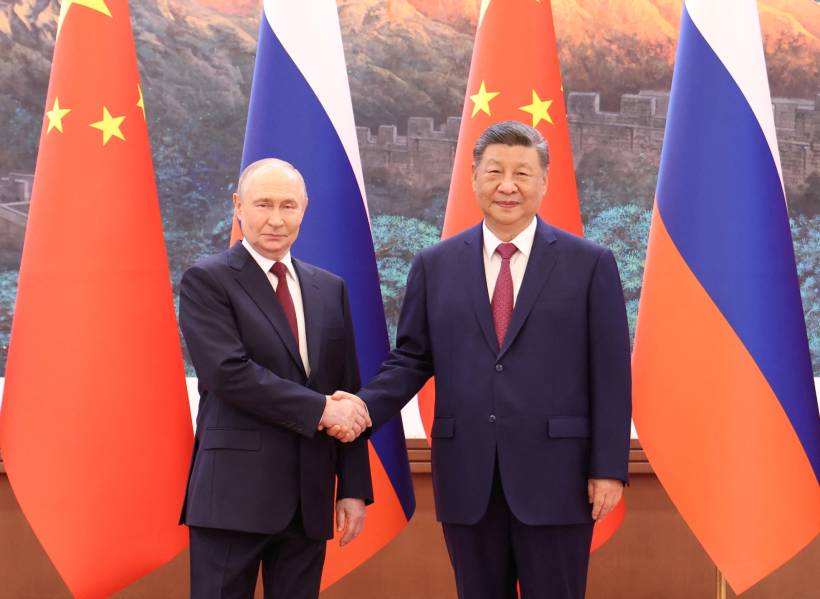
Trump was barely back on Air Force One when Putin landed in Beijing.
The contrast was deliberate, and everyone involved understood it. Trump had arrived at the tarmac to a welcome from Vice President Han Zheng. Putin got Foreign Minister Wang Yi. Trump brought the CEOs of Apple, Tesla, and Nvidia. Putin brought security personnel. Trump walked away with a deal for 200 Boeing jets and $17 billion in annual agricultural purchases. Putin and Xi signed 40 cooperation agreements and issued a 47-page joint declaration on building a multipolar world order.
As one analyst put it, Trump went to Beijing as a tradesman to sell airplanes. Putin went as a strategic partner to reaffirm an alliance. The reception was warmer for the American, at least on the surface. The outcomes were more substantial for the Russian. And the sequencing, Trump first, Putin days later, was Xi’s way of demonstrating something that no communiqué needed to spell out: Beijing can deal with Washington without abandoning Moscow, and Washington should understand that clearly.
Trump had promised during his 2024 campaign to “un-unite” Russia and China, accusing Biden of driving them together through poor policy. Eighteen months into his second term, the two countries’ ties have reached what Xi described this week as “the highest level in history.” Bilateral trade grew 20% in the first four months of 2026. Russia now imports more than 90% of the technology targeted by Western sanctions via Chinese suppliers. The Power of Siberia 2 pipeline, delayed for years, is back on the table with a route through Mongolia agreed in principle. Nearly all trade between the two countries is conducted in roubles and yuan, a dollar-free system that both governments describe as protected from external interference.
Stay ahead of the geopolitical week.
MD Briefing delivers expert analysis across five global fronts — the Indo-Pacific, energy, geoeconomics, European security, and the Middle East — every Monday morning. Free.
Trump did not cause this. But he has accelerated it in ways he probably did not intend, and understanding how is worth more than the usual commentary about great power competition.
The Iran War Did What Years of Sanctions Could Not
Before February 28, China’s economic relationship with Russia was already deep but carried some friction. Chinese companies were wary of secondary sanctions. Banks were reluctant to process payments. Some firms pulled back from the Russian market after the 2022 invasion of Ukraine to protect their access to Western markets and technology.
The Iran war changed the calculation. When the Strait of Hormuz closed and global oil markets went into crisis, China suddenly needed Russian energy more urgently than any diplomatic consideration could offset. Russian oil and gas became not just economically attractive but strategically essential. Chinese companies signed a memorandum with Gazprom to expand gas imports through two pipelines from 48 to 56 billion cubic metres. Russian crude flooded into Chinese refineries at discounted prices. The energy emergency that Washington inadvertently created by triggering a Middle East war removed whatever hesitation Beijing had about deepening its Russian energy dependency.
Moscow noticed what happened and drew the obvious conclusion. Putin arrived in Beijing this week knowing that the Hormuz crisis had made him more valuable to Xi, not less. Russia’s economy is struggling, its growth forecast cut to 0.4% this year as Ukrainian attacks on oil infrastructure and export terminals bite into war financing. But the leverage that comes from being China’s most reliable alternative to Gulf energy supplies during a crisis is real and Putin intends to use it. The pipeline deals, the energy cooperation language in the joint statement, the 40 signed agreements — all of it reflects a relationship that the Iran war pushed to a new level of mutual dependency.
The Un-Uniting That Never Happened
Trump’s promise to split Russia and China was always more of a rhetorical gesture than a policy, but it is worth tracing why even a genuine attempt would have faced enormous structural obstacles.
The Nixon strategy that managed to drive a wedge between the Soviet Union and China in the early 1970s worked because there were genuine and deep ideological and territorial rivalries between the two communist powers. The Sino-Soviet split was real, bitter, and rooted in decades of competing claims over communist leadership and border disputes that had turned violent. Nixon did not manufacture a division. He exploited one that already existed.
No comparable division exists today, and Washington has spent the past thirty years systematically eliminating the conditions that might have produced one. NATO expansion to Russia’s borders pushed Moscow toward Beijing. American pressure on China over Taiwan pushed Beijing toward Moscow. Western sanctions after Ukraine made China Russia’s economic lifeline. The Iran war made Russia China’s energy lifeline. Each crisis that Washington managed through pressure rather than engagement removed another reason for Moscow and Beijing to maintain distance from each other.
What really binds them is a shared reading of what America represents right now. Both governments look at the United States and see a country that wages wars during active negotiations, breaks international agreements when they become inconvenient, applies sanctions extraterritorially to punish any country that does business with its adversaries, and lurches between engagement and confrontation depending on domestic political pressures. That reading may be unfair in some respects but it is not entirely inaccurate, and it is powerful precisely because both countries have lived the consequences of American policy in very different contexts and arrived at very similar conclusions.
Putin said it clearly before leaving for Beijing: the Russia-China partnership represents “exemplary comprehensive strategic cooperation.” Xi said the countries’ ties are at their “highest level in history.” These are not just diplomatic formulas. They reflect a genuine alignment of interests that has deepened every time Washington has applied maximum pressure to both countries simultaneously.
Putin Needs This More Than Xi Does
One thing the Beijing summit makes visible that gets obscured in the “China-Russia alliance” framing is the profound asymmetry between the two sides. Putin needs this relationship considerably more than Xi does.
Russia’s economy is heavily dependent on Chinese purchases of its energy, Chinese technology to keep its military industry running, and Chinese financial infrastructure to work around Western sanctions. China is Russia’s largest trading partner. Russia is not China’s. Beijing can afford to manage the relationship at arm’s length, calibrating support to serve Chinese interests rather than Russian ones, precisely because Moscow has no real alternatives. There is nowhere else Putin can get what Beijing provides.
This asymmetry gives Xi options that Putin does not have. China has not given Russia the military hardware Putin has reportedly sought. It has not formally recognized Russian annexation of Ukrainian territory. It maintains the public posture of a neutral mediator that wants a negotiated peace, even while its private posture involves supplying the technology and components that keep Russia’s war machine operational. Beijing is supporting Moscow enough to keep it viable without committing to outcomes that would damage China’s relationships with Europe and the Global South.
Putin arrived in Beijing needing reassurance that Xi’s recent engagement with Trump had not shifted China’s strategic orientation. He appears to have gotten that reassurance. But the very fact that Putin needed it, that he was watching anxiously from Moscow while Xi hosted Trump, says everything about who holds the cards in this relationship. Moscow will have drawn “quiet satisfaction” from the Trump-Xi summit’s failure to produce a breakthrough on Iran, as one analyst noted. That satisfaction is itself revealing: Russia is reduced to hoping that Washington and Beijing cannot get their act together, because a genuinely improved US-China relationship would be one of the few things that could meaningfully reduce Chinese support for Moscow.
The Document Trump Should Read Very Carefully
The joint declaration Putin and Xi signed this week runs to 47 pages. The Kremlin described it as a comprehensive policy document on building a “multipolar world and a new type of international relations.” The language is the same language both governments have been using since 2022, refined and elaborated, but not fundamentally changed. What the document represents is not a new strategic vision but a consolidated one: two governments that have decided the current international order is structured against their interests and that working together to erode it is better than working separately.
The multipolar world they are calling for is one in which American power is reduced, in which regional organizations like SCO and BRICS provide alternative governance frameworks that do not run through Washington or its allies, in which currencies other than the dollar structure international trade, and in which military alliances that include American bases do not extend to their immediate neighborhoods. None of that is new. What is new is that they are issuing a 47-page document about it days after Trump left Beijing having secured a few agricultural contracts and some Boeing orders.
The sequencing is the statement. Trump came to Beijing as a buyer. Putin came as a partner. Xi received both and sent a clear message about which relationship he considers more strategically significant by issuing a joint declaration the size of a policy manifesto with Moscow while giving Washington a trade deal the size of a press release.
What Washington Got Wrong, and Keeps Getting Wrong
The failure to split Russia and China is not specifically Trump’s failure, though his policies have accelerated the dynamic. It is the accumulated failure of three decades of American foreign policy that treated both countries as problems to be managed through pressure rather than interests to be engaged through diplomacy.
Clinton, Bush, and Obama each made choices that pushed Moscow and Beijing closer together. NATO expansion, the Iraq war, financial sanctions, support for regime change in countries on Russia’s periphery, all of it gave both governments reasons to view American power as a threat rather than a potential partner. Trump’s first term added tariff pressure on China and ambivalent posturing on Ukraine. His second term has added a Middle East war that closed the Strait of Hormuz, deepened China’s Russian energy dependency, and given both governments their clearest shared grievance yet: the perception that Washington is, as Singaporean Foreign Minister Vivian Balakrishnan put it, “a revisionist power” that reshapes international arrangements through force when they stop serving American interests.
Nixon managed the Sino-Soviet split because he approached both countries with a combination of strategic empathy and genuine diplomatic investment. He understood what each country needed, offered something real in exchange, and built relationships over time. The current approach, maximum pressure on both fronts simultaneously, produces exactly the opposite result. It confirms every fear both governments have about American intentions and removes every incentive they might have to move toward Washington rather than toward each other.
Putin will leave Beijing having signed 40 agreements, secured energy commitments, and demonstrated to his domestic audience that Russia is not isolated. Xi will have demonstrated to every government watching that China can host the American president and the Russian president in the same week, on its own terms, without owing either of them an exclusive relationship. Trump will return to Washington having sold some planes and soybeans.
The scoreboard is not complicated.
