


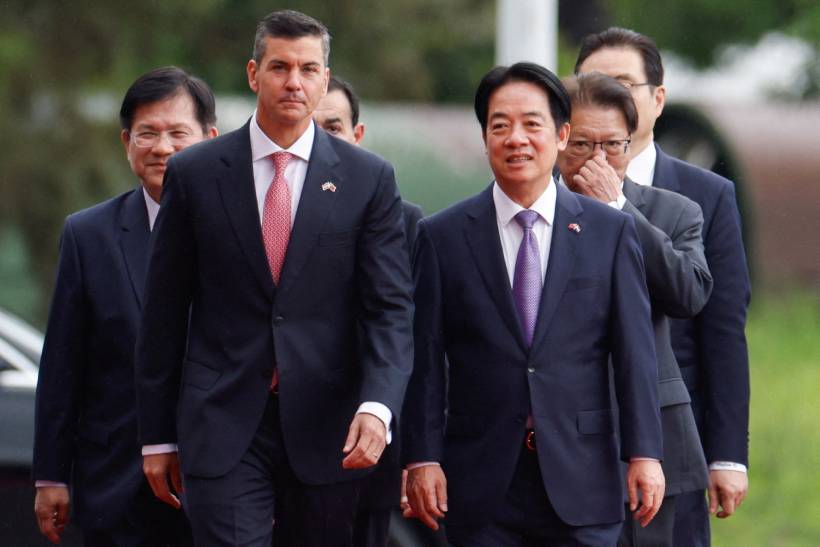
China has intensified its diplomatic rhetoric against Santiago Peña following his recent visit to Taiwan, reflecting Beijing’s growing efforts to isolate Taipei internationally and weaken the remaining countries that maintain formal diplomatic ties with the island.
Paraguay is one of only 12 states that officially recognize Taiwan instead of the People’s Republic of China. During his visit, Peña reaffirmed support for Taiwan and described relations with Taipei as rooted in shared democratic values and political freedom.
Beijing responded sharply, accusing Paraguayan politicians of serving as “pawns” of Taiwanese separatist forces and suggesting that leaders supporting Taiwan may have “ulterior motives.” The unusually aggressive language highlights how sensitive the Taiwan issue has become within China’s broader foreign policy strategy.
Stay ahead of the geopolitical week.
MD Briefing delivers expert analysis across five global fronts — the Indo-Pacific, energy, geoeconomics, European security, and the Middle East — every Monday morning. Free.
Why Paraguay Matters to China and Taiwan
Although Paraguay is not a major global power, its diplomatic recognition carries significant symbolic and strategic importance for both China and Taiwan.
For Taiwan, maintaining formal diplomatic allies is essential to preserving international legitimacy and resisting Beijing’s efforts to diplomatically isolate the island. Each country that continues to recognize Taiwan represents political resistance against China’s One China principle.
For China, reducing Taiwan’s remaining diplomatic partnerships is part of a long term strategy aimed at reinforcing Beijing’s claim that Taiwan lacks the status of an independent state. Over the past decade, several countries have switched diplomatic recognition from Taipei to Beijing after economic and political engagement with China.
Paraguay therefore represents one of Taiwan’s most important remaining diplomatic footholds in South America.
Economic Pressure Shapes the Debate
The controversy surrounding Paraguay’s Taiwan relationship is increasingly driven by economic considerations. Some Paraguayan politicians, agricultural exporters, and business groups argue that maintaining ties with Taiwan limits access to Chinese markets and investment opportunities.
China is the world’s second largest economy and a major importer of agricultural products, making diplomatic recognition economically attractive for many developing states.
Supporters of relations with Beijing argue that Paraguay could gain greater trade access, infrastructure investment, and financial opportunities if it abandoned Taiwan.
However, Peña and supporters of Taiwan emphasize ideological and political considerations, framing the relationship as a partnership based on democratic governance and political sovereignty rather than purely economic interests.
This reflects a broader global trend where smaller states increasingly face pressure to balance economic incentives against political alignment and strategic values.
China’s Diplomatic Messaging Is Becoming More Aggressive
The sharp rhetoric from China’s foreign ministry demonstrates Beijing’s increasingly confrontational diplomatic approach on issues related to Taiwan.
By describing Paraguayan leaders as “pawns” and questioning their motivations, China is signaling that support for Taiwan will be treated not merely as a diplomatic disagreement but as active opposition to Chinese national interests.
This language also serves multiple audiences simultaneously.
Internationally, Beijing seeks to discourage other governments from strengthening ties with Taiwan.
Domestically, strong rhetoric reinforces nationalist narratives surrounding territorial sovereignty and reunification.
Regionally, China is attempting to increase pressure on Paraguay by suggesting that continued support for Taiwan contradicts public opinion and economic interests.
The emphasis on opinion polls claiming support for relations with Beijing also reflects China’s strategy of portraying diplomatic recognition of Taiwan as politically unsustainable.
Taiwan’s Shrinking Diplomatic Space
The dispute illustrates Taiwan’s increasingly difficult international position as China expands its diplomatic, military, and economic influence globally.
Under President Lai Ching-te, Taiwan has continued emphasizing democracy, sovereignty, and international partnerships. However, Beijing views Lai as supporting separatist policies and has intensified political and military pressure against Taipei.
Taiwan’s formal diplomatic allies have steadily declined over recent decades as China has used economic incentives and geopolitical influence to persuade states to switch recognition.
As a result, every remaining ally now carries outsized symbolic importance for Taipei’s international visibility and diplomatic legitimacy.
Analysis
China’s reaction to Peña’s Taiwan visit demonstrates how the Taiwan issue has evolved into one of the most emotionally and strategically sensitive dimensions of Chinese foreign policy.
Beijing no longer views diplomatic recognition of Taiwan as a minor symbolic issue. Instead, it increasingly interprets international engagement with Taipei as a challenge to China’s sovereignty, territorial integrity, and geopolitical authority.
The pressure on Paraguay also reflects the broader transformation of global diplomacy under growing United States China rivalry. Smaller countries are increasingly caught between competing geopolitical and economic pressures, particularly when balancing relations with democratic partners against the economic power of China.
For Paraguay, the debate is ultimately about strategic identity as much as economics. Maintaining relations with Taiwan offers political alignment with democratic values and preserves diplomatic independence from Beijing’s influence. Switching recognition to China could deliver economic benefits but may also reduce Paraguay’s foreign policy autonomy.
For Taiwan, retaining Paraguay is important not only diplomatically but psychologically. Every diplomatic loss strengthens Beijing’s narrative that international recognition of Taiwan is disappearing and that eventual reunification is inevitable.
The dispute therefore reflects a much larger geopolitical contest over legitimacy, influence, and the future international status of Taiwan. As competition between China and Taiwan intensifies, diplomatic battles involving even relatively small states are likely to become increasingly significant within global geopolitics.
With information from Reuters.
