



Friendship treaty in 1950, Tehran Declaration in 2001, and Chahbahar port’s construction and development in progress are a timeline of India’s relationship with Tehran, yet in Tehran’s most grueling times, New Delhi happens to lose its voice. There are a few reasons for the expectation of a voice to be heard from India, one being the relationship timeline between India and Iran that is nothing short of a close ally. Second, the claims iterated by India’s Prime Minister and Foreign Minister of it being the voice of the global south. Third, the strategic autonomy it claims to have, the ability to make, create, and execute its foreign policy independently.
In addition to that, its initiative such as “Voice of Global South,” which is led by India, provides a collaborative platform for developing nations to share perspectives, challenges, and solutions, prioritizing their interests in global governance. There have been summits hosted by India via the platform of the Voice of Global South. Till now, three summits have been held. Two in 2023 and one in 2024. The first summit had the theme of Unity of Voice, Unity of Purpose, and the focus was on bringing the concerns of the developing world to the G20 agenda. The Second Summit was themed as Together for Everyone’s Growth with Everyone’s Trust, and it focused on sharing the outcomes of India’s presidency with the Global South. The Third Summit was themed as Empowered Global South for a Sustainable Future.
Now, with all this and India having a threshold alliance with the US, it was rational to expect India to speak up and, if possible, mediate in the US-Israel and Iran war that spanned the duration of over a month and is still continuing in the Strait of Hormuz at least. Though it could not mediate or speak. The possible reason could be the prick in its throat, and that happens to be Israel or Fatherland, as PM Modi calls it. Further, it is kowtowing with the US-Israel side. Thus, losing the strategic autonomy it so long preserved.
Whether India chose to speak or not, there would have been, and there are, consequences of the war being imposed on Iran as India leans heavily on the Middle East with regard to energy.
Stay ahead of the geopolitical week.
MD Briefing delivers expert analysis across five global fronts — the Indo-Pacific, energy, geoeconomics, European security, and the Middle East — every Monday morning. Free.
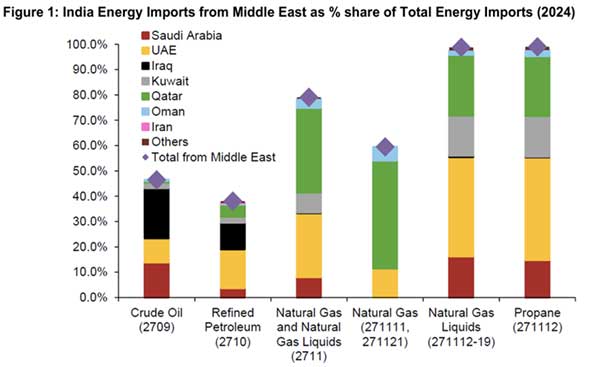
Source: Mitsubishi UFJ Financial Group (MUFG Research) 2024
The figure is for the year 2024 and highlights how dependent India is on the Middle East. The x-axis demonstrates the categories of energy imports by India from the Middle East, and the y-axis demonstrates their percentage. The numbers under the energy imports, 2709, are Harmonized System codes. These are international product classification codes used in global trade to identify specific commodities.
With this level of dependence, it was inevitable for it to step up and speak up, if not for others, then for its own interests. It chose not to do so, and in silence, it chose sides. It is hesitant to call the US out, as angering Trump means bad PR for India. That bad PR has been witnessed in Trump’s statements after the May war between India and Pakistan, when he kept reiterating that Modi called him to stop the war and that planes were shot down.
It received a thirty-day exemption advantagefor Russian oil, and that was the strategy they adopted to deal with the consequences of war. The condemnation it did was in the UNSC (United Nations Security Council), and that too was against Iran for attacking Gulf states. If the vision was to ignore and protect one’s own interests, then even that has not landed well. Mediation was possible without angering the US, and that was witnessed when Pakistan stepped up for negotiation and even brokered a ceasefire deal. A peace deal is in the loop, though there appears to be a long way to go. It was not expecting Pakistan would play the role of a mediator, and even Iran and the US chose it as one. It played safe, but safe had consequences of war and of not being part of the mediation.
This turned New Delhi’s safe play to a diplomatic blunder at a time when it could have been the voice of the Global South and a bridge that would connect it to the West. It chose silence, and now it is paying the price of being irrelevant in a war that is waged by its Threshold alliance and a close ally. It was an opportunity it lost that would have materialized its dream of being the voice of the global south.
From 2025 being PM Modi’s busiest year diplomatically and from calling itself Vishwa Mitr, friend of the world, to the continuation of the claims of being the voice of the global south, to not speaking up or mediating when the world needed it, India did a Himalayan blunder. It was diplomatically restrained on what to do and what not to do, and that has resulted in it being the victim of collateral damage of war with regard to energy and having almost no influence on changing the situation or turning the tide in its favor. The one thing it could have done was to speak up and mediate, but it ended up losing the very voice it claimed to have. Even if, at some point, it did speak up, the voice was inaudible.
