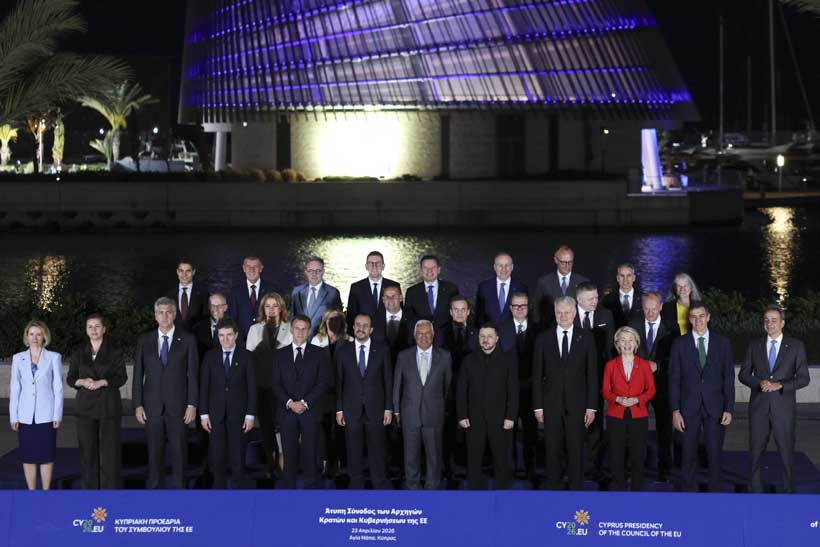
In light of recent security threats, European Union leaders are set to conduct a wargame on the EU’s mutual defence clause set on article 42.7 next month. This action stems from doubts over Cyprus’ pressure to better define the article after its country was hit by an Iranian-made drone, one of which hit RAF Akrotiri Airbase. Instead of invoking article 42.7, Cypriot president, Nikos Christodoulides, called for bilateral assistance, deeming the clause as poorly defined.
This event highlights Europe’s ability (or lack thereof) in managing defence-related crises. Europe possessed a mutual defence clause which has taken a nap for more than a decade, and now suddenly becomes the center of geopolitical attention in Europe. EU’s steps to operationalize the clause can set the future for Europe’s security readiness and strategic autonomy amidst geopolitical tension.
History and Development
EU’s article 42.7 was inspired by article 5 of the founding treaty of the Western Union Defense Organization, which later superseded by NATO. Since then, it has been Europe’s primary security guarantor. Article 42.7 however, is a recent creation, born out of the Lisbon Treaty in 2009. It reads:
Stay ahead of the geopolitical week.
MD Briefing delivers expert analysis across five global fronts — the Indo-Pacific, energy, geoeconomics, European security, and the Middle East — every Monday morning. Free.
“If a Member State is the victim of armed aggression on its territory, the other Member States shall have towards it an obligation of aid and assistance by all the means in their power, in accordance with Article 51 of the United Nations Charter. This shall not prejudice the specific character of the security and defence policy of certain Member States. Commitments and cooperation in this area shall be consistent with commitments under the North Atlantic Treaty Organisation, which, for those States which are members of it, remains the foundation of their collective defence and the forum for its implementation.”
The article has been invoked once in its history by France after the 2015 Paris terror attack. Subsequently, other Member States provided assistance in the form of intelligence, logistics, police, and troops, as shown by Finland who were sending its troops to replace French troops in UNIFIL. Yet, it is worth noting that France invoked article 42.7 as a political act to call for European solidarity amidst the criticisms it faced regarding its interventions in Mali and the Central African Republic.
EU’s Leaders Homeworks
If the EU is looking to operationalize article 42.7, they need to address some deficiencies beforehand. First and the most notable one is the absence of military action. Instead, it is written “aid and assistance by all the means in their power”, which does not entail boots on the ground. Member States are allowed to decide its nature of support individually, whether it is military or diplomatic support, or perhaps – for some countries – do nothing. This is the second weakness that stems from the sentence “This shall not prejudice the specific character of the security and defence policy of certain Member States”. It provides special exception for historically neutral countries – e.g Ireland, Malta, and Austria – to opt out from the obligation.
Aside from that, viewing it from a legal lens, the use of “military aggression” wording produces an ambiguity. No definition of said wording is provided in the article or anywhere in the Treaty on European Union (TEU). According to legal experts, the threshold of an armed aggression is lower than an armed attack. Not every act of armed aggression reaches the threshold of armed attack triggering the right to self-defence as stated on Article 51 of the UN Charter, which article 42.7 made reference to.
Furthermore, when France invoked article 42.7, aid and assistance were done through bilateral means instead through the EU. This is because the EU does not have an integrated military structure, unlike NATO which has Allied Command Operations (ACO) and Supreme Headquarters Allied Powers Europe (SHAPE) which command NATO’s operations worldwide. A mutual defence clause will only be meaningful if Member States have faith that others will come to help. EU’s lack of military standing , on the other hand, seriously hurt the Union’s defence posture and credibility.
What’s Next?
EU’s leaders’ attempt to map-out article 42.7 is a step forward in strengthening the EU’s defence posture. However, this raises the question of where it should be placed with NATO’s article 5 already available. The most extreme scenario would be to replace NATO’s article 5 wholly, although this step requires the most resources and time, which the Union scarcely possesses.
A more plausible course of action comes from the concept of burden shifting. Since the majority of Trump’s criticism towards European countries stems from its reluctance to bear the most responsibility in the Trans-Atlantic relationship, article 42.7 presents a way to rebalance the scale and perhaps achieve strategic autonomy in the future. The words armed aggression have a lower threshold to invoke, therefore article 42.7 could be applied to non-existential threats, such as limited hybrid attacks or terrorist attacks. This arrangement would distribute responsibilities evenly, US for existential threats and EU for non-existential threats, provided that the US is committed to safeguarding Europe. Moreover, it would accommodate some concern from countries that hold primacy to NATO’s article 5 over its EU counterpart, such as Poland and the Baltic States. These countries treat article 5 as their primary security guarantor over possible threats such as Russia. Second, it would allow the Union to handle issues that are unique to the EU. This is supported by the Chair of EU’s Military Committee, General Seán Clancy, who stated that the operationalization of 42.7 could handle issues that are ‘below article 5’. The burden shifting arrangement then would complement article 5 instead of replacing it altogether.
In Conclusion
Article 42.7 works better hand-in-hand with article 5. However, it is up to the Union itself on whether it should rely on the old security blueprint, compliment it, or achieve security autonomy right away. One thing for sure, the current article is way too broad to define, and Europe needs to act quickly to achieve what von der Leyen described as a ‘European Awakening’. Amidst tensions and threats worldwide, the EU cannot allow its mutual defence clause to take a nap anymore.