


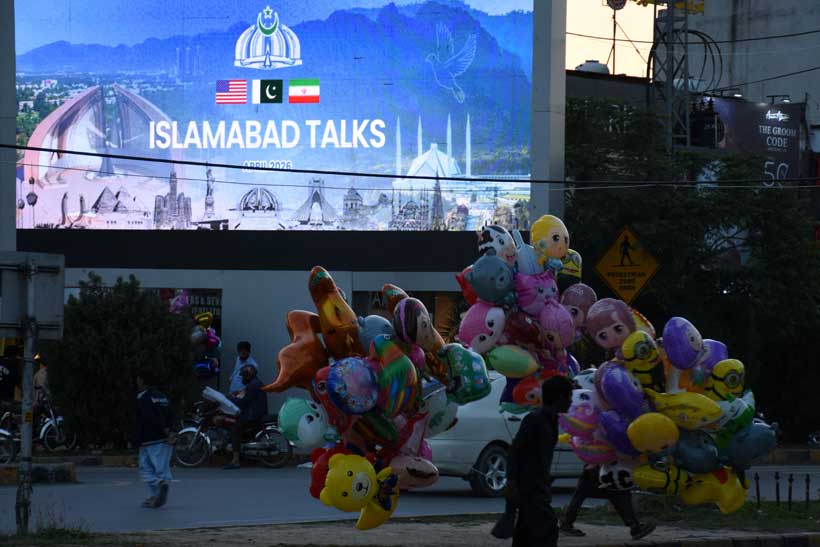
Donald Trump signaled that Iran could directly initiate negotiations to end the ongoing conflict, stressing that any agreement must ensure Tehran never acquires nuclear weapons. His remarks came as diplomatic momentum weakened following the cancellation of a planned visit by U.S. envoys to Islamabad.
At the same time, Iran’s Foreign Minister Abbas Araqchi moved between regional mediators before heading to Russia for talks with Vladimir Putin. Despite a temporary pause in large scale fighting, no formal agreement has been reached to end the war that began earlier this year.
Stalled Diplomacy and Rising Stakes
Efforts to revive negotiations have faltered amid deep mistrust. Reports suggest Iran proposed reopening the Strait of Hormuz and postponing nuclear discussions, but Washington has not confirmed any response.
The strategic waterway remains partially closed, disrupting global oil flows and adding pressure on international markets. Iran continues to demand recognition of its right to enrich uranium, while the United States insists on strict limits to prevent weaponization.
Stay ahead of the geopolitical week.
MD Briefing delivers expert analysis across five global fronts — the Indo-Pacific, energy, geoeconomics, European security, and the Middle East — every Monday morning. Free.
Regional Mediation Efforts
Iran has intensified diplomatic engagement with regional actors. Talks in Oman focused on maritime security and safe transit, while discussions in Pakistan reportedly included compensation, legal control of the strait, and guarantees against further military action.
Araqchi’s visit to Moscow highlights growing alignment between Iran and Russia, with both countries framing their cooperation as resistance to Western influence.
Domestic and International Pressure
Trump faces mounting domestic pressure as the prolonged conflict weighs on public opinion and economic stability. Rising oil prices and uncertainty in global markets have added urgency to finding a resolution.
Iran, despite military setbacks, retains leverage through its ability to disrupt a critical share of global oil shipments, strengthening its bargaining position.
Wider Conflict Dynamics
The conflict has expanded beyond bilateral tensions. Iran’s regional alliances and U.S. demands to curb Tehran’s support for groups such as Hezbollah and Hamas have complicated negotiations.
Meanwhile, violence continues in parts of the Middle East, including renewed clashes involving Israel and Hezbollah, underscoring the broader instability linked to the war.
Analysis
The current impasse reflects fundamentally incompatible priorities. The United States seeks a comprehensive deal that addresses nuclear capability, regional influence, and missile programs. Iran, by contrast, is focused on sanctions relief, sovereignty, and security guarantees.
Trump’s public invitation for Iran to initiate talks suggests a shift toward direct engagement, but it also places the burden of movement on Tehran. This approach may be aimed at strengthening Washington’s negotiating position domestically while signaling openness internationally.
Iran’s strategy appears to combine diplomacy with pressure. By leveraging the Strait of Hormuz and strengthening ties with Russia, Tehran is attempting to counterbalance U.S. demands and avoid negotiating from a position of weakness.
Unless both sides show flexibility, the conflict risks settling into a prolonged stalemate. The continued disruption of global energy supplies and the widening regional fallout increase the cost of inaction, making eventual negotiations likely but potentially more complex and drawn out.
With information from Reuters.
