


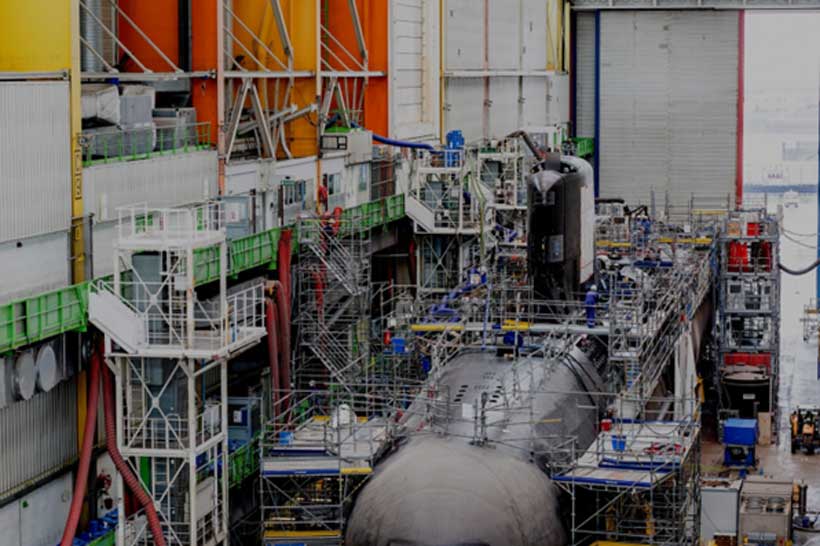
The news is reporting that a Korean KSS-111-class submarine is now on the west coast of Canada to be highlighted for the RCN and the Canadian public to see, on its longest sea voyage to date. Part of the Korean charm offensive, these submarines are a marvel of engineering and the newest examples of advanced undersea weaponry the South Korean Navy has to offer. It is also one of two finalists for the new RCN submarine replacement program alongside the German/Norwegian TKMS U-212CD class of SSK. Unfortunately, neither conventionally powered submarine really fits fully with what is required for the RCN to operate effectively in the Pacific or Arctic oceans.
While the KSS-111 class, like the U-212CD class, has the pedigree for fulfilling NATO ASW duties in the GUIK gap, it would actually make better logistical and operational sense to procure the U-212CD class for that duty in order to share and take advantage of commonality and supply chains with our NATO partners than rely on a long-distance Korean logistical tail that none of your allies share. But for the requirement to patrol for long periods under ice within the Arctic and the long distances needed to transit the vast distances of the Pacific Ocean quickly, neither finalist is really optimal. Canada would be better served with the purchase of a dedicated fleet of nuclear attack boats for that mission set, specifically the new French Suffren / Barracuda Class SSN.
Canada has no need for the size and long-range land strike capabilities of an Astute or Virginia-class submarine to fulfill her navy’s operational needs, because who are we realistically going to strike on land? Canada once upon a time almost purchased a fleet of nuclear submarines in the 1980s for the same mission requirement as today. Specifically, the now decommissioned British Trafalgar Class, but then the Cold War ended, and it was peace dividend time, and like so much else concerning the armed forces, the initiative was abandoned, but the need remained.
The French Suffren/Barracuda class today offers exactly what the RCN needs. The ideal balance of nuclear propulsion, almost unlimited endurance, and a small crew of just 65 people versus 100 or more for the British and American designs. Nuclear propulsion allows for fast transit underwater at high speed to anywhere and submerged endurance, only limited by the food aboard to meet the needs of the RCN to keep a constant presence in the Arctic ice pack or dash across the Pacific, making it a true threat to any adversaries.
A mixed fleet of 5 U-212CD and 5 Suffren/Barracuda-class nuclear submarines should actually be procured as the ideal RCN submarine fleet, allowing more capability with fewer ships. Stationing two Type 212 CD and two Suffren-class submarines with the Pacific fleet allows at least one and usually two subs to always be patrolling in both the mid- and Western Pacific. In the Atlantic, there should be stationed three type 212CDs and three Suffren-class submarines. This would allow there to be a conventional submarine to always be with the NATO North Atlantic ASW mission where ultra-long range is not so much of a concern. The three nuclear boats assigned for Arctic patrol would allow the RCN to keep at least one sub deployed at all times and could rapidly transit from area to area to meet any threats quickly. Canada has no real requirement for the offensive 1500 km land attack punch of the BGM-109 Tomahawk found in the British or American submarines. Conventional torpedoes and sub-launched NSM missiles are much more in line with the primary Canadian requirement to gather intelligence and hunt enemy surface and subsurface adversaries.
The submarine service in Canada is already quite small; 5 Suffren-class boats require a grand total of 325 crew, whereas 5 Virginia-class subs would require 675 sailors to man. That is a lot to ask for, the navy already having trouble filling ranks. If you add the 150 crew required to man 5 U-212CDs, you can either crew 4 Virginia-class or 10 of the 12 anticipated KSS-111 subs or instead fully man a mixed fleet of 10 nuclear and conventional Suffren and U-212CD submarines, allowing Canada to keep 4-5 subs at sea for about 90% of the time. While, granted, the cost of acquiring and maintaining a mixed fleet of 10 nuclear and conventional submarines is significantly more than just buying 12 conventional submarines, the capability and lethality boost for the RCN to fulfill its needed missions would be exponentially more with the mixed fleet including nuclear subs than any all-conventional fleet.
The RCN leadership are of course naturally ecstatic to be getting new subs at all and especially this quickly. The 12 talked about it like Christmas coming early after the struggles and money spent with the four used Upholder class that they have now. They know that both finalists being considered are not ideal for effective long endurance under ice patrolling or patrolling in the fairway western Pacific, but they know better than to look a gift horse in the mouth and speak up. That would risk having the whole existing project scuppered and turned into another in the long list of decades-long procurement fiascos, like the CH-148 or F-35. Unfortunately, civilian industrial politics has also reared its ugly head into the government decision-making process on which submarine to buy. Entirely unrelated industrial policy issues like automotive assembly in Canada have been rumored to be discussed as part of the submarine purchase.
Military procurement should ever only be about buying and building the right military hardware required for the actual mission requirements. Military hardware is already expensive enough to buy on its own. No contractor will use his own money to support a pet project; the cost gets added, and Canadians will pay, seeming way too much for a submarine that really costs less. We Canadians all get it that we need to keep jobs in Canada, but for once can the government actually focus on what equipment is best for our soldiers, sailors, and airmen to do the mission they actually will be called on to fight, and with whom they will fight alongside? Contractually mandate that the winners set up facilities here to manufacture and support the components required to build the weapons system in Canada, absolutely. If you really want to have the Koreans or Germans build autos here, at least have the honesty to give them the same separate direct multi-billion dollar subsidy to build the car plant like you traditionally do to every other automaker. Keep military procurement transparent and exclusively focused on our military needs and requirements only; don’t make defense contractors build civilian industrial pork into the cost of a military purchase.
The Koreans actually do build a very good modern submarine, and there is nothing wrong with the KSS-111 class, and it will definitely be light years better than our existing submarines. I fear, though, that the real reason that it might win the competition is because they promised to build more cars here, not because it fits the RCN’s needs better than the U-212CD or a nuclear sub. A few simple questions I wish to pose to our federal government as they contemplate which submarines to buy. Are we more likely to be fighting alongside the French, Germans, and Norwegians, or alongside the South Koreans? Whose equipment should we be more compatible with to share parts, service, and integrated tactics with? Do we really need to pad our sub-purchase cost to subsidize a car plant? Btw, there is still time to sign a contract for a mixed nuclear and conventional fleet and actually give the RCN the best tools to do its job, because if we are serious about giving our sailors the best kit to do the mission, let’s actually do it.
Stay ahead of the geopolitical week.
MD Briefing delivers expert analysis across five global fronts — the Indo-Pacific, energy, geoeconomics, European security, and the Middle East — every Monday morning. Free.
