


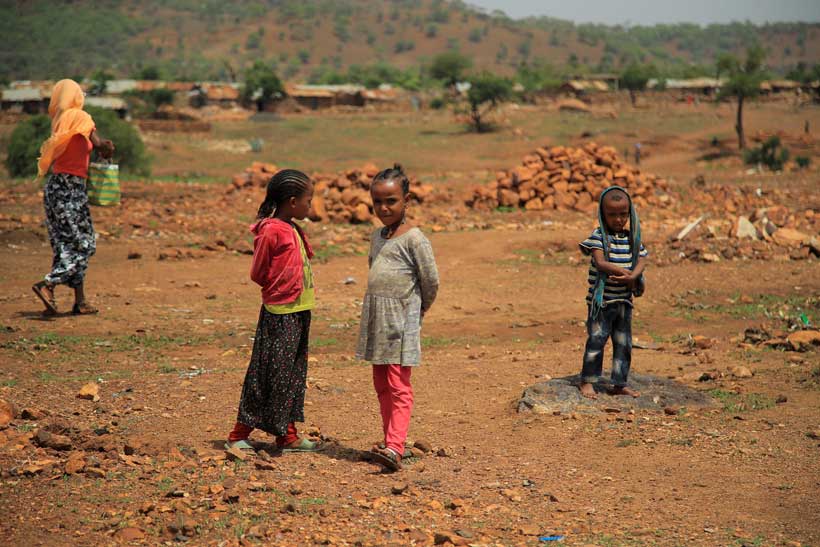
Ethiopia, which has the second-largest population on the African continent and belongs to the category of the fastest-growing economy in the region, entered the darkest phase in its modern history when, in November 2020, the federal government led by Prime Minister Abiy Ahmed carried out a massive military operation against the Tigray People’s Liberation Front (TPLF) in the Tigray region located in the northern part of the country. This conflict is not just a dispute between citizens; it vividly reflects the ethno-political tensions that have long accumulated in Ethiopia’s federal political structure. In the Horn of Africa region, which has been vulnerable to various forms of instability, the conflict in Tigray is a severe test for the regional system of governance in dealing with a large-scale humanitarian and security crisis. This article states that the Tigray problem was born out of the lack of political inclusion in Ethiopia’s system of ethnic federalism, which has a major impact on security in the Horn of Africa region in general. Therefore, there is a need for a structural and transformative solution, not just a temporary ceasefire, which is an urgent need and cannot be postponed any longer.
Ethnic Federalism as the Root of Structural Tensions
The ethnicity-based federal system introduced in Ethiopia since 1991 is essentially aimed at addressing the country’s highly complex ethnic diversity. However, as this system profoundly expresses, it inadvertently makes ethnic identity the main political entity in power, thus reinforcing the tendency to compete and divide among groups rather than countering them. For nearly 30 years, the TPLF held power within the ruling party coalition known as the Ethiopian People’s Revolutionary Democratic Front (EPRDF), placing its members in key positions in the military, intelligence, and civil administration, which made for a very solid network of clientelism. (Biramo Allaro et al., 2019)
When Abiy Ahmed, a leader from an Oromo-Amhara background, came to power in 2018 and began aggressively making changes to the EPRDF’s structure into a more centralistic Prosperity Party, the TPLF chose not to take part and preferred to isolate itself in Tigray while retaining its local military power. Tensions escalated until in November 2020, the TPLF launched an attack on a federal military base in Tigray, triggering a major military reaction from Addis Ababa and also involving Eritrean forces from the north. The conflict, which was initially expected to be brief, has instead extended for nearly two full years, leaving the impact of damage that is very difficult to measure. (Amuche EZUGWU & Duruji, 2023)
Stay ahead of the geopolitical week.
MD Briefing delivers expert analysis across five global fronts — the Indo-Pacific, energy, geoeconomics, European security, and the Middle East — every Monday morning. Free.
The Dimension of Humanity: When Weapons Become Tools of Hunger
In the context of human security, the conflict in Tigray led to one of the worst humanitarian crises in Africa’s modern history. critically evaluates that the military approach applied in Tigray systematically exploits famine as a tool of war through the closure of access to international humanitarian assistance, the destruction of agricultural and irrigation infrastructure, and the takeover of food production assets belonging to civil society. It is estimated that more than 500,000 people lost their lives due to direct violence or famine artificially created by the conflict, while more than 2.2 million people were forced to flee and lose their homes. This condition also has a very important aspect of international law that cannot be ignored. stated in their research that the acts recorded during the Tigray conflict had elements that could be categorized as crimes against humanity as well as serious violations of international humanitarian law, including the practice of organized and massive sexual violence. This requires a much more firm and real international legal response, not just at the level of diplomatic rejection statements. (Pellet, 2021) (Amuche EZUGWU & Duruji, 2023) (International Crisis Group, 2026)
Regional Impact: The Horn of Africa in a Circle of Instability
The Tigray conflict should not be understood only as Ethiopia’s domestic problem but should also be seen as a broader issue with regional implications. Eritrea’s active participation in sending its members to Tigray with the indirect approval of the Ethiopian government has turned this issue into a crisis involving much more complicated geopolitical aspects. Relations between Ethiopia and Eritrea, which had shown signs of improvement after the 2018 Peace Agreement that even led to Abiy Ahmed winning the Nobel Peace Prize, have been seriously tarnished again by Eritrean military involvement that resulted in a series of atrocities against the civilian population in Tigray. On the other hand, the flow of refugees stretching into eastern Sudan has further exacerbated the situation in Sudan, which is also facing a post-transition political crisis. (Demissie, 2023)
According to the report, instability in the Horn of Africa area is essentially mutually reinforcing: conflicts in one country often exacerbate weak stability in neighboring countries through the phenomenon of refugee flows and illegal arms trade across borders, as well as the impact of demonstrations on armed opposition groups in other countries. Furthermore, the African Union (AU) as the main regional organization was unable to act quickly and efficiently in the crucial early stages of this conflict. The African Peace and Security Architecture (APSA) mechanism, which is supposed to be the foundation for regional conflict management, has proven to be slow to move and lacks sufficient pressure on the parties involved in the conflict. This further strengthens the urgent argument about the need for institutional reform in the AU in its capacity to deal with intra-state conflicts that have cross-border impacts (Demissie, 2023).
The Pretoria Armistice and the Limitations in Improving the System
The Pretoria Peace Agreement agreed in November 2022 provides an opportunity to formally end the armed conflict and start a national dialogue involving all parties. However, lasting and meaningful peace cannot be simplified simply by stopping shooting on the battlefield. The underlying causes of conflict, including inequities in inter-ethnic political representation, persistent ethno-regional marginalization, and a culture of freedom from responsibility for perpetrators of violence, must be seriously and comprehensively addressed through constitutional reform that truly involves all stakeholders. (Heyi, 2023)
A meaningful reconciliation process urgently requires appropriate transitional justice mechanisms: comprehensive accounting of all abuses, accountability for perpetrators of all parties, comprehensive recovery for victims and affected communities, and significant institutional reforms. The lack of a strong accountability mechanism can lead to a state of “negative peace,” a situation in which there is no open war but also no real conflict resolution that could at some point explode again on a larger and more destructive scale.
Conclusion: The Importance of Inclusive Governance as the Basis for Lasting Peace
The conflict in Tigray provides a clear insight to the global community, especially to Africa, that while there is impressive economic growth in theory, it does not automatically guarantee sustainable political stability without inclusivity in true and meaningful governance. Ethiopia under Abiy Ahmed’s leadership has shown very high and impressive economic growth rates, but the strengthening of the centralization of power and the disregard for non-mainstream political actors have sown the seeds of conflict that have ended in fatality both in terms of the loss of countless lives and from the dwindling legitimacy of the state. For the entire East African region, the lessons learned from Tigray are a call that cannot be ignored: strengthen a regional peace framework capable of responding to and predicting situations, creating a truly efficient and integrated conflict prevention system, and encouraging the implementation of a better model of governance than just elite management of ethnic diversity. Without real and bold structural changes, the stability of the Horn of Africa region will continue to be a fragile edifice standing on a foundation that has never been properly repaired.
