


China is exploiting the escalating tension between US President Donald Trump and Pope Leo XIV (Robert Prevost) to bolster its image as a force for global stability and peace, in contrast to what it describes as the confusion and confrontational policies of the current US administration. From my analytical perspective as an expert on Chinese politics, the most significant impact of the Trump-Vatican dispute lies in fostering a rapprochement between China and the Vatican, perhaps for the first time in history, on sensitive international issues. The disagreement between Trump and the Pope over immigration and foreign policy opens a crucial avenue for Chinese diplomacy to engage with the Holy See on shared concerns, such as international multilateralism, by aligning China with the Vatican’s vision of a multipolar world that rejects American hegemony. China capitalized on the crisis and the war of words between Trump and the Pope to bolster its soft power. It exploited the Vatican’s isolation from the White House to strengthen agreements, such as the agreement on the appointment of bishops, and to portray itself as a nation that respects international institutions at a time when Trump was attacking them.
Although no official statement was issued by Chinese intelligence or military agencies regarding the verbal clash between US President Donald Trump and Pope Leo XIV in April 2026, China’s position can be inferred from the current geopolitical context of the crisis and the broader context of the dispute. Tensions began after the election of Pope Leo XIV (the American Robert Francis Prevost) in May 2025. The clash escalated in April 2026 after the Pope criticized the US- and Israeli-led war against Iran. Despite this, the general context of the expected Chinese political analyses emerged, based on China’s usual approach in such crises. The relevant intelligence circles in Beijing analyzed the situation from several angles, the most important of which was the dispute between Trump and Pope Leo XIV, which highlighted the deepening religious and institutional divide in the West and America. Here, China sees Trump’s attack on the first American Pope of the Vatican as an opportunity to reinforce its narrative about the erosion of American domestic stability and the division between religious and political institutions in Washington and the West. China also exploited Pope Leo XIII’s speech opposing a US war against Iran to support its anti-war rhetoric. Since China is adopting a diplomatic stance calling for de-escalation in the Iran conflict, Pope Leo XIV’s statements describing leaders as tyrants who are destroying the world align with the Chinese discourse advocating for multipolarity and rejecting American hegemony.
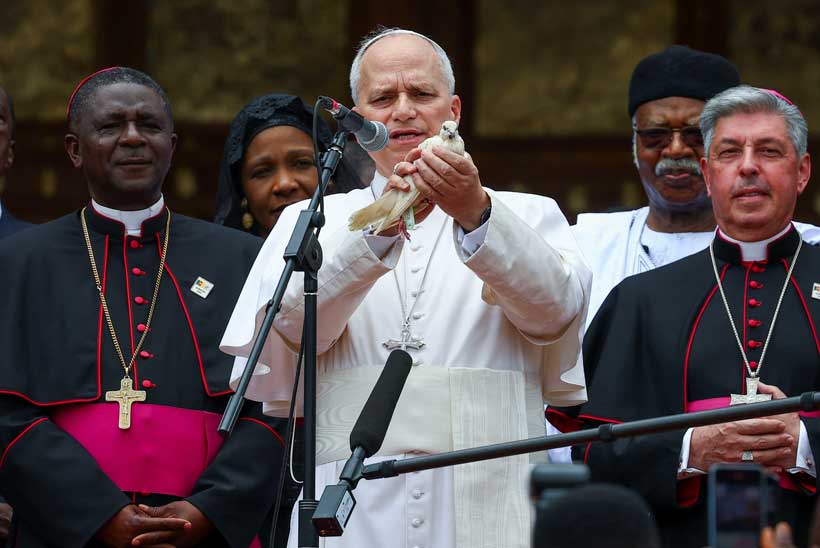
Here, Beijing’s propaganda machine seeks to highlight the perceived value contradiction in American policy. China capitalizes on the fact that Pope Benedict XVI, the first American pope in history, is facing harsh criticism from his own country’s president. Chinese media and spokespeople use this dispute to emphasize the internal divisions within the West, portraying the US administration as disrespectful even of its own spiritual symbols if they oppose its military ambitions. China exploits the crisis between Trump and the Pope to present itself as an alternative to war leaders, particularly after the Pope described Trump and other leaders as a handful of tyrants destroying the world. Immediately afterward, China moved to bolster its global diplomatic role. Regarding Iran, while Trump accuses the Pope of being lenient with Tehran, China promotes its efforts to secure the Strait of Hormuz and mediate an end to the conflict, a point Trump himself alluded to when he spoke of an anticipated warm embrace from Chinese President Xi Jinping. On the other hand, Chinese circles have been monitoring Pope Leo XIV’s movements to exploit his religious speeches highlighting tensions in Africa, especially after his visit in April 2016 to several African countries (Algeria and Cameroon), where he condemned all colonial abuses in his sermons. China capitalized on the Pope’s moral and religious discourse in Africa, leveraging his calls for peace during his tour of Algeria and Cameroon to emphasize its role as a strong development partner that does not interfere in the religious or moral affairs of countries or individuals, unlike the US administration, which has entered into a clash of values with the Vatican. Given China’s extensive influence in Africa, it has used this moral alignment with the Vatican to bolster its image as a more balanced partner compared to the current US administration. With China emphasizing the reality of the divide between Washington and the West and promoting the idea of American political isolation, China views Pope Leo XIV’s criticism of American wars and military funding as evidence of the West’s moral compass straying from the path of hawkish American foreign policy. This is further evidenced by the perceived unraveling of the unified narrative of the West and the United States. Beijing uses this perceived gap to assert that Western values are not monolithic and that there is a fundamental conflict between the religious left (represented by the Pope in Trump’s view) and American nationalist tendencies.
China also capitalized on the escalating tensions between Trump’s political rhetoric and Pope Leo XIV’s religious pronouncements opposing US wars and the war against Iran. China publicly welcomed Pope Leo XIV’s criticism of Washington’s policies in Iran, while Trump responded on Truth Social with sharp accusations, even posting an AI-generated image of himself as the Messiah, the savior of the world, an image that sparked widespread controversy both globally and within China. This was especially true given Trump’s repeated accusations that Pope Leo XIV was weak on crime and favored the radical left, while Pope Leo XIV affirmed that he was not afraid of the US administration and would continue his calls for peace. China exploited this situation for media, political, and propaganda purposes, highlighting Trump’s attacks on Pope Leo XIV. Trump described the Pope as weak on crime and disastrous on foreign policy and claimed that the Pope supported Iran’s acquisition of nuclear weapons, a claim the Vatican denied. This is in addition to Trump’s controversial statement that if I hadn’t been in the White House, Leo wouldn’t be in the Vatican, implying a political role in his election. Beijing is exploiting the harshness of these statements (Trump’s description of the Pope as weak and bad on foreign policy) as evidence of a fracturing of the traditional alliance between political power in Washington and global religious institutions. China is highlighting the moral rift in the relationship between religious and political institutions, seeing this clash between Trump and the Pope as an opportunity to portray the Western and American model as divided and incoherent, where the American political leadership attacks religious figures who criticize its military policies (especially regarding the war in Iran). Therefore, it is likely that China will limit itself to observing the political repercussions of this dispute on the upcoming US elections and on the cohesion of Washington’s allies, such as Italy (whose Prime Minister Meloni opposed Trump’s statements), without directly intervening in the religious debate.
Stay ahead of the geopolitical week.
MD Briefing delivers expert analysis across five global fronts — the Indo-Pacific, energy, geoeconomics, European security, and the Middle East — every Monday morning. Free.
In this context, China has exploited Trump’s boat diplomacy policy while simultaneously benefiting from his maximum pressure campaign against countries he labels as rogue states, such as Venezuela and Iran, which the Pope has explicitly criticized. Beijing presents itself to these countries as an economic and military lifeline (as in the case of Chinese satellites monitoring US bases on behalf of Iran), leveraging the moral cover provided by the Pope’s criticism of Washington’s policies. In short, China is not defending Pope Leo XIV for religious reasons but rather using the war of words between him and Trump as a propaganda tool to demonstrate that current US policy is morally isolated, even from the most important Christian institution in the world.
Based on the preceding analysis and understanding, we can see that this clash represents an ideal propaganda tool for China to demonstrate that American democracy is suffering from a severe identity crisis that is affecting its most stable institutions, thus weakening Washington’s influence in imposing its standards on the world.
