


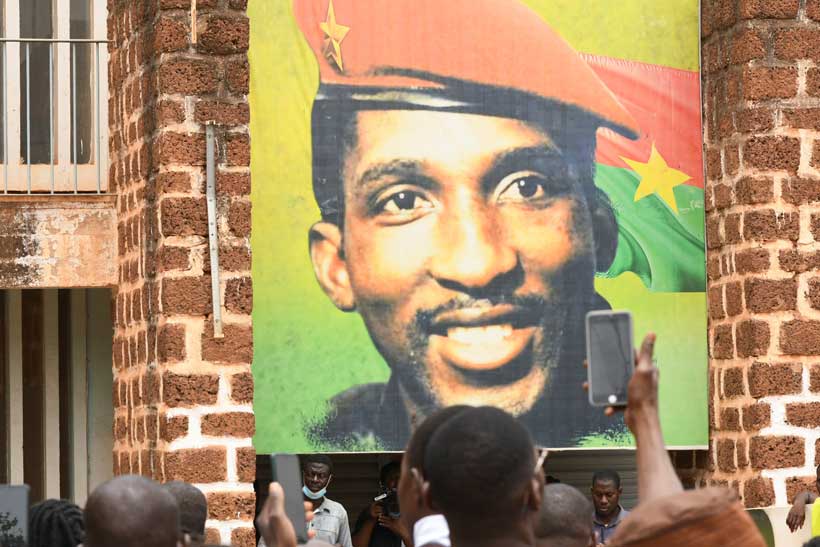
Authors: Lyna Saadi and Dr. Julian Spencer-Churchill
Western democracy-promotion programs in Africa are failing, but not for the reasons most analysts claim. The problem is not naivety or poor implementation. It is that the international system is structurally designed to produce exactly the kind of hollow, dependent governance it publicly decries. The case of Burkina Faso, from Thomas Sankara’s sovereign revolution to Blaise Compaoré’s twenty-seven-year accommodation, shows how that system operates in practice: rewarding pliability, penalizing sovereignty, and sustaining a façade of democracy that serves external interests far more than African citizens.
The Democracy Trap
There is a puzzle at the center of African political development that the mainstream literature has never satisfactorily resolved. If strong institutions are the prerequisite for stable democracy, why have certain African leaders, operating outside liberal democratic norms, managed to deliver tangible national development and relative stability, while externally sponsored democratic transitions have repeatedly collapsed into the corruption and fragility they were meant to prevent? The conventional answer, associated with scholars like Larry Diamond and Thomas Carothers, is that these cases represent transitional turbulence: democracy is messy in its infancy, and the solution is more democracy, better implemented, with stronger institutional scaffolding.
Stay ahead of the geopolitical week.
MD Briefing delivers expert analysis across five global fronts — the Indo-Pacific, energy, geoeconomics, European security, and the Middle East — every Monday morning. Free.
This paper argues that the conventional answer gets the causal story precisely backwards. The instability that plagues many post-transition African states is not a symptom of too little external democratic guidance. It is, in significant part, a symptom of too much but of the wrong kind. What masquerades as democracy promotion is often, in practice, the deliberate cultivation of what this paper calls pliable democracy: a governance arrangement that maintains democratic form while systematically hollowing out democratic substance, producing states that are legible and manageable to external actors but incapable of sovereign, transformative development.
This is not a new pathology. Its logic was visible in the CIA’s destabilization of Salvador Allende’s Chile in the early 1970s, when a democratically elected government was undermined precisely because it used democratic legitimacy to assert economic sovereignty. The same logic operates today across resource-rich African states, in subtler but no less consequential forms. When a government in Abuja or Accra moves to renegotiate an unfair mining contract, it faces what might be called a “sovereignty penalty,” not a crude blockade, but a sudden credit downgrade, a withdrawal of investor confidence, and a diplomatic campaign labeling it “unstable.” The goal is governance that remains reliably open and aligned, regardless of its democratic credentials. What masquerades as democracy promotion is often the deliberate cultivation of states that are legible to external actors but incapable of sovereign development.
Three interlocking mechanisms produce and sustain this condition. The first is façade democracy: the overwhelming allocation of external democracy aid toward electoral processes rather than institution-building, courts, civil services, or independent audit bodies that would make democratic accountability real. The second is elite co-option: the creation of a transnational political class whose personal economic futures are tied to foreign capitals, not their own citizens, producing what dependency theorists call a comprador class with split loyalties. The third is the sovereignty penalty itself: the enforcement mechanism that disciplines governments attempting to break from the model through financial pressure, diplomatic isolation, or the empowerment of domestic opposition.
Together, these mechanisms create what might be called a stable equilibrium of governed instability: enough disorder to justify continued external management, not enough to threaten the underlying architecture of access and extraction. The case of Burkina Faso between 1983 and 2014 illustrates this architecture with unusual clarity.
The Chilean Precedent
Before turning to Africa, it is worth pausing on Chile, because the mechanisms visible there in 1970–73 are the same ones operating today, and because the Chilean case reveals something important about the relationship between democracy and external interest that the conventional literature consistently obscures.
When Salvador Allende won the Chilean presidency in 1970 on a platform of copper nationalization and economic self-determination, the Nixon administration’s response was not to engage with his democratic mandate. National Security Advisor Henry Kissinger dismissed Chilean voters‘ choice as an “irresponsibility.” What followed was a textbook exercise in the three mechanisms described above. CIA funds flowed to Allende‘s opposition, centrist politicians, far-right agitators, and the press, most consequentially the newspaper El Mercurio, creating a class of Chilean elites whose political survival depended on serving foreign patrons rather than domestic constituents. Simultaneously, the United States orchestrated a global credit blockade, pressuring international lenders to close their coffers and manufacturing the economic crisis that would then be cited as proof of Allende’s ideological failure. The sovereignty penalty, in its rawest form: a nation choosing to control its own resources was cut off from the global financial system, its economy sabotaged to make sovereignty appear synonymous with collapse.
The coup’s aftermath cemented the cynical logic. Augusto Pinochet’s dictatorship, which murdered and disappeared thousands of citizens, was swiftly embraced by Washington. Pinochet dismantled democracy but guaranteed the pliability the Nixon administration sought. His Chicago Boy economists reinstated a free-market order hospitable to foreign capital. The lesson for subsequent governments in the developing world was unmistakable: a difficult democracy that asserts control over its resources is more threatening to external interests than a compliant autocracy that guarantees access.
This pattern did not end with the Cold War. Its contemporary African iteration is simply more sanitized: multilateral rather than unilateral, expressed through institutional conditionality rather than CIA covert operations, dressed in the language of governance reform rather than anti-communism. The substance remains.
The Burkina Faso Laboratory
Sankara’s Sovereign Experiment
Thomas Sankara came to power in Burkina Faso in 1983 with a program of radical economic and political self-sufficiency he called auto-centered development. For four years, his government represented one of the most deliberate attempts in postcolonial African history to break every mechanism of external dependence simultaneously.
He rejected IMF and World Bank structural adjustment programs, deriding them as tools of “financial imperialism.” He nationalized land and mineral wealth, declaring them the patrimony of the Burkinabè people, and launched ambitious agricultural programs aimed at food sovereignty. In foreign policy, he pursued a fiercely non-aligned stance, criticizing both Western and Eastern blocs and building South-South solidarity networks that bypassed traditional patrons. He implemented a severe anti-corruption campaign, forcing public officials to declare their assets, slashing their salaries, and replacing imported luxury vehicles with bicycles. Most importantly, he attacked the structural conditions that produce elite co-option: the material privileges and political centrality of the intermediary class that links foreign capital to domestic resources.
Sankara’s was not a flawless government. His revolutionary committees could be authoritarian; his treatment of rival leftist groups was often harsh; his disruptive social programs generated genuine domestic enemies among traditional chiefs, urban trade unions, and disaffected military officers. These internal tensions matter, and any honest account must acknowledge them. But they do not explain the external environment in which his experiment unfolded or how systematically that environment was engineered against him.
The Sovereignty Penalty Applied
The international response to Sankara’s four-year revolution was a textbook application of the sovereignty penalty. France, the former colonial power with deep political and economic ties to the region, significantly reduced aid and diplomatic engagement. The IMF and World Bank, whose policy prescriptions Sankara had rejected, labeled Burkina Faso uncooperative and high-risk, stifling access to credit. Conservative regional allies of France, most notably Côte d’Ivoire’s Félix Houphouët-Boigny, worked actively to isolate him, viewing his agenda as a dangerous ideological contagion.
The squeeze was multifaceted: financial, diplomatic, and regional. Its intended signal was unmistakable. The cost of radical sovereignty was economic hardship and political marginalization. The penalty was designed to make sovereignty synonymous with crisis to discredit the idea of autonomous development before it could demonstrate results. As historian Bruno Jaffré has documented, France viewed Sankara’s rhetoric and policies as a destabilizing force in its traditional sphere of influence and worked to ensure he remained isolated.
On October 15, 1987, Sankara was assassinated in a coup orchestrated by his closest comrade, Blaise Compaoré. While the coup was driven in part by personal rivalry and military factional politics, its external dimensions remain contested; some accounts suggest CIA involvement, though conclusive evidence is limited. What is not contested is the international community’s response to the result.
The Reward for Pliability
Compaoré’s subsequent twenty-seven-year rule can be read as a deliberate and largely successful effort to dismantle Sankara’s sovereign model and reintegrate Burkina Faso into the global system on terms favorable to external actors and a reconstituted domestic elite. He immediately rejoined the IMF and World Bank, embracing the structural adjustment programs his predecessor had spurned. This return to the fold was rewarded with a resumption and eventual increase in foreign aid and debt relief.
Crucially, Compaoré liberalized the mining sector, enacting a new mining code in 1997 that offered generous tax holidays and profit-repatriation terms to foreign corporations. Within years, Burkina Faso became a significant African gold producer, but revenues flowed disproportionately to multinational companies and a narrow political elite rather than funding transformative national development. The state’s role shifted from sovereign director to facilitating broker. The correlation between the Compaoré regime’s external orientation and its access to international support is difficult to explain without reference to the reward structure this paper describes.
After an initial period of military rule, Compaoré introduced a multiparty system in 1991. Elections were regularly held but systematically skewed: through control of the electoral commission, harassment of opposition, and dominant party advantages funded by state and illicit resources. The formal trappings of democracy, parties, polls, and a parliament were maintained, providing a veneer of legitimacy for international partners. Substantive institutions of accountability were gutted. The judiciary was subservient, the legislature a rubber stamp, and the media largely controlled or cowed. Western donors, keen to point to a stable democracy in a volatile region, continued their support while overlooking the authoritarian reality. This was façade democracy functioning precisely as the model predicts. The façade allowed Western donors to point to a “stable democracy” while overlooking its authoritarian core, a relationship of mutual convenience that served everyone except Burkinabe citizens.
The cornerstone of Compaoré’s system was the reconstruction of a co-opted elite. He deliberately fostered a new bourgeoisie whose wealth was entirely dependent on political connection and access to externalized rents: lucrative import-export licenses, contracts from donor-funded projects, and control over artisanal and small-scale mining sectors adjacent to industrial sites. This elite had no stake in national industrialization or economic sovereignty. Its prosperity was inextricably linked to maintaining the political conditions that guaranteed its privileged intermediary position. Political scientist Frederick Cooper’s concept of the gatekeeper state captures the dynamic precisely: political power functions primarily as a mechanism for granting access to wealth derived from external linkages.
Against the Conventional Wisdom
The mainstream democracy-promotion literature, associated most prominently with Diamond’s work on democratic consolidation and Carothers’ analysis of transitional governance, argues that development achieved under authoritarian conditions is fundamentally unsustainable. The centralized, coercive state can force rapid infrastructure projects and short-term economic growth, but it fails to build the inclusive, participatory institutions necessary for long-term resilience. When the strongman falls, the edifice collapses.
This argument contains genuine insight. Many authoritarian development models have been fragile, leader-dependent, and incapable of generating the distributional politics that sustain growth across transitions. But as an account of African political instability, it is incomplete in ways that matter for policy.
First, it misidentifies the direction of causality. The conventional wisdom treats instability as a product of authoritarian rule. But in many cases, the instability precedes and produces the authoritarian response; leaders who can impose order on politically fractured, economically pressured states may be responding to existential threats rather than creating them. To then blame those leaders for being illiberal is to ignore the conditions, often externally exacerbated, that made their rule a perceived necessity.
Second, and more fundamentally, the conventional wisdom treats the failure of democratic transitions as an internal African problem. It pathologizes African political experimentation as a deviation from a universal developmental path, rather than examining the structural international environment in which that experimentation occurs. When Sankara’s sovereign project was strangled economically and his successor rewarded for dismantling it, that was not an African governance failure. It was the international system operating as designed.
Third, the conventional hypothesis contains a circularity that renders it unfalsifiable. If an authoritarian development model succeeds, its successes are dismissed as temporary or illusory. If it fails, that is taken as proof of the model’s correctness. If a democracy is stable, it validates the theory; if it collapses, it is labeled a necessary growing pain. No outcome can challenge the prior conclusion. This is not a feature of good social science.
The unconventional wisdom offered here is falsifiable. It would be disproven if Western powers and international financial institutions consistently prioritized building strong, sovereign institutions in resource-rich nations even when those nations pursued independent foreign policies and demanded less favorable resource contracts. The evidence from Burkina Faso and from Chile, Libya, and the contemporary experience of states like Bolivia and Ecuador when they have asserted resource sovereignty does not support that scenario.
Toward Structural Reform
The implications of this analysis for policy are sobering but not paralyzing. If the mechanisms driving African governance failures are structural rather than merely behavioral, if the problem is not bad leaders making poor choices but a system that selects for pliable governance and punishes sovereign development, then the solutions must be structural as well.
The prescription is not the abandonment of democratic norms. It is the creation of institutional arrangements that make sovereign development viable and that sever the link between resource revenues and the patronage networks that sustain façade governance. One such arrangement is the Sovereign Development Trust (SDT): a legally independent, transparently governed national fund for managing strategic natural resource revenues, insulated by design from both elite capture and external conditionality.
The operational logic is straightforward. When a country negotiates a major mining or oil contract, a substantial fixed percentage of revenues, indexed to resource prices and national development needs, does not enter the national budget. Instead, it flows into the SDT, a public trust legally chartered to fund only long-term, sovereignty-building projects: national infrastructure, agricultural capacity, public health systems, and vocational education. The trust’s governance structure is designed as a firewall against the mechanisms identified in this analysis: citizen oversight bodies modeled on jury selection to disrupt elite monopolization; technical experts appointed by professional bodies rather than the presidency; regional institutional observers with strictly limited veto power over clear corruption, not policy choices; and, critically, zero sitting government officials with appointment or dismissal authority over trustees.
This model draws on established precedents, Norway’s Government Pension Fund Global, and Botswana’s Pula Fund, but is redesigned for political insulation rather than financial management alone. It accepts the realpolitik diagnosis that resources invite interference and corruption and builds a system that constrains both internal predators and external manipulators. Most importantly, it addresses the sovereignty penalty directly: when a government faces financial pressure for pursuing an independent resource policy, the SDT’s insulated projects continue, blunting the weapon of economic coercion that has historically made sovereign development too costly to sustain.
This is not a utopian vision. It is a structural fix for a structural problem, one that requires the international community to examine honestly whether its democracy-promotion programs are designed to build sovereign states or to manage dependent ones. The record of the past four decades suggests the answer. Until the incentive structures that punish sovereignty and reward hollow compliance are fundamentally reformed, the cycle of façade governance and its inevitable collapse will continue to define the political landscape of the African periphery.
Thomas Sankara was assassinated thirty-eight years ago. Blaise Compaoré governed for twenty-seven years, collected his rewards from Paris and Washington, and was eventually overthrown by the popular uprising his own system’s moral bankruptcy made inevitable. The jihadist insurgency that has since consumed Burkina Faso, rendering it one of the most severely affected countries by political violence in the world, is the long-run consequence of a governance model that prioritized external pliability over endogenous resilience.
The lesson is not that Sankara’s specific program was correct in every detail or that all authoritarian developmentalism deserves rehabilitation. It is that the international community’s framework for evaluating African governance is systematically biased toward forms of stability that serve external interests and against forms of sovereignty that might serve African citizens. Democracy is a genuine value. But the democracy promotion industry, as currently constituted, too often serves as a sophisticated mechanism for achieving something quite different: the maintenance of states that can hold elections but cannot enforce contracts, collect taxes, build industry, or negotiate on equal terms with multinational capital. Until that contradiction is honestly named, the golden handcuffs will remain in place, and the citizens of Burkina Faso, and dozens of states like it, will continue to pay the cost.
