


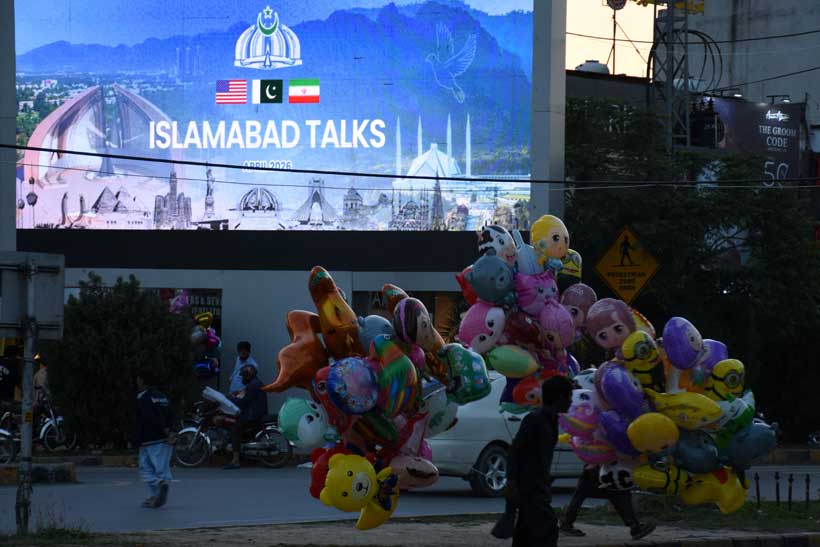
After more than six weeks of intense conflict triggered by US and Israeli strikes on Iran, delegations from Washington and Tehran met in Islamabad for the first direct negotiations in over a decade. The talks followed a fragile two week ceasefire aimed at halting a war that has already killed thousands, disrupted global trade, and shaken energy markets.
The negotiations marked the highest level engagement since the 1979 Islamic Revolution, raising cautious hopes for de escalation. However, deep mistrust and fundamentally opposing strategic goals quickly resurfaced.
Why the Talks Failed
Clashing Core Demands
The United States, represented by JD Vance, insisted on firm guarantees that Iran would permanently abandon any pathway to nuclear weapons.
Iran, led by Mohammad Baqer Qalibaf and Foreign Minister Abbas Araqchi, rejected what it described as excessive and one sided demands. Tehran instead pushed for:
Stay ahead of the geopolitical week.
MD Briefing delivers expert analysis across five global fronts — the Indo-Pacific, energy, geoeconomics, European security, and the Middle East — every Monday morning. Free.
- Control and economic leverage over the Strait of Hormuz
- War reparations
- A broader regional ceasefire including Lebanon
- Access to frozen financial assets
Trust Deficit
Iran framed the breakdown primarily as a failure of trust, arguing that Washington had not demonstrated credible commitment to honoring any agreement.
The US, on the other hand, portrayed Iran as unwilling to meet basic non proliferation conditions.
Flashpoints Beyond the Table
Even during negotiations, violence continued across the region:
- Israeli strikes targeted Iran backed groups in Lebanon
- Rocket fire and air raid alerts persisted along the Israel Lebanon border
These developments reinforced Iran’s demand that any agreement must extend beyond bilateral terms and address regional conflict dynamics.
Strategic Importance of the Strait
The Strait of Hormuz remains central to the crisis:
- Roughly one fifth of global oil flows pass through it
- Iran’s blockade has already disrupted supply chains
- Hundreds of tankers remain stranded despite limited movement during the ceasefire
Control over this chokepoint has become both a bargaining tool and a geopolitical risk multiplier.
Implications
1. Ceasefire at Risk
Pakistan’s foreign minister Ishaq Dar warned that maintaining the ceasefire is imperative. Without diplomatic progress, the likelihood of renewed large scale conflict increases significantly.
2. Energy Market Volatility
With uncertainty over shipping routes and supply continuity:
- Oil prices are likely to remain elevated
- Insurance and transport costs for shipping may surge
- Global inflationary pressures could intensify
3. Regional Spillover
The linkage between Iran and allied groups means:
- Conflict in Lebanon could escalate further
- Israel may expand operations
- A localized war risks turning into a wider regional confrontation
4. Diplomatic Setback
The failure undermines:
- Confidence in direct US Iran engagement
- Pakistan’s role as a mediator
- Prospects for near term nuclear diplomacy
Analysis
This breakdown highlights a fundamental misalignment rather than a temporary negotiating gap.
The United States is pursuing a narrowly defined security objective focused on nuclear containment and maritime freedom. Iran, by contrast, is negotiating from a broader geopolitical framework, seeking recognition of its regional influence, economic relief, and strategic control points.
Neither side appears willing to concede on these core priorities.
Statements from Donald Trump suggesting that a deal is not essential further weaken incentives for compromise, while Iran’s insistence on linking multiple regional issues raises the cost of any agreement for Washington.
The result is a classic deadlock:
- The US demands limitation
- Iran demands leverage
Until that equation changes, diplomacy is likely to stall while tensions remain dangerously contained rather than resolved.
With information from Reuters.
