


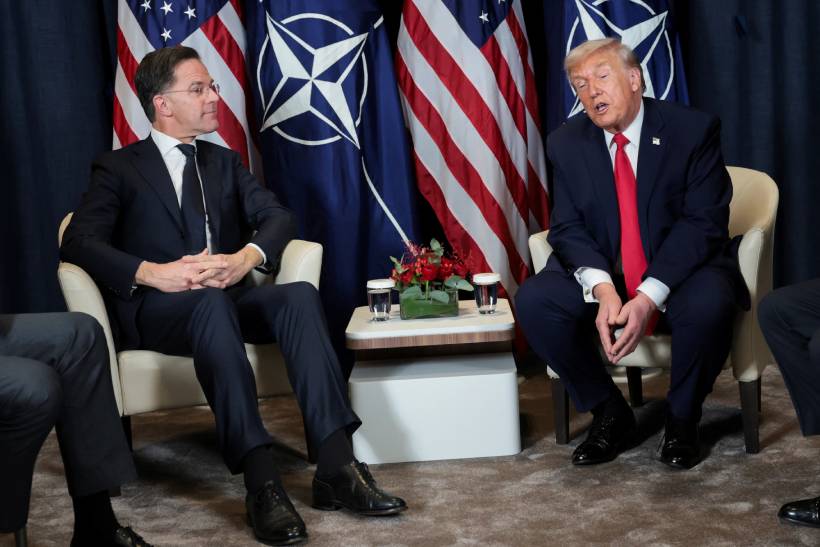
The recent escalation between Iran and US-Israel has once again reinstated President Trump’s views on NATO alliance as he openly warned of withdrawing from the Treaty. In order to counter the communist threat during the Cold War, the North Atlantic Treaty Organization was established on April 4, 1949 by Western bloc. The main objective of the alliance was to contain threat that was believed to come from behind the eastern borders. It establishes a sense of solidarity inside the alliance and pledges it’s members to defend one another under collective security (Article 5). In a media address, a couple of days ago, President Trump said that “we spent trillions of dollars on NATO and they treated us very badly.”
President Trump is furious with his western allies for not joining him in the Iran war. Western Allies have declined to support President Trump’s campaign against Iran. France was criticized by Trump for not permitting military flights to Israel. Meanwhile, Italy, as per a long-term agreement with the US, stated that special authorization for some flights was not requested, leading to a refusal. Spain has also closed its airspace to US operations, labeling the war as against international law. UK Prime Minister Starmer on Wednesday in a press conference affirmed that “this is not our war” and claimed it is not in the UK’s national interest. Germany’s President Steinmeier described the war as “possibly illegal,” asserting it violates international law.
The president stated in an interview with The Telegraph that U.S. membership in NATO was “beyond reconsideration.” I was never swayed by NATO. I always knew they were a paper tiger, and Putin knows that too, by the way,” Trump said. In December, 2023 US Congress approved a bill barring presidents from unilaterally exiting NATO. The provision was included in the National Defense Authorization Act, an annual bill detailing defense policy. Under the law, the president would be prohibited from withdrawing from NATO without the approval of two-thirds of the Senate or separate legislation passed by Congress.
Trump wants NATO to expand its role beyond Europe, engaging in a broader array of issues and missions, with the United States leading the charge. While the U.S. views NATO as a critical avenue for Trans-Atlantic dialogue and organizing military missions outside Europe, West European nations prefer a more cautious and conciliatory strategy, steering clear of a hard-line stance this time. Consensus decision-making is a fundamental principle of the alliance. It has been accepted as the sole basis for decision-making in NATO since the creation of the Alliance in 1949. Upon asking by Media about Trump calling allies ‘cowards’ on Iran, NATO General Secretory, Mark Rutte said that the US didn’t inform Europe because they wanted to keep the campaign secret. Some European leaders like Macron says that France has not been consulted about this war.
Stay ahead of the geopolitical week.
MD Briefing delivers expert analysis across five global fronts — the Indo-Pacific, energy, geoeconomics, European security, and the Middle East — every Monday morning. Free.
Secretary of State Marco Rubio stated that the U.S. will reassess its NATO relationship after the conflict with Iran, mirroring President Trump’s criticism of European allies’ reluctance to support military operations in the Middle East. Ultimately, that’s a decision for the President to make, and he’ll have to make it,” Rubio told host Sean Hannity during an appearance on Fox News. Defence Secretary, Pete Hegeseth when asked in a media briefing whether US will commit to the NATO’s collective defence, he suggest that the decision is up to the president but ‘a lot has been laid bare’.
The future of NATO in a potential second Trump presidency may involve a gradual redefinition of alliance commitments rather than a formal withdrawal. Trump threatened to stop weapons to Ukraine unless Europe joined Hormuz coalition, a move to secure and open the Strait by force in the current crises. Some analysts believe he may consider drawing down or recalling troops from Europe if the situation go from bad to worse. Minority leader of the US Senate, Chuck Schumer on X quoted Secretory of State Rubio’s statement about NATO withdrawal and Senate approval which says that ‘The Senate will not vote to leave NATO and abandon our allies just because Trump is upset they wouldn’t go along with his reckless war of choice. Some analyses suggest that the President rhetoric is intended to force some action from NATO allies during this ongoing war in the Middle East. There is a view that if he withdraws from NATO without congressional approval, it could lead to a legal battle against him. If a President violates the law on this treaty Congress can seek recourse in the courts.
