


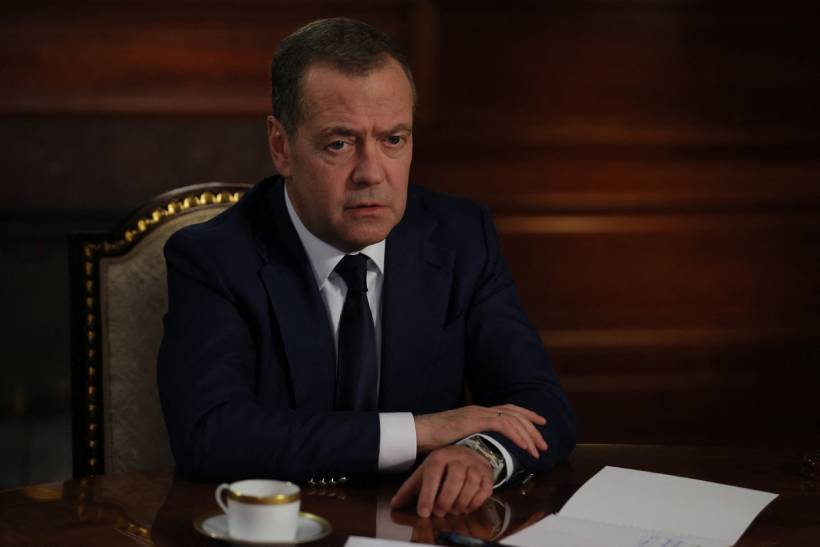
Dmitry Medvedev, deputy chairman of Russia’s Security Council, signaled on Friday that Moscow should abandon its “tolerant attitude” toward Ukraine’s potential accession to the European Union. Medvedev framed the EU not merely as an economic bloc but as a rapidly evolving “military-economic” alliance, which he suggested could become overtly hostile to Russian interests.
By linking EU membership to a potential military threat, Medvedev highlighted Moscow’s perception that Ukraine’s westward integration—whether through the EU or through NATO influence—represents a strategic challenge. He explicitly compared the potential EU-military convergence to NATO, suggesting it could be “in some ways worse” for Russia.
NATO and U.S. Role
Medvedev acknowledged that the United States is unlikely to leave NATO but suggested Washington might take symbolic measures such as reducing troop deployments to Europe. This underscores Russia’s focus on Western military structures and their potential impact on its regional security calculus.
His comments also pointed to the perception of NATO divisions, implying that these fractures could accelerate the EU’s transformation from a primarily economic union into a militarized bloc—heightening Russia’s security concerns.
Stay ahead of the geopolitical week.
MD Briefing delivers expert analysis across five global fronts — the Indo-Pacific, energy, geoeconomics, European security, and the Middle East — every Monday morning. Free.
Strategic Implications
Medvedev’s remarks signal a more assertive stance from Moscow toward Ukraine’s European integration. By framing the EU as a potential military threat, Russia could justify increased pressure on Kyiv and justify defensive or offensive measures under the guise of protecting national security.
This rhetoric may also aim to influence internal Russian discourse, rallying support around the government’s position against Western encroachment, while sending a warning to European capitals about the consequences of deepening Ukraine-EU ties.
Analysis
Medvedev’s statement illustrates how Russia is redefining traditional security threats. The EU, traditionally seen as a soft-power economic partner, is now cast as a potential adversary in Russia’s strategic narrative. This aligns with broader Russian policy trends, where Western integration of neighboring states is increasingly viewed as a direct challenge to Moscow’s sphere of influence.
It also reflects a potential shift toward preemptive measures against Ukraine’s European ambitions, suggesting that Russia may act not only militarily but also politically and economically to counter Kyiv’s EU trajectory.
With information from Reuters.
