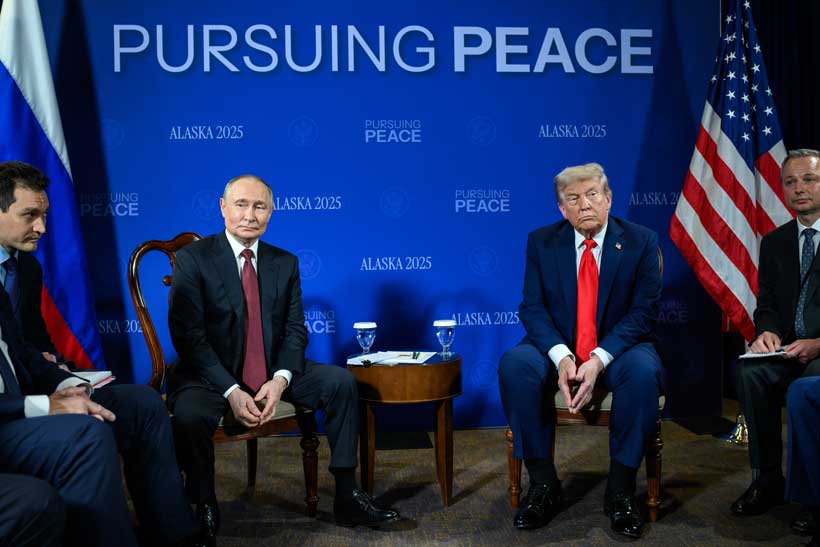
On March 22, Donald Trump posted a threat on Truth Social. If Iran did not fully open the Strait of Hormuz within 48 hours, the United States would strike and destroy its power plants, starting with the largest. Tehran responded within hours through the spokesman of its central command, warning that Iran would attack desalination plants and information technology infrastructure associated with the United States and Israel. Within less than a day it had named, without ambiguity, what each side held over the other: the physical systems on which populations depend for electricity and water, rather than armies, territory, or nuclear arsenals. Both sides have reached, independently and symmetrically, for the same instrument.
Twelve hundred kilometres to the north, Russia had been reaching for the same instrument for more than four years. The campaign against Ukrainian energy infrastructure began with substations in the first winter and extended progressively to generation capacity, gas production, and underground storage through 2025. By the time of the Trump ultimatum, it had reduced Ukraine’s electricity generation to less than 40 percent of its prewar capacity. Millions of Ukrainians had spent the winter in blackouts lasting up to four days at subzero temperatures. The logic driving that campaign is not fundamentally different from the logic Trump applied to Iran on a Saturday morning on a social media platform. Civilian infrastructure, in both cases, has been repurposed into something the classical military sense never anticipated, a lever through which a political objective, something that could not be settled on the battlefield, was to be extracted from a population made to bear the cost of its government’s choices.
What the exchange made visible, in a way that months of military analysis had not, is the logic that now governs great power coercion in both active conflicts reshaping the international order. Civilian infrastructure has become a hostage. That is not quite the same thing as a target: where a target is destroyed to produce military effect and discarded, a hostage derives its value from remaining intact, and the threat to it is what generates the political price, not its destruction. The Trump-Iran exchange, read alongside Russia’s four-year campaign against Ukrainian energy infrastructure, marks the point at which that logic has become openly declared and, more tellingly, apparently unremarkable to the governments deploying it.
The Structure of the Threat
What distinguishes Trump’s ultimatum from ordinary military signaling is its specificity. He does not threaten Iran with escalation in general terms but names a category of target, power plants, and specifies a sequencing logic, starting with the largest. The 48-hour deadline is a price tag. Structured as a bargaining instrument and not as a declaration of war, its terms are left unstated but readable to anyone paying attention. The target is deliberately named for its pain value to the Iranian population and its recoverability as a threat, leaving military decisiveness beside the point. A threat loses its utility the moment it is executed, and Trump is, at least at the moment of posting, still in the phase where the threat is the point.
Stay ahead of the geopolitical week.
MD Briefing delivers expert analysis across five global fronts — the Indo-Pacific, energy, geoeconomics, European security, and the Middle East — every Monday morning. Free.
Iran’s counter-designation carries the same internal logic. Desalination plants and IT infrastructure are not military assets but the systems that provide fresh water to populations across the Gulf and sustain the digital connectivity on which regional economies depend. By naming them, Iran threatens to impose costs on civilian life and economic function across a region that includes US allies, US investment, and US-aligned populations. American military capacity is largely beside the point. The population becomes the medium of pressure, the infrastructure its instrument, and compliance the price set for its release, calibrated to impose discomfort while remaining difficult to frame as an act of war.
Within a single news cycle, the United States and Iran publicly designate civilian infrastructure as a legitimate coercive instrument. Washington threatens Iranian power plants, Tehran threatens US bases and allied infrastructure across the region, both treating the move as unremarkable, both declining to frame it as a war crime. The framework governing both threats is the Schellingian logic of threats, commitments, and credibility. The logic of coercion remains intact, but its object has shifted from military capability toward the infrastructural systems that sustain civilian life, allowing threats to be maintained without triggering the escalation that execution would require.
Mehr News Agency, an Iranian state outlet, published a map marking the locations of major power plants across the Gulf, covering sites in the UAE, Saudi Arabia, Qatar, and Kuwait. It noted that 70 to 80 percent of the region’s major plants sit along the coastline and within range of Iranian missiles, and warned that a limited strike on Iranian electricity infrastructure would plunge the entire region into darkness. The designation of civilian infrastructure as coercive currency has acquired a geography, a distribution, a visual form. Bilateral rhetoric alone could never have provided that, and the threat now extends across the region’s entire energy landscape.
At the same time, Iran’s permanent representative to the International Maritime Organization stated that the strait remained open to all except Iran’s enemies, that diplomacy was Tehran’s priority, and that a complete cessation of aggression was the condition for any resolution. The threat and the off-ramp are issued simultaneously, through different channels and to different audiences. This is how the hostage logic operates when it is working as intended, the infrastructure held instead of destroyed, the door kept open, compliance made the condition of relief.
Putin’s Version
Russia has not needed to issue an ultimatum. It has been executing the same logic through sustained bombardment for four years. The difference in method sits on top of a remarkably similar purpose. Russia’s infrastructure campaign in Ukraine is coercive in exactly the same sense as Trump’s threat to Iran, oriented away from destroying Ukrainian military capacity and toward making the Ukrainian population bear costs severe enough to erode the political will sustaining the war effort. The target is chosen for the pain it can inflict and the near-impossibility of defending it across the entire surface area of a modern state.
The campaign’s evolution revealed how the logic develops when it moves from the threat phase into the execution phase. In the first winter, Russia targeted transmission infrastructure, the connections between generators and consumers: severing the relationship is cheaper than destroying the node, and a generator unable to transmit is already defeated. When that proved insufficient, the campaign shifted to generation capacity directly, then extended to gas production and underground storage, then began targeting the railway network that supplies the front, each escalation widening the surface area under attack because the previous layer had not been enough.
And yet what Ukraine’s resilience revealed is that coercive infrastructure warfare carries an execution problem that the threat phase conceals. The execution of the threat has produced rubble and international condemnation, and a population response that has proved more adaptive than Russia’s planners had calculated. Ukraine decentralised its generation, repaired faster than most analysts expected, absorbed costs that would have been politically intolerable in most European states, and kept fighting. The coercive logic assumes a particular relationship between infrastructure damage and political compliance, and that relationship has not held so far in the way the campaign required. Whether Ukrainian resilience reflects a genuine refutation of the model or simply a longer timeline than Russia anticipated remains unclear. The population absorbs the cost and directs its anger not at the government but at Russia, which is precisely the outcome the coercive model is designed to prevent.
That misdirection is the miscalibration. It lies in the model of how populations respond to sustained infrastructural pressure, which complicates the doctrine without refuting it, and Trump’s planners face the same unresolved problem Russia has been living with. If the plants are struck and Iran does not open the strait, the United States will have executed a threat that was supposed to remain in the threat phase, and the coercive logic will need to be rebuilt from a position of having already acted.
The Currency of Coercion
What the Trump-Iran exchange and the Russia-Ukraine campaign share, beneath their differences in scale and method and political context, is a common understanding of what infrastructure is for in the current moment of international politics. Its role has shifted away from the military targeting logic it once served and toward what appears, in both these cases, to be the most available instrument of pressure. States reach for it when direct military decision cannot deliver their objectives, either because the cost is too high, or because the adversary’s conventional defense has proven adequate, or simply because the escalation risks of direct engagement exceed what the objective is worth.
Trump cannot invade Iran, the military capacity existing but the political cost in lives, treasure, regional stability, and domestic opinion exceeding what the opening of a commercial waterway can justify. Putin cannot break through in the Donbas at acceptable cost after four years of trying. The constraints differ, and so do the credibility structures. Trump issued his threat once, publicly, with a deadline he has since extended twice, first by five days, then by ten to April 6, each extension confirming that the threat is worth more intact than executed. Russia’s credibility was built differently, through four years of incremental execution that made its seriousness impossible to dispute. That asymmetry matters. Trump’s behaviour in this exchange suggests something closer to a dealer’s instinct than a strategist’s, transactional and always looking for the exit, the infrastructure threat functioning as the lever, held long enough to generate movement, then released the moment he had something to point to as progress. Putin, by contrast, has built no equivalent release mechanism into the campaign. It runs as a strategy of exhaustion, indifferent to the diplomatic off-ramp, sustained across four winters without pause.
But both reach for the same substitute: turning the adversary’s population into the medium of pressure by designating the infrastructure that sustains daily life as the instrument. The governing authority is left with a choice between political compliance and continued civilian suffering. The populations of Iran, Ukraine, and potentially the Gulf are becoming the terrain on which great power objectives are pursued.
Iran’s counter-threat on desalination completes a circuit that the Trump-Iran exchange opened. The transactional frame, applied across military operations, alliance commitments, and now coercive ultimatums, arrives at the same destination each time, the point where the population itself becomes the bargaining chip and the infrastructure that sustains it becoming the currency of that pressure.
Schelling’s grammar is visible throughout. He wrote that the power to hurt is bargaining power. The current moment has preserved that grammar while expanding its surface area, extending it across infrastructure that is vast, interdependent, and difficult to defend. It is now being deployed in public, by presidents, on social media, about power plants and desalination facilities, with nobody particularly surprised. That absence of shock is perhaps where the real shift has occurred, more telling than the threats themselves. What the postponement also reveals is that deployments of the instrument differ in a way that matters. Trump threatened and pulled back, confirming that for him the infrastructure was never the objective but the price tag. Russia has spent four years making clear that for Putin the destruction is the point, not the leverage. They share the instrument but not the doctrine of its use, and that difference shapes how the hostage logic functions depending on what coercion is being asked to achieve and in whose hands it sits.
Conclusion
There is a line that connects Trump’s Truth Social post to Putin’s winter campaign and to Iran’s counter-designation of desalination infrastructure, and the line is not ideological. Trump and Putin converge on an instrument without sharing a vision of international order. It is the instrument that presents itself when conventional military decision has become too costly or too slow or too escalatory, redirecting the contest away from the battlefield toward the substrate where populations can be made to feel the cost of their government’s choices.
The convergence across these theatres suggests, though it does not yet prove, that what is being witnessed is not a series of separate tactical decisions but the consolidation of a doctrine that no state has formally articulated, that no international framework has yet named, and that all the major powers appear to be practicing simultaneously.
The openness with which this logic is now being deployed, through 48-hour ultimatums and published maps of regional power plants, suggests that the normative boundary that once made civilian infrastructure a protected category has not just eroded but may have quietly given way to something else entirely. Infrastructure has become the currency of coercive diplomacy, where what you hold may matter more than what you can deploy. What both conflicts are revealing, at different speeds and through very different instruments, is that the era in which military decision could be purchased at acceptable cost may be closing, and that populations, not territory, are becoming the surface on which that cost is now imposed.