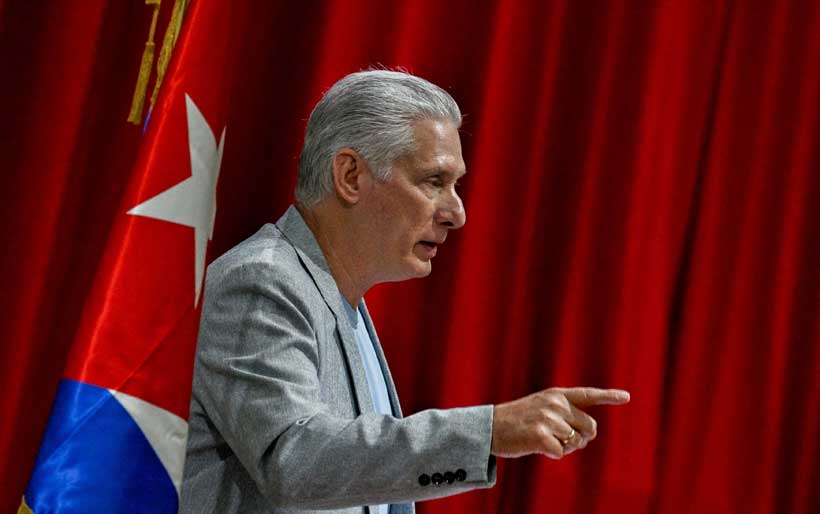
Cuba and the United States are currently involved in talks amid rising tensions, driven by President Donald Trump’s de facto oil blockade affecting the Cuban government. Cuban President Miguel Diaz-Canel has stated that the discussions should occur “on the basis of equality” and mutual respect. However, Trump has made aggressive comments, claiming he can do whatever he wants regarding Cuba, which he considers a sovereign neighbor. Despite this, reports suggest that there could be a potential deal where the U. S. seeks to push Diaz-Canel from power in exchange for easing sanctions and not acting against the Castro family.
Key figures in this situation include U. S. President Donald Trump, who has made several threatening statements, indicating he might focus on Cuba after dealing with Iran. U. S. military officials have assured that there are no plans for a military invasion of Cuba. Leaked information implies that the U. S.’s strategy might mirror its actions in Venezuela, where it removed President Nicolas Maduro.
Trump’s discussions are reportedly being led by Marco Rubio, the Secretary of State and National Security Advisor. Rubio, a Cuban American with strong ties to the Cuban diaspora, is navigating a complex landscape; any agreement that does not diminish the power of the Communist Party could be unpopular, particularly in Florida. A push to remove the Cuban government might lead to violence and a possible mass migration from Cuba, while the Cuban government currently cooperates in drug trafficking efforts.
Raul Castro, 94, who fought alongside his brother Fidel in the 1959 revolution, remains influential despite stepping back from official leadership roles. He is still viewed as a unifying figure among revolution supporters and is involved in the ongoing U. S. negotiations alongside Diaz-Canel. Notably, Castro suggested postponing a critical Communist Party congress slated for December 2025 due to Cuba’s economic struggles.
Miguel Diaz-Canel became the first non-Castro leader of Cuba in 2018. He initially faced challenges from Trump’s reversal of the previous administration’s more open approach to Cuba. His image was severely impacted by his reaction to national protests in July 2021, when he called for a strong response, resulting in a crackdown on demonstrators that further strained his public standing.
Raul Guillermo Rodriguez Castro, also known as “El Cangrejo” or “The Crab,” is another key player. At 41, he is described as a close confidant of Raul Castro and is reported to be involved in secret talks with Rubio. The Cuban government has provided no details on his role. His background positions him strategically at the intersection of Cuba’s political and economic power, potentially making him an important intermediary in negotiations.
Manuel Marrero has served as Cuba’s prime minister since 2019 and was elevated to the Politburo in 2021. His experience spans tourism management, and he’s considered a potential successor to Diaz-Canel. Oscar Perez-Oliva Fraga, a rising figure since becoming foreign trade minister in 2024, has added significant roles to his portfolio. He is linked to the Castro family by his grandmother, who was a sister to Fidel and Raul Castro, giving him a unique position within the leadership.
Together, these individuals will shape Cuba’s future as the discussions between Cuba and the U. S. unfold.
With information from Reuters