


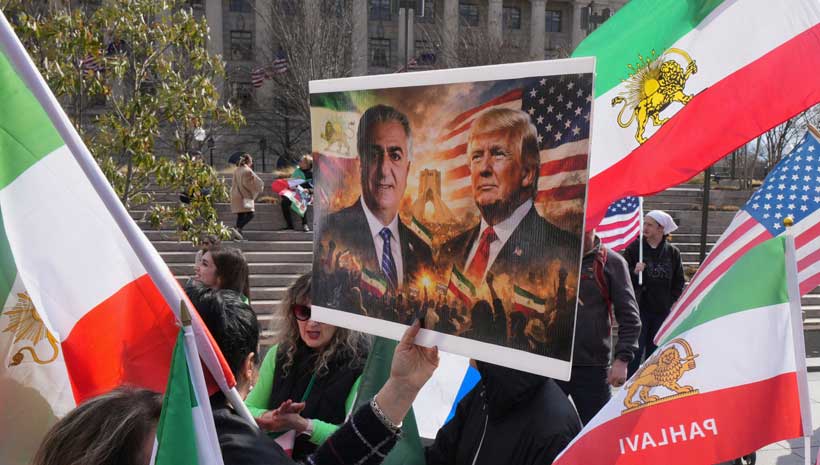
Nearly four weeks into a devastating conflict triggered by United States and Israeli strikes on Iran, the war has entered a volatile and uncertain phase. What initially appeared to be a contained military escalation has rapidly transformed into a multidimensional crisis with global repercussions. At the center of the latest developments lies a stark contradiction between statements from Donald Trump and Iran’s foreign minister Abbas Araqchi.
Trump claims that Iranian leadership is quietly seeking a deal, suggesting desperation beneath Tehran’s public posture. In contrast, Araqchi has firmly rejected the notion of negotiations, emphasizing that indirect message exchanges through intermediaries do not constitute dialogue. This divergence reflects not merely a disagreement in rhetoric but a deeper strategic signaling battle, where perception itself becomes a tool of war.
The absence of direct negotiations underscores a broader diplomatic vacuum, even as backchannel communications continue through regional actors such as Pakistan. This ambiguity is not accidental. It allows both sides to maintain domestic legitimacy while testing the waters for possible de escalation.
The Strategic Messaging War
The conflicting narratives emerging from Washington and Tehran are indicative of a classic coercive diplomacy framework. Trump’s assertion that Iranian leaders “want a deal” but fear internal backlash serves two purposes. First, it attempts to portray Iran as internally fragile. Second, it signals to both domestic and international audiences that the United States holds the upper hand.
Stay ahead of the geopolitical week.
MD Briefing delivers expert analysis across five global fronts — the Indo-Pacific, energy, geoeconomics, European security, and the Middle East — every Monday morning. Free.
On the other side, Iran’s insistence on the absence of negotiations is rooted in regime survival. Public acknowledgment of talks under military pressure could be interpreted domestically as capitulation. For Tehran, maintaining the image of resistance is as critical as any battlefield outcome.
This dual messaging creates a paradox. Both sides may be inching toward de escalation through intermediaries, yet neither can politically afford to admit it openly. The result is a dangerous limbo where diplomacy exists without being formally recognized.
Expanding Conflict, Collapsing Stability
The war’s consequences are no longer confined to military exchanges. The effective closure of the Strait of Hormuz has triggered what many analysts describe as the most severe energy shock in modern history. As a vital artery for global oil and gas flows, its disruption has sent shockwaves across industries and economies.
Energy prices have surged, supply chains have fractured, and governments are once again considering emergency interventions reminiscent of the COVID era. From aviation to agriculture, the ripple effects are profound. Farmers face diesel shortages, logistics networks are strained, and food insecurity is rising at an alarming rate.
The warning issued by Antonio Guterres that the world is “staring down the barrel of a wider war” reflects not only military risks but systemic global instability. The longer the conflict persists, the more it erodes economic resilience and political stability worldwide.
The Ceasefire Proposal: Conditions or Surrender
The reported fifteen point United States proposal, conveyed through intermediaries, outlines sweeping demands. These include reopening the Strait of Hormuz, dismantling Iran’s enriched uranium stockpiles, curbing its missile program, and ending support for regional allies.
From a strategic standpoint, these terms resemble not a compromise but a framework for strategic rollback. For Iran, accepting such conditions would fundamentally weaken its deterrence architecture and regional influence. This explains Tehran’s resistance and its insistence on including Lebanon in any ceasefire arrangement, signaling that its regional network remains central to its bargaining position.
Israel’s skepticism toward Iran’s willingness to comply, coupled with its desire to retain the option of preemptive strikes, further complicates the equation. Even if negotiations were to materialize, the lack of trust among all parties would make enforcement of any agreement extremely fragile.
Domestic Pressures and Political Calculations
The war is increasingly shaping domestic political landscapes, particularly in the United States. With declining approval ratings and growing public opposition to military action, Trump faces mounting pressure to deliver a diplomatic outcome. The timing is critical, as the conflict unfolds in the shadow of upcoming congressional elections.
In Iran, internal dynamics are even more opaque and volatile. The reported killing of Ali Khamenei and the uncertain status of his successor has likely intensified internal power struggles. In such an environment, engaging in overt negotiations with the United States could be politically destabilizing for the regime.
Thus, both leaderships are constrained not only by strategic considerations but by domestic legitimacy. This convergence of internal and external pressures makes the path to peace exceedingly narrow.
Military Momentum versus Diplomatic Urgency
On the battlefield, the United States and Israel appear to have achieved significant tactical gains, with claims of widespread destruction of Iranian military infrastructure. However, military success does not necessarily translate into strategic victory.
History has repeatedly shown that overwhelming force can degrade capabilities but rarely eliminates political will. Iran’s continued missile launches and its ability to disrupt global trade routes demonstrate that it retains asymmetric leverage.
Meanwhile, the reported deployment of additional United States forces to the Gulf suggests preparations for further escalation rather than de escalation. This creates a contradiction between the pursuit of military dominance and the stated desire for a negotiated settlement.
Implications: A Fragmenting Global Order
The broader implications of this conflict extend far beyond the Middle East. The weaponization of energy routes has exposed vulnerabilities in the global economic system. Countries heavily dependent on imported energy are now facing acute risks, while alternative supply chains remain limited.
Geopolitically, the conflict is accelerating a shift toward fragmentation. Alliances are being tested, neutral states are being drawn into mediation roles, and global governance mechanisms appear increasingly strained.
The involvement of intermediaries and the reliance on indirect communication channels reflect a declining capacity for direct great power diplomacy. This trend, if sustained, could redefine how future conflicts are managed.
Conclusion: Between Escalation and Illusion
The current moment is defined by contradiction. Publicly, there are no negotiations. Privately, messages are being exchanged. Militarily, escalation continues. Politically, there is urgency for restraint.
The gap between rhetoric and reality is where the greatest danger lies. Miscalculation becomes more likely when intentions are obscured and communication is indirect. A single misstep could transform a regional war into a global crisis.
Ultimately, the path forward depends on whether both sides can transition from signaling to substantive dialogue. Until then, the illusion of diplomacy may persist, but it will do little to halt the steady march toward deeper instability.
With information from Reuters.
