


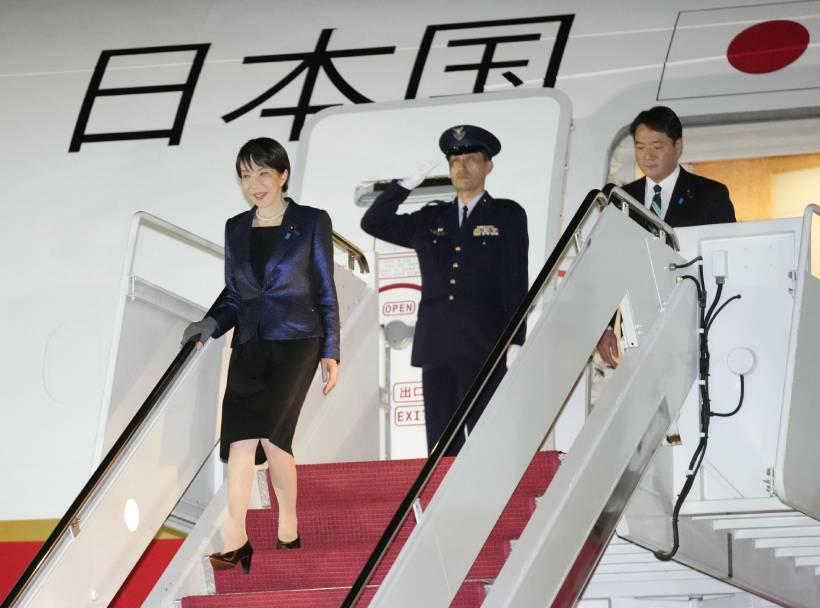
Donald Trump is expected to use a White House meeting with Sanae Takaichi to push for greater Japanese involvement in the Iran war, opening a sensitive front in U.S. alliance politics as the conflict strains global security and energy systems.
What was meant to showcase the durability of the U.S.-Japan partnership has instead become a test of how far Washington can lean on its allies in a conflict that many view as geographically distant but economically unavoidable.
A Strategic Ask Meets Constitutional Limits
At the center of the discussion is the Strait of Hormuz, where Iran’s disruption of shipping has shaken global markets. The United States is seeking naval support to clear mines and escort tankers, a mission that would directly involve allies in the operational theater of the war.
Stay ahead of the geopolitical week.
MD Briefing delivers expert analysis across five global fronts — the Indo-Pacific, energy, geoeconomics, European security, and the Middle East — every Monday morning. Free.
For Tokyo, the request cuts into longstanding constraints. Japan’s postwar constitution limits the scope of military action abroad, and while Takaichi has advocated a more assertive defense posture, domestic opinion remains wary of entanglement in Middle Eastern conflicts. Any commitment to maritime operations would require careful legal framing and political justification at home.
The result is a narrow path: Japan must weigh alliance expectations against constitutional boundaries and public skepticism, all while avoiding the perception of strategic drift.
Alliance Friction Beneath the Surface
Trump’s public frustration with allies has already exposed cracks. European powers including Germany, Italy, and Spain have declined participation in Gulf operations, signaling reluctance to be drawn into a conflict centered on energy security rather than direct territorial threat.
Japan now finds itself in a uniquely delicate position. As Washington’s closest ally in East Asia, its response will be closely watched as a benchmark for burden-sharing. A refusal risks further irritation from Trump; a commitment risks domestic backlash and regional complications.
This dynamic reflects a broader shift in U.S. alliance management under pressure. Security guarantees are increasingly tied to expectations of operational support, even outside traditional theaters.
Indo Pacific Priorities Collide with Middle East Crisis
Takaichi’s broader strategic focus lies elsewhere. Japan’s primary concern remains China’s growing assertiveness and the security of Taiwan, issues that directly affect its national defense calculus. The Iran war, by contrast, is an external shock with indirect but significant economic consequences.
The timing of the meeting complicates this agenda. Instead of shaping Trump’s approach to Asia ahead of a planned China visit, Takaichi is forced into a reactive posture, addressing immediate demands tied to the Middle East.
This shift underscores how rapidly geopolitical priorities can be reordered by crisis. For Japan, it risks diverting attention and resources from its core strategic environment.
Beyond Ships: The Expanding Scope of Requests
The U.S. ask is not limited to naval support. Washington is also expected to press Tokyo on defense industrial cooperation, including missile production to replenish stockpiles depleted by conflicts in Iran and Ukraine. Such requests align with a longer-term U.S. strategy of integrating allied industrial bases into its defense planning.
For Japan, this presents both opportunity and risk. Expanding defense cooperation could deepen the alliance and strengthen deterrence, but it also accelerates Japan’s shift away from its traditionally restrained security posture.
At the same time, Tokyo’s ongoing economic engagement with the United States, including large-scale investment commitments, provides leverage. Takaichi may seek to balance security concessions with economic cooperation, framing Japan’s contributions in broader terms than direct military involvement.
A Potential Diplomatic Role
Unlike Washington, Japan maintains diplomatic ties with Tehran. This creates a potential, if limited, avenue for mediation. While past efforts have yielded little, the current crisis may revive interest in diplomatic channels that bypass direct confrontation.
Such a role would allow Japan to contribute without crossing its constitutional red lines. However, the effectiveness of mediation depends on the willingness of all parties to engage, which remains uncertain amid escalating hostilities.
A Defining Moment for Alliance Politics
The meeting between Trump and Takaichi is less about immediate decisions and more about setting expectations. It will signal how the United States intends to mobilize its alliances in a conflict that blends military, economic, and energy dimensions.
For Japan, the challenge is to respond in a way that preserves alliance credibility without overextending its political and legal limits. For the United States, it is a test of how far pressure can translate into tangible support.
As the Iran war continues to reshape global risk, alliances are being tested not just in principle, but in practice.
With information from Reuters.
