


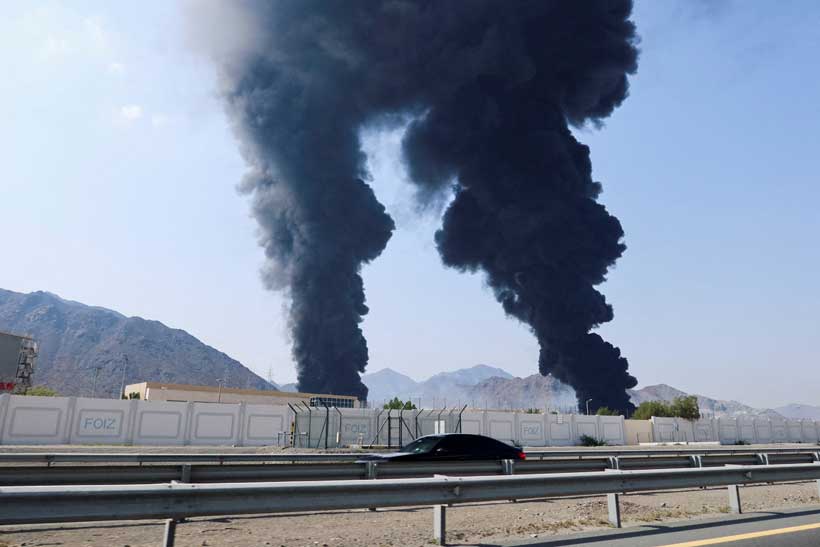
The conflict between Iran and the United States and Israel has entered a more volatile phase, as Tehran expands its attacks to include U.S. aligned Gulf states. Fresh strikes on the United Arab Emirates, including energy infrastructure in Fujairah and Abu Dhabi, signal a clear shift from contained confrontation to region wide escalation.
President Donald Trump has described these attacks as unexpected. Yet reports that he had been warned in advance that Iran would likely retaliate against Gulf capitals complicate that claim. The contradiction underscores a growing gap between public messaging and strategic reality.
At the same time, the Strait of Hormuz remains largely closed, turning a military conflict into an economic shock with global consequences.
From contained war to regional pressure campaign
Stay ahead of the geopolitical week.
MD Briefing delivers expert analysis across five global fronts — the Indo-Pacific, energy, geoeconomics, European security, and the Middle East — every Monday morning. Free.
Iran’s decision to target Gulf states marks a deliberate expansion of the battlefield. Rather than confining retaliation to U.S. or Israeli assets, Tehran is increasing the cost of the war for Washington’s regional partners, many of whom host U.S. military facilities or are seen as tacitly supporting the campaign.
Strikes and threats directed at countries such as Saudi Arabia and Qatar point to a broader strategy of deterrence through disruption. By widening the circle of risk, Iran is signalling that the consequences of the war will not remain geographically limited.
This is a familiar escalation pattern in Middle Eastern conflicts, where direct confrontation quickly evolves into a networked struggle involving allies, proxies and critical infrastructure.
Military pressure without decisive outcomes
Despite sustained U.S. and Israeli strikes, Iran continues to demonstrate its ability to project force. Missile attacks on Israel and drone strikes on U.S. positions in Baghdad highlight the resilience of its military capabilities.
The continued use of low cost drones has proven particularly effective, allowing Tehran to maintain operational pressure without relying on vulnerable high end systems. This asymmetry complicates claims that Iran’s capabilities have been decisively degraded.
The result is a war that is intense but inconclusive. Tactical gains have not translated into strategic resolution, and both sides appear prepared for a longer conflict.
Allies hesitate as Hormuz remains shut
Efforts to reopen the Strait of Hormuz have stalled, revealing limits in U.S. alliance coordination. Several key partners have declined to deploy naval forces without broader legal backing or clearer strategic objectives.
This hesitation reflects both political caution and the reality that naval escorts cannot guarantee safe passage in an environment shaped by drones, mines and missile threats. The absence of a coordinated international response leaves a critical artery of global energy supply severely constrained.
Trump’s public frustration with allies points to a deeper issue. Long standing security relationships are no longer translating automatically into operational support, particularly when the risks are immediate and the objectives uncertain.
Economic fallout spreads globally
The continued closure of Hormuz is feeding directly into global markets. Oil prices are rising, supply chains are tightening and inflationary pressures are building across major economies.
Central banks are beginning to respond. The decision by the Reserve Bank of Australia to raise interest rates again reflects growing concern that energy driven inflation could become entrenched.
This creates the conditions for stagflation, where rising prices coincide with slowing growth. For many economies, particularly in Asia and Europe, the shock is both external and unavoidable.
Analysis
What is unfolding is no longer a contained military campaign but a systemic crisis with regional and global dimensions. Iran’s expansion of the conflict was not an aberration but a predictable extension of its strategy to raise the cost of war for its adversaries.
For Trump, the framing of these developments as unexpected weakens the coherence of the U.S. position. Whether due to miscalculation or messaging, the gap between anticipation and outcome is becoming increasingly visible.
For U.S. allies, the conflict is forcing a recalibration of risk. Their reluctance to engage militarily in Hormuz suggests that alignment with Washington has limits, particularly when exposure to retaliation is direct.
The broader implication is that the war is slipping beyond the control of any single actor. Military, economic and diplomatic pressures are now deeply intertwined, making resolution more complex and escalation more likely.
In that sense, the latest strikes are not just another phase in the conflict. They are evidence that the war has entered a new and more unpredictable stage, one where its consequences will be harder to contain and far more difficult to reverse.
With information from Reuters.
