


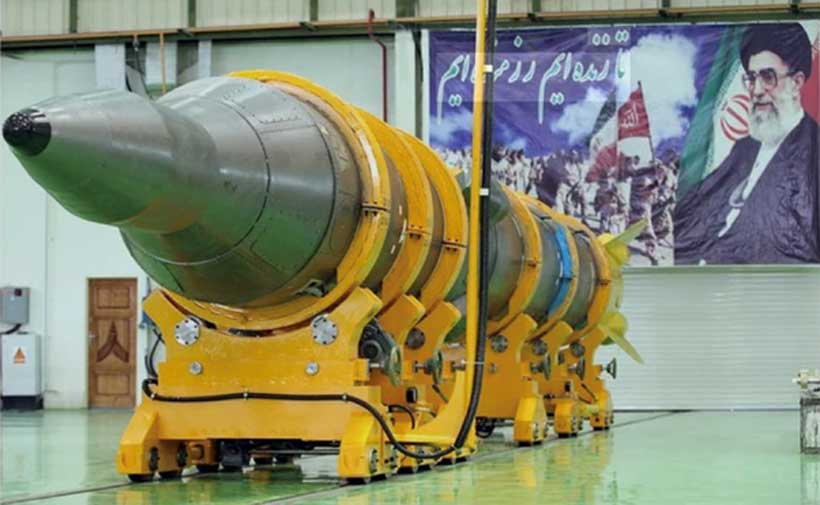
Reports around Sunday’s attack said Iran had introduced the Sajjil, often spelled Sejjil, into this phase of the war for the first time. Even without overstatement, that is serious. The missile matters because it joins long reach with fast launch preparation, and that combination changes the pressure on Israel and on the wider region. The current conflict has already spilled into shipping lanes, oil routes, and neighboring states, as shown in a Reuters report on the widening war and a Reuters survey of Iran’s ballistic missiles. My view is that the Sajil is dangerous less because it is some miracle weapon and more because it gives Tehran a stronger way to threaten, signal, and escalate in the same moment. (The Times of India)
What makes the Sajil different?
The technical case is clear enough. The missile is widely described as a two-stage, solid-fuel, medium-range ballistic missile that Iran built at home. That matters because solid fuel systems are generally quicker to ready and harder to disrupt before launch than older liquid fuel missiles. A missile that can be moved, hidden, and prepared fast creates less warning time for the side defending against it. The best basic references remain the CSIS profile of the Sejjil, the CSIS catalogue of Iranian missiles, and the broader CSIS study of the Iranian missile threat. None of this means the Sajil is unstoppable. It does mean that it is a more mature and more practical tool of coercion than the old image of Iran’s missile force as mostly loud rhetoric and parade footage. (Missile Threat)
Range is important, but range is not the whole story.
Stay ahead of the geopolitical week.
MD Briefing delivers expert analysis across five global fronts — the Indo-Pacific, energy, geoeconomics, European security, and the Middle East — every Monday morning. Free.
Much of the fear around the Sajil comes from reach. Public estimates usually place its range at about 2,000 kilometers, with some assessments pushing the number higher. That puts Israel well within range and places large parts of the Middle East and beyond inside the missile’s notional map. The missile is also said to carry a payload of roughly 700 kilograms. Those numbers are not trivial, but they should not be treated like the final answer. What matters is not only how far a missile can fly on paper, but also how accurate it is, how reliable it is, and what kind of warhead it carries. For that reason, I think the most useful reading is the Council on Foreign Relations overview, the older but still relevant National Interest assessment, and a newer Arms Control Association brief. The nuclear angle is what makes people shudder, but that part remains a question of capability, decision, and timing, not a settled fact. (Council on Foreign Relations)
Real danger shows up in actual war, not in slogans.
What pushes Sajil from theoretical danger into practical danger is the wider pattern of recent combat. Even strong air defense does not promise a sealed sky. Recent reporting has described missile fragments hitting sensitive sites, threats to commercial and banking interests, environmental damage inside Iran, and a steadily widening battlefield. See the Reuters account of the fragment that hit a building used by the U.S. consul, the Reuters report on threats to banking and commercial targets, the Reuters report on the toxic clouds over Tehran, the Reuters report on Israeli targeting of Iranian checkpoints, the Reuters report on the strike in Isfahan, and the Reuters report on Lebanon’s expanding front. The point is simple. A missile like the Sajil is dangerous not only because of what it can hit but also because of the chain reaction it can trigger across diplomacy, markets, civilian life, and military planning. (Reuters)
Defense can reduce the danger, but it cannot erase it.
Israel is not defenseless. It has a layered shield built around systems such as Iron Dome, David’s Sling, and Arrow. Industry pages on Arrow 2 and David’s Sling show how much work has gone into this shield, while a Reuters photo package on missiles piercing the shield is a reminder that no shield is perfect. That is why I think the smartest position is neither panic nor complacency. The Sajil does not make defense useless, but it does shrink the margin for error. In missile warfare, shrinking that margin is often enough to change political behavior, public fear, and military choices all at once. (Missile Defense Advocacy Alliance)
So how dangerous is Iran’s Sajil missile? Very dangerous, but in a specific way. It is not the kind of weapon that ends a war by itself. It is the kind of weapon that makes miscalculation easier, interception harder, and escalation faster. That is enough to make it one of the most worrying parts of Iran’s arsenal. If the missile remains reliable in real combat use, and if Iran can fire it in larger numbers or alongside drones and cruise missiles, its threat grows sharply. My judgment is that Sajil’s real power lies in forcing every defender to act faster, guess earlier, and accept that some attacks may still get through. In a region already loaded with tension, that is more than dangerous enough.
