


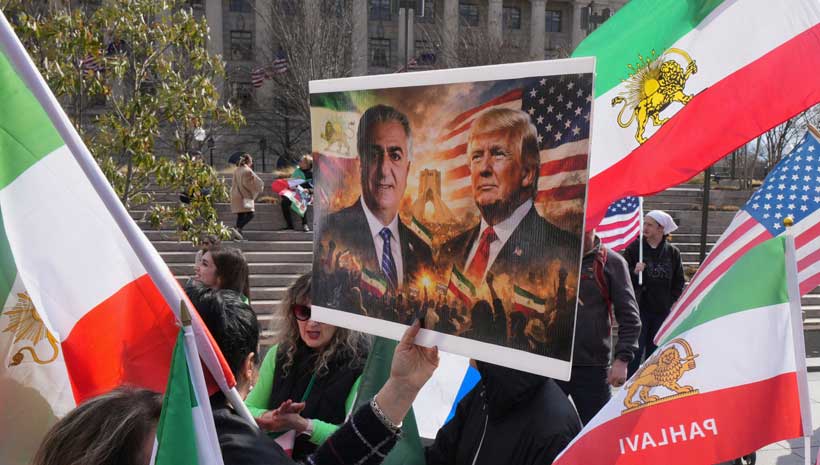
The recent escalation into open military confrontation between Iran and external actors has transformed what had long been a theoretical debate into an immediate political reality. For months, calls for military intervention and then external involvement in Iran had been growing louder—from the Iranian diaspora in Western capitals to citizens inside the country who have endured decades under the Islamic Republic. For many, foreign engagement appears to offer a decisive shortcut to freedom. Yet beneath this apparent consensus lies a far more complicated reality. The shared language of “liberation” and “change” conceals competing political ambitions, each hoping that outside pressure might rearrange Iran’s internal balance of power in its favor.
The question is no longer only the prospect of external involvement but the tendency to present it as the primary solution to Iran’s political crisis. Many groups appear aligned in their desire for outside engagement, often overlooking the political responsibilities they themselves must assume. In reality, however, each envisions external involvement as a strategic opening—an opportunity to secure hegemonic authority over rivals. What appears as unity may in fact be only a temporary convergence of incompatible political projects.
Among the most vocal supporters of stronger foreign engagement are forces aligned with the royalist tradition. They argue that outside involvement could stabilize Iran and preserve its centralized political structure, presenting themselves as guardians of national unity. Yet their discourse rarely includes a serious reassessment of the monarchy’s historical shortcomings. Instead, the pre-1979 era is frequently invoked as a period of stability unjustly interrupted—a past that can simply be restored. Rather than critically examined, that past is often idealized.
Recent developments have sharpened these concerns. Since January, Reza Pahlavi has presented himself as a potential transitional figure and proposed a unilateral political roadmap, deepening skepticism among many Iranians. Protest movements that initially appeared capable of uniting diverse communities began to fragment as fears emerged that regime change might simply reproduce another centralized dominance. In Kurdish regions—where demonstrations erupted early and forcefully—and later in Azeri, Arab, and Baluch areas, doubts surfaced about whether a post-Islamic Republic order would genuinely accommodate pluralism. Some critics have described the royalist narrative as more homogenizing than unifying.
Stay ahead of the geopolitical week.
MD Briefing delivers expert analysis across five global fronts — the Indo-Pacific, energy, geoeconomics, European security, and the Middle East — every Monday morning. Free.
Another actor positioned to benefit from a geopolitical rupture is the People’s Mojahedin Organization of Iran (PMOI). In its own narrative, the organization was deprived of its rightful place in the 1979 revolution and continues to see itself as the legitimate heir to that historical moment. Despite its marginal standing within Iranian society and its rigid organizational structure, the group appears to view heightened external pressure as a second opportunity. For the PMOI, stronger foreign engagement would not merely weaken the Islamic Republic; it could reopen a revolutionary space they believe was unjustly closed decades ago. Here too, however, there has been little critical reassessment of the movement’s own past.
Within Iran, several national communities also interpret the prospect of external involvement as a potential opening. Decades of centralization and cultural suppression have fostered skepticism that the existing political structure—or a centralized successor—will gradually evolve into a genuinely pluralistic democracy. For Kurds, Azeris, Arabs, Baluch, and others, comparisons with Iraq are often instructive. There, international involvement reshaped political realities and created new forms of regional autonomy. Whether such a model could be replicated in Iran is highly debatable, but the perception persists that without a major external shock, structural inequalities may endure.
Among Kurds in particular, the attention they are receiving from Western countries regarding the role they might play amid the current escalation is often seen as a historic opportunity. Disappointed by the absence of strong democratic Iranian allies, many have turned their hopes toward external support. Numerous Kurds believe that during the Woman, Life, Freedom movement in 2023, the Kurdish community was ultimately left alone—even “betrayed”—as it faced the full force of a tyrannical state without meaningful solidarity from other political forces. For many, this experience served as a harsh lesson: that they should rely primarily on themselves rather than on broader Iranian movements. Yet past experience also tempers these expectations. Having witnessed previous episodes of cooperation between Kurdish forces and the United States in Iraq and, more recently, in Syria, many Iranian Kurds fear a repetition of broken promises. The prospect of international attention therefore generates both hope and apprehension. At the same time, while many Kurds perceive an absence of credible modern democratic forces in the current Iranian political landscape, they themselves show limited gestures of communication or tolerance toward one another.
This convergence around external involvement—even as military confrontation has now been underway for several weeks—does not amount to democratic consensus. Rather, it reflects divergent expectations about what might follow. Each political force imagines that outside pressure would shift the balance of power in its own favor. Under such conditions, external involvement would not end Iran’s crisis; it would simply inaugurate a new phase of struggle.
Over the past half-century, Iran’s political forces have largely developed in isolation from one another, constructing separate and often exclusive narratives of legitimacy. Dialogue, reconciliation, and mutual recognition have remained limited. Each camp tends to present itself as the sole authentic representative of Iran’s future. This fragmentation is visible not only within Iran but also among diaspora communities across Europe and North America. What remains rare is collective self-criticism—a willingness to confront past failures and prepare for shared governance rather than unilateral victory. Today, what Iran may need as urgently as external pressure is a form of political maturation. Such maturation requires self-reflection, mutual recognition, dialogue, and the acceptance of difference.
None of this diminishes the danger posed by the current regime. The Islamic Republic’s nuclear ambitions and its regional military activities are legitimate international concerns. Efforts to constrain its destabilizing capacities are therefore understandable. However, without prior groundwork for pluralism, external pressure risks merely rearranging power rather than transforming political culture. This helps explain why Iran’s various political forces and communities, instead of engaging in deeper self-reflection and dialogue, often seek outside involvement as a means of securing recognition as the sole legitimate successor to the existing regime.
Given this level of fragmentation, external actors now face a clear choice as their involvement in the conflict deepens. They can commit to the difficult task of supporting an inclusive democratic transition, explicitly linking their ongoing engagement to pluralistic political guarantees and institutional safeguards. Or they can limit their actions to constraining the regime’s military capabilities and weakening its infrastructure of coercion. External actors must therefore decide whether they are prepared to invest in the complex architecture of a pluralistic transition—or whether their intervention will remain limited to weakening the regime. The first path requires patience, political safeguards, and sustained international commitment. The second risks reproducing the very instability it claims to resolve—leaving Iran’s political future to be decided not by democratic consensus, but by the shifting balance of power created by war.
