


Why Iran?
It’s nukes! It’s oil! No, it’s Iran! The Trump administration’s purported justifications for war against Iran have been varying and unsubstantiated. President Trump himself has claimed development of Iranian nuclear weapons as justification for the strikes, Senator Lindsey Graham has declared Iran to be the location of a future American fortune (it’s the oil again), and Secretary of State Marco Rubio delivered bewildering remarks implying that America hastily struck Iran due to a planned Israeli strike that would’ve endangered American targets.
Nevertheless, throughout these contradictory and concerning justifications, one line of uniquely American, uniquely moral, and uniquely idealistic explanation has been reinforced: the U.S. is targeting Iran to free its people of the current regime. President Trump himself expressed his desire for Iranians to “take back their country.” Indeed, many scholars have already described the oppressive and cruel nature of the Iranian government under the rule of Ayatollah Khamenei and enforcement by the Islamic Revolutionary Guard Corps (IRGC). But the question must be asked: are the actual actions of the U.S. military in Iran reflective of a competent, well-planned operation focused on freeing the people? The answer, conclusively, is no.
Decentralized Operations Ensure Survivability
Stay ahead of the geopolitical week.
MD Briefing delivers expert analysis across five global fronts — the Indo-Pacific, energy, geoeconomics, European security, and the Middle East — every Monday morning. Free.
Understandably, the best way to ascertain the objective of a military operation is to determine the targets of strikes. Though Western-allied forces have struck targets throughout the country, the overwhelming majority of strikes have focused on Tehran. At first glance, this is logical, since the heart of Iran’s national security apparatus and the regime is based in the city. But on the first day of the war, Ayatollah Khamenei was killed by strikes, which triggered the IRGC’s decentralized mosaic defense, which distributes decisions on strategy, targeting, and warfighting to regional IRGC leaders instead of remaining Iranian leadership in Tehran. An analysis through The Soufan Center, a security think tank, describes, “The decentralization of Iran’s command-and-control has made it resilient to U.S. and Israeli decapitation strikes… Every [regional] unit effectively has a full ‘military’ at its disposal, with its own intelligence capabilities, weapons stockpile, and command-and-control.” This is no surprise to America’s intelligence apparatus or war planners; a February assessment concluded that if the Ayatollah was killed, the IRGC would pivot to their mosaic strategy.
Though targeting Iran may reduce the morale of Iranians and any lower-level Iranian leadership, it will have no substantial effect on the ability of the IRGC to prosecute war. The Iranian Foreign Minister, Seyed Abbas Aragchi, noted in a post on X, “We’ve had two decades to study defeats of the U.S. military to our immediate east and west. We’ve incorporated lessons accordingly. Bombings in our capital have no impact on our ability to conduct war. Decentralized Mosaic Defense enables us to decide when—and how—war will end.” To substantially improve the security environment in the Middle East and secure self-governance for Iranians, the IRGC, which is the heart and soul of the regime, must be defeated. It’s not enough to kill the Supreme Leader; the entire organization of the IRGC must be systematically overthrown. Even American intelligence assessments concluded that an extensive U.S. military campaign would be unable to cause the deeply rooted IRGC to lose its grip on Iranian society.
Bombing Tehran Is Counterproductive
If incessantly bombing Tehran doesn’t further any conceivable American objective, does it harm our interests? Yes. “Secretary of War” Pete Hegseth commented that he expects Iranians to, at some point, revolt against the IRGC (though he did note that this would be after America finished its bombing campaigns, inevitably destroying Iranians’ homes and critical infrastructure).
But remember—not every Iranian opposes the regime. Those in rural Iran, where the IRGC’s decentralized mosaic defense is robust, are generally more religiously conservative and support an extreme, theocratic state. Those in Tehran (and other urban areas) are generally younger, more progressive, and more critical of the current government. In 2024, the Group for Analyzing and Measuring Attitudes in Iran surveyed more than 70,000 Iranians; the survey concluded that opposition to the regime is “strongest among young, educated, and urban Iranians. More than 74 percent of university graduates rejected the Islamic Republic… In rural areas, however, support for the current system reached 28 percent—nearly double the level found in cities.”
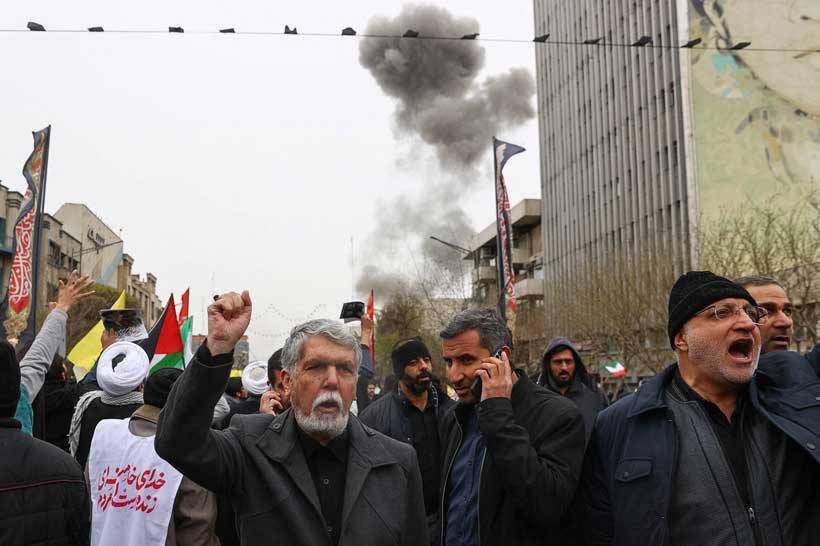
Bombing the people that President Trump wants to revolt against the government, destroying their homes, cities, and critical infrastructure, isn’t the best idea. Even if they did revolt, the IRGC is embedded throughout the country and is capable of maintaining strongholds without leadership in Tehran. Focusing strikes on Tehran is lazy, ill-thought-out war planning. And to be sure, US Central Command (CENTCOM) is still striking Tehran. On March 7th, Western-allied forces destroyed an oil facility in Tehran (which would have been important to Iran’s economy to a post-regime government); one college student in Tehran told PBS News that “Tehran is under severe bombardment.” Forces also struck an airport in Tehran, which would be important for the flourishing of a free Iranian nation.
Crippling a New Government Before It Exists
With civilian infrastructure and the largest urban hub in Iran (which is also responsible for most of Iran’s economic output) devastated by attacks, the solvency of a future democratic Iranian government is put into question. With an economy in shambles, a defeated people, and a government in its infancy, Iran would have to rely on predatory foreign investment, perhaps only perpetuating a cycle of oppression and ineffective governance.
As the new Supreme Leader of Iran was chosen, the future of Iran seems to look much like its past. America’s hasty entrance into the conflict, coupled with poor targeting data, uninformed strategy, and politically motivated strikes, is counterproductive to national interests. If the conflict is ultimately about freeing the people of Iran and allowing them to enjoy democracy, current actions are futile. And if the conflict is about something else, be it Iran’s nuclear program, ballistic missile supply, oil, or anything else, bombing Iranians in Tehran who oppose the current regime is still a dismal decision. It’s possible to conquer the IRGC, but only by targeting the distributed assets that actually impact the group’s ability to maintain power will the U.S. have an opportunity to actually transform Iran.
