


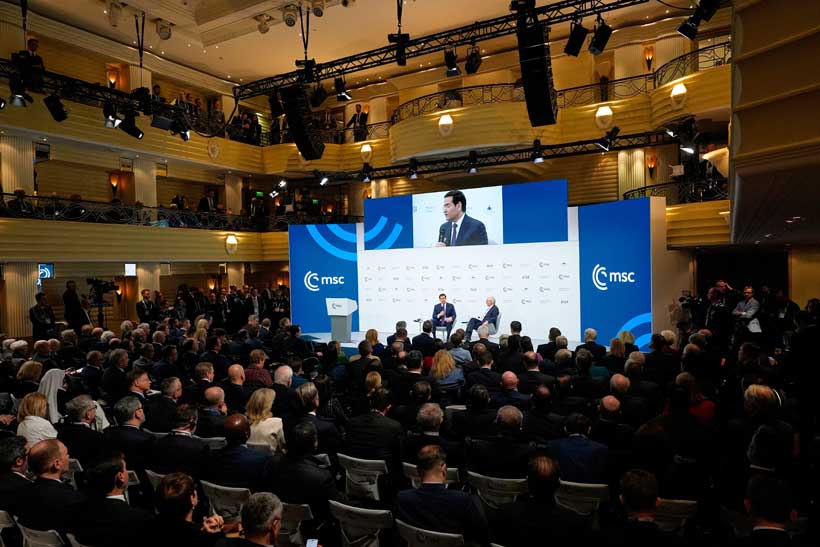
Secretary Rubio, I want you to know that I took some comfort in reading the press coverage of your public remarks at the Munich Security Conference last month—not because I agreed with every single point, but because it was far less nauseating than having to look at J.D. Vance’s face (let alone his words). Perhaps I am damning with faint praise. But if I squint hard enough, I can allow myself to think that, at bottom, you still believe the things I believe about the transatlantic alliance, about Russia and China, and about what a real strategy of ‘peace through strength’ would look like.
Ukrainians know all too well that strength is the only way they will ever see peace. Consider this excerpt from a David Ignatius column in 2024: “During a break from the conference, I visited a Ukrainian friend named Sergiy Koshman, a free-wheeling intellectual from Kharkiv and onetime civil society activist. Now he’s working to design weapons…‘We thought that once we showed solidarity, Russia would back off,’ he told me. ‘Now it seems the war could last for decades.’ He described a ‘radicalization’ of intellectual life, in which the core principle had become, ‘We have to kill as many Russians as possible and find innovative ways to do it.’”
It is tragic that Ukrainians must think that way, but that is, you might say, the hand they’ve been dealt. And far from having no cards to play, they have continued to inflict an enormous toll on the Russian state, not least in terms of the mind-numbing rate at which Russian troops are killed or injured. But you already know this, Secretary Rubio, because you said as much in Munich: “The Russians are losing seven to eight thousand soldiers a week—a week. Not wounded—dead.” As for Ukraine, you rightly pointed out that it has “suffered extraordinary damage, again, to its energy infrastructure. And it will take billions of dollars and years and years to rebuild that country.” I would note an important distinction here (since you did not)—namely, that these attacks on energy infrastructure are blatant war crimes, at the very least. In fact, they are essentially the same crimes for which two senior Russian officials have already been indicted by the International Criminal Court. But this will not surprise you, Secretary Rubio, since you have been famously clear-eyed on this issue for a long time. Like that time in 2017 when you admirably took on Donald Trump’s then-nominee for secretary of state, Rex Tillerson, at his confirmation hearing, passionately advocating for a public acknowledgement that “Vladimir Putin’s military has conducted war crimes in Aleppo, because it is never acceptable, you would agree, for a military to specifically target civilians, which is what’s happened through the Russian military.”
I would agree, by the way, and I trust you still think the same. But I cannot endorse your view that as we look at the war in Ukraine today, “I don’t think anyone can claim to be winning it.” Certainly Russia is not winning the war, judging by any reasonable standard. For anyone who doubts that, I would refer you to a quote that Joe Biden’s national security adviser, Jake Sullivan, gave to Ezra Klein in an interview approximately a year ago:
Stay ahead of the geopolitical week.
MD Briefing delivers expert analysis across five global fronts — the Indo-Pacific, energy, geoeconomics, European security, and the Middle East — every Monday morning. Free.
Let’s imagine, in February 2022, that Joe Biden went on television and told the American people, “I’m invading Canada, and I’m going to seize Ottawa in a week and replace the government.” It’s going to be not a war but a special military operation. It’ll be done in a few days—and the Canadians will welcome us as liberators.
Three years later, the American army was in the wheat fields of Manitoba, grinding out mile by mile. Having lost 600,000 dead and wounded Americans. Having inflation near 10 percent and interest rates near 20 percent in the United States. Having mortgaged our economic future technologically and in terms of our high-tech industrial base.
Would anybody say: Hey, America’s doing pretty well there—Joe Biden’s a smart guy? Absolutely not… Fundamentally, Russia’s strategic objectives in this war have failed. They failed to take Kyiv. They failed to destroy Ukraine. They failed to break NATO.
Flash forward another year, and does the picture look any better from Russia’s perspective? Allow me to offer some data from a report published last month by the Centre for Strategic & International Studies (CSIS):
· According to CSIS estimates, Russian forces suffered nearly 1.2 million battlefield casualties, which include killed, wounded, and missing, between February 2022 and December 2025. No major power has suffered anywhere near these numbers of casualties or fatalities in any war since World War II.
· Along most of the battlefronts, Russia’s rate of advance has been slower than “the most brutal offensive campaigns over the last century, including the notoriously bloody Battle of the Somme during World War I.” For example, from February 2024 to January 2026, Russian forces attempting to take the city of Pokrovsk (which is over 500 kilometers from Kyiv) advanced just under 50 kilometers, at an average pace of only about 70 meters per day.
· Overall, Russian forces have gained less than 1.5 percent of Ukrainian territory since the start of 2024. At this pace, it would take the Russian military decades to conquer all of Ukraine.
And all of this comes, Secretary Rubio, despite U.S. aid to Ukraine being reduced by 99% in the first year of the new U.S. administration. Fortunately, Ukrainians were under no illusion that Vladimir Putin had any intention to stop a war that was entirely his choice, absent a dramatic change in circumstances that, as Peter Dickinson wrote recently, would “threaten the future of his regime and the stability of Russia itself.” And maybe such a moment could arrive if the full weight of American influence is finally brought to bear—and not only against the side that might have been able to achieve a peace deal much sooner with the appropriate military and economic backing.
But you needn’t wait any longer, Secretary Rubio, to build upon the legitimately creditable aspects of your administration’s approach thus far. Like the sanctions against Russian oil companies that have contributed to a 50 percent year-over-year decline in the country’s oil revenue as of January 2026. Or the intelligence that the C.I.A. has provided to enable Ukrainian drone strikes against Russian oil refineries (which were reportedly draining as much as $75 million from the Russian economy per day), as well as oil tankers belonging to Russia’s sanctions-busting ‘shadow fleet.’ If the U.S. continues to clamp down on Russia’s war economy, other countries will get in line.
But as the war enters its fifth year, I think it is worth pausing to acknowledge that Ukraine is winning, and not only because it is still defending the vast majority of its rightful territory. This war was never as much about territory as it was about extinguishing Ukrainian sovereignty and identity, and on that score Putin has lost totally. Please go read the essay that Ira Wells—a literature professor at my university, as it so happens—wrote for The Walrus last December, where he observes, “Every air strike, every wall pockmarked with bullet holes, every act of violence and depravity created another visible marker of Ukrainian identity, another physical manifestation of the difference between Russia and Ukraine, another promise of redemption. With every missile and every drone launched, Putin’s dream of a unified Ukraine and Russia receded a little further into the background.”
Once upon a time, Secretary Rubio, you worried about America being perceived as a country that “cares about democracy and freedom—as long as it’s not being violated by someone that they need for something else.” You looked at a man who balked at calling Putin a war criminal, and you said, “That cannot be who we are in the 21st century. We need a secretary of state that will fight for these principles…because I believe it’s that important for the future of the world that America lead now more than ever.” Maybe that guy still exists somewhere, but I don’t think he can claim to be winning.
