


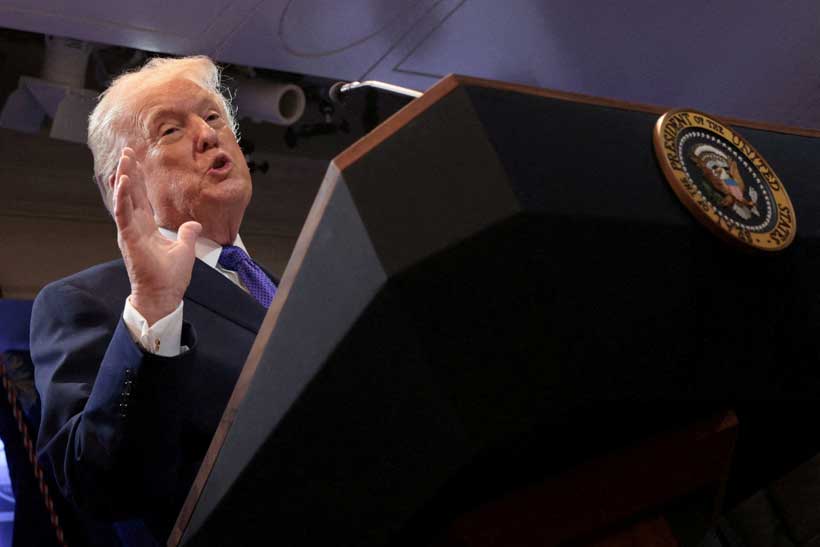
U.S. President Donald Trump boasted about the killing of Iranian leaders and intensified rhetoric against Tehran as the U.S.–Israel war against Iran approached its second week, with missile and drone exchanges continuing across the Middle East.
The conflict began with joint strikes by the United States and Israel on Iranian targets on February 28. Since then, the fighting has killed more than 2,000 people, displaced millions and triggered volatility in global energy and financial markets.
In a social media post late Friday, Trump said the United States was “totally destroying the terrorist regime of Iran,” describing the killings of Iranian leaders as an honor.
The remarks came as the region faced escalating strikes across multiple fronts, including Iran, Israel, Iraq and parts of the Gulf.
Stay ahead of the geopolitical week.
MD Briefing delivers expert analysis across five global fronts — the Indo-Pacific, energy, geoeconomics, European security, and the Middle East — every Monday morning. Free.
Iran vows retaliation
Iran’s new supreme leader, Mojtaba Khamenei, issued his first public comments since taking power after the death of his father in the initial Israeli strikes.
Khamenei vowed to keep the strategic Strait of Hormuz closed and warned neighboring states hosting U.S. military bases that they risk becoming targets if those facilities remain operational.
The Strait of Hormuz is one of the world’s most critical energy routes, handling roughly a fifth of global oil shipments. Any prolonged disruption there could severely affect global energy markets.
Iranian officials have said Khamenei was lightly wounded during the early phase of the war. Trump has said he believes the cleric is alive but “damaged.”
Israel expands strikes
Israeli Prime Minister Benjamin Netanyahu held his first press conference since the war began, suggesting Israel was seeking to create conditions that could eventually topple Iran’s leadership.
While stopping short of explicitly calling for regime change, Netanyahu said Israel was helping create “optimal conditions” for internal upheaval inside Iran.
The Israel Defense Forces said its air force struck more than 200 targets in western and central Iran over the previous 24 hours as part of an operation known as Operation Roar of the Lion.
Targets included missile launchers, air defence systems and weapons production facilities. Iranian state media reported multiple explosions in Karaj, a city west of Tehran, as Israeli jets continued strikes.
Israel also said it struck a bridge over Lebanon’s Litani River that it said was being used by fighters from the Iran backed group Hezbollah. The strike appeared to be the first acknowledged Israeli attack on civilian infrastructure during the current campaign against Hezbollah.
Missiles strike Israel and region
Iran responded with a fresh barrage of missiles and drones overnight, showing it retained the ability to launch long range attacks despite U.S. and Israeli claims that much of its arsenal had been destroyed.
One Iranian missile struck a Bedouin Arab town in northern Israel near Nazareth, damaging several homes and injuring 58 people according to Israeli emergency services.
The war has also spilled across the region. In Iraq, the U.S. Central Command said it was conducting rescue operations after a refueling aircraft went down during an incident involving another aircraft.
The Iran aligned group Islamic Resistance in Iraq claimed responsibility for downing the aircraft.
Meanwhile, Emmanuel Macron said a French soldier had been killed and others wounded in an attack in northern Iraq, while an Italian military base in the region was also targeted.
Missiles and drones have struck infrastructure across Kuwait, Saudi Arabia, the United Arab Emirates, Bahrain and Oman in recent days, illustrating the widening geographic scope of the conflict.
Financial hubs on edge
The war has also shaken financial centers in the Gulf. Debris from a missile interception caused minor damage to a building in central Dubai near the Dubai International Financial Centre.
Following threats by Iran against Gulf banking interests tied to the United States and Israel, several major financial institutions including Citigroup and Standard Chartered told some employees to work from home and began evacuating certain offices in the city.
The move highlights concerns that the conflict could begin directly affecting the region’s commercial infrastructure.
Markets react as oil surges
Energy markets have already begun reacting to the crisis. Oil prices jumped about nine percent to around $100 per barrel as fears grew of disruptions to supply routes in the Gulf.
The United States government attempted to calm markets by issuing a temporary 30 day license allowing countries to buy Russian oil currently stranded at sea.
Trump said the United States could benefit economically from higher oil prices because it is the world’s largest oil producer, arguing the price surge would generate long term economic gains.
Political backlash in the United States
Trump’s remarks celebrating the killing of Iranian leaders drew sharp criticism from political opponents at home.
Democratic lawmakers accused the administration of showing little concern about the humanitarian consequences of the war and demanded greater transparency about civilian casualties.
One strike that reportedly killed dozens of children at an Iranian girls’ school has intensified scrutiny of the campaign.
Critics also say the administration has yet to outline the expected duration, cost or political endgame of the war.
Analysis
The rhetoric from Washington and Tehran suggests the conflict is entering a more dangerous phase rather than moving toward de escalation. Trump’s public celebration of assassinations signals a strategy aimed at crippling Iran’s leadership and weakening the regime’s command structure.
However, such statements also risk hardening Iran’s resolve and strengthening hardline factions around the new leadership of Mojtaba Khamenei.
At the same time, the widening geographic footprint of the war from Iraq to the Gulf indicates the conflict is evolving into a broader regional confrontation rather than a contained bilateral struggle between Iran and Israel.
The economic implications could be equally significant. With the Strait of Hormuz under threat and attacks on shipping already reported, global energy markets remain highly vulnerable to prolonged disruption.
If the war continues to escalate, the political and economic fallout could extend far beyond the Middle East, reshaping global energy flows and financial stability.
With information from Reuters.
