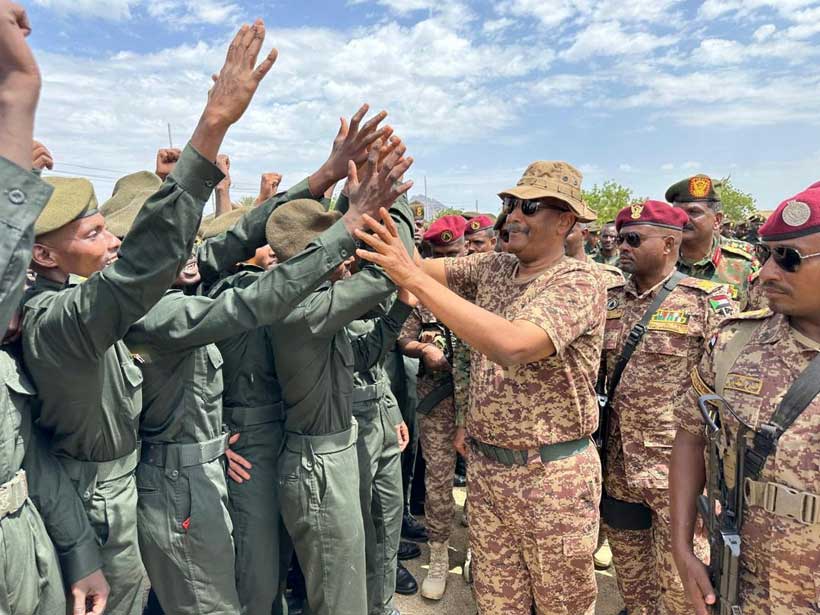
The US-Israeli air war against Iran has thrown into relief a curious symmetry of interests between Iran and Saudi Arabia in the future of Sudan, and their common support for the post-Bashir, Islamist regime of General Abdel Fattah al-Burhan.
It is worth noting that the improvement of Saudi Arabia’s diplomatic relations with Iran, which began with an agreement signed in Beijing in March 2023, was followed four months later by a meeting in July between the Sudanese and Iranian foreign ministers in Baku and the formal restoration of diplomatic ties three months after that, in October 2023.
Were these two initiatives in any way connected? It hardly seems a coincidence, even if Iran and Saudi Arabia make for strange bedfellows. But the bombing of Iran and its retaliation against Gulf neighbors has also been marked by the notably lesser degree to which Saudi Arabia has been targeted by Iranian missiles.
What common ground might the Saudis have pointed out to the Iranians? The Houthis, for one, Saudi’s old north Yemeni tribal adversaries, have long been a thorn in Riyadh’s side and have been armed with the same Iranian drones and missiles that, since the October 2023 rapprochement, have been supplied to General Burhan’s Sudanese Armed Forces.
Stay ahead of the geopolitical week.
MD Briefing delivers expert analysis across five global fronts — the Indo-Pacific, energy, geoeconomics, European security, and the Middle East — every Monday morning. Free.
In the hands of the Houthis, not only have those drones been pointed at Israel from time to time, but they have also threatened international shipping in the Red Sea, a distinct and powerful sphere of influence for Saudi Arabia—and one in which Iran too believes it should have a stake, although whatever regime emerges from the rubble of this current war may have to curtail such ambitions.
Other common ground would be the Red Sea itself. Writing for the Al Habtoor Research Centre a year later, Mostafa Ahmed observed that Sudan was of particular interest to Iran for its strategic location on the Red Sea, that securing a foothold there had been a priority for Iran since the presidency of Mahmoud Ahmadinejad, and that supporting Abdel Fattah al-Burhan could ensure greater Iranian influence in the Red Sea.
Saudi Arabia will have had to acquiesce in Iran’s intrusion into this key zone of influence and control. But the return on that is proving considerable in the current crisis. Through the Beijing agreement, Saudi Arabia won the vital concession from Iran that the latter would not embroil it in any wider conflict with Israel. That deal held through the Israel-Hamas conflict that ensued from the massacre of 7 October 2023. The agreement also afforded Saudi Arabia some breathing space in Yemen, where it has sought to deescalate with the Houthis—albeit at the expense of other allies.
More importantly, that concession seems to be holding now as the Saudis continue to be shielded from the worst of Iran’s retaliatory strikes against the oil and water infrastructure of Gulf states and the US bases they host. And if that has also meant soft-pedaling on General Burhan over the influence of the Muslim Brotherhood and ‘political Islam’ in the future of Sudan, so be it—apparently.