


A potential visit by King Charles III to the United States has sparked political controversy in Britain after the leader of the Liberal Democrats called for the trip to be cancelled following remarks by U.S. President Donald Trump about the British government.
Ed Davey, whose party is the third-largest in the UK parliament, argued that the monarch should not be placed at the centre of what he described as a “highly political situation.” Davey said a state visit by the king would hand Trump a diplomatic victory despite what he called repeated insults toward Britain.
Davey’s comments reflect growing political tension between London and Washington after disagreements over the expanding conflict involving Iran.
Tensions Between Trump and Starmer
Trump has recently criticised British Prime Minister Keir Starmer, particularly after Britain initially refused to allow U.S. forces to use British bases for strikes against Iran.
Stay ahead of the geopolitical week.
MD Briefing delivers expert analysis across five global fronts — the Indo-Pacific, energy, geoeconomics, European security, and the Middle East — every Monday morning. Free.
The U.S. president reportedly said Starmer was “not Winston Churchill” and accused him of damaging the historic “special relationship” between the United Kingdom and the United States.
The dispute follows earlier tensions between the two leaders. In January, Trump claimed European forces had largely stayed away from frontline combat during the war in Afghanistan. Starmer responded by calling the remarks “frankly appalling,” noting that 457 British service personnel died in the conflict.
Role of the Monarchy in Diplomacy
In Britain’s constitutional system, foreign visits by the monarch are arranged on the advice of the government. The royal family often plays a diplomatic role by hosting foreign leaders or representing the country abroad in what is sometimes referred to as Britain’s “soft power.”
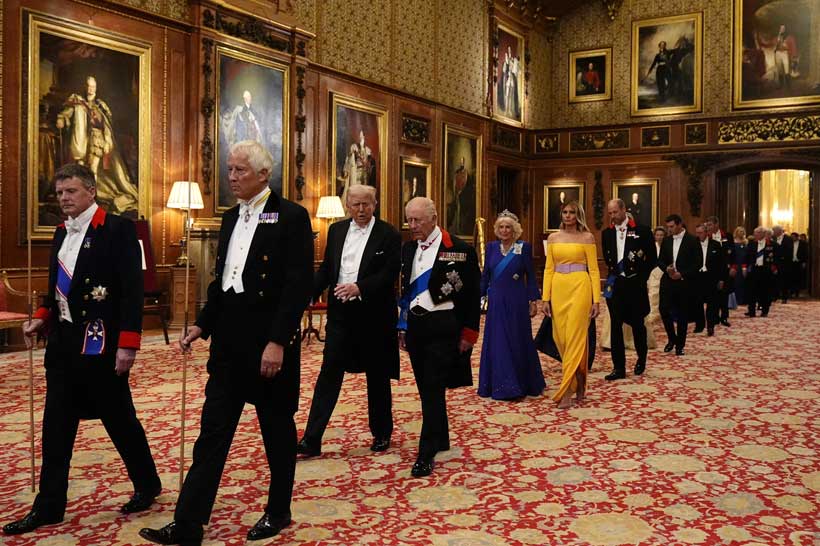
The Starmer government has previously relied on royal diplomacy to maintain relations with Washington. In September, King Charles hosted Trump for a second state visit to the United Kingdom, an unusual gesture that included a state banquet and ceremonial events at Windsor Castle.
Meanwhile, the heir to the throne, Prince William, is expected to travel to the United States later this year during the FIFA World Cup.
Government Response
Senior minister Steve Reed declined to comment directly on Davey’s suggestion that the trip should be cancelled. He said the king does an “extraordinary job” representing Britain internationally and emphasised that it was not appropriate for politicians to speculate on royal travel plans.
Buckingham Palace also declined to comment, noting that it does not discuss official trips before they are formally confirmed.
Analysis: Diplomacy, Politics and Royal Soft Power
The controversy highlights the delicate role the British monarchy plays in international diplomacy. While the king is constitutionally neutral and above party politics, royal visits can carry significant political symbolism, particularly when relations between governments are strained.
Opposition politicians worry that a state visit could be interpreted as endorsing Trump despite his criticism of Britain’s government and policies. For the British government, however, maintaining stable ties with Washington remains a strategic priority, especially during a period of heightened geopolitical tension.
Historically, royal diplomacy has often been used to smooth political differences between allied countries. Hosting or visiting foreign leaders through ceremonial events allows governments to signal cooperation even when policy disagreements exist.
The debate therefore reflects a broader question about the limits of symbolic diplomacy. While the royal family can help preserve the image of the long-standing U.S.–UK partnership, it cannot fully shield that relationship from the political tensions emerging between leaders on both sides of the Atlantic.
With information fromReuters.
